
AI agents can take over the repetitive work in adverse media screening: searching sources, matching names, summarizing articles and drafting a rationale. A named human, such as an analyst or the MLRO, should still decide what the finding means for the customer relationship. This article shows how to split that work, what to ask vendors, and what to record so the decision can be audited.
It is written for MLROs, Heads of Compliance, CROs and CTOs at banks and fintechs in Switzerland, Germany and the US. It is general information, not legal advice.
Key Takeaways
- Adverse media has no universal definition, so each bank sets its own risk-based scope, sources and look-back period and writes them down.
- Agents are well suited to collection, name matching, de-duplication, summarizing and first-pass triage. Relevance to the customer, materiality and the risk rating stay with a person.
- Source credibility and name matching are the two criteria that decide whether a screening solution is usable. Traceability decides whether it is defensible.
- FINMA’s 29 September 2026 release on Julius Bär points to weak review of negative media, which is a reason to design the review step first.
- Check the AI system itself against FINMA expectations, the FADP and the EU AI Act, and run a pilot with a clear exit decision before production.
Table of Contents
- What adverse media screening is, and what it is not
- Define the scope before you automate it
- Where AI agents help, and where a human decides
- Source credibility is a control, not a detail
- Name matching decides most of the workload
- What FINMA’s 2026 release on Julius Bär means for review design
- Evaluating a screening solution
- Regulatory points for Swiss banks and fintechs
- Designing the agent with human review and an audit trail
- Our perspective
- Where S-PRO fits
- How S-PRO helps banks and financial institutions
- FAQ
- Sources
What adverse media screening is, and what it is not
Adverse media screening, also called negative news screening, is the search for unfavorable information about existing and prospective customers and related parties, used to supplement customer due diligence. There is no single, universal definition of what counts as adverse, so the scope is a decision each institution makes.
The Wolfsberg Group’s Negative News Screening FAQs from 2022 describe the purpose: searching for negative news can improve an institution’s awareness of financial crime risk posed by customers, and it can supplement the CDD process. The same FAQs list where it adds value: revealing involvement in criminal activity, informing risk classification, acting as part of a CDD trigger event strategy, giving context to an investigation of potentially suspicious activity, and supporting the source of wealth and source of funds narrative.
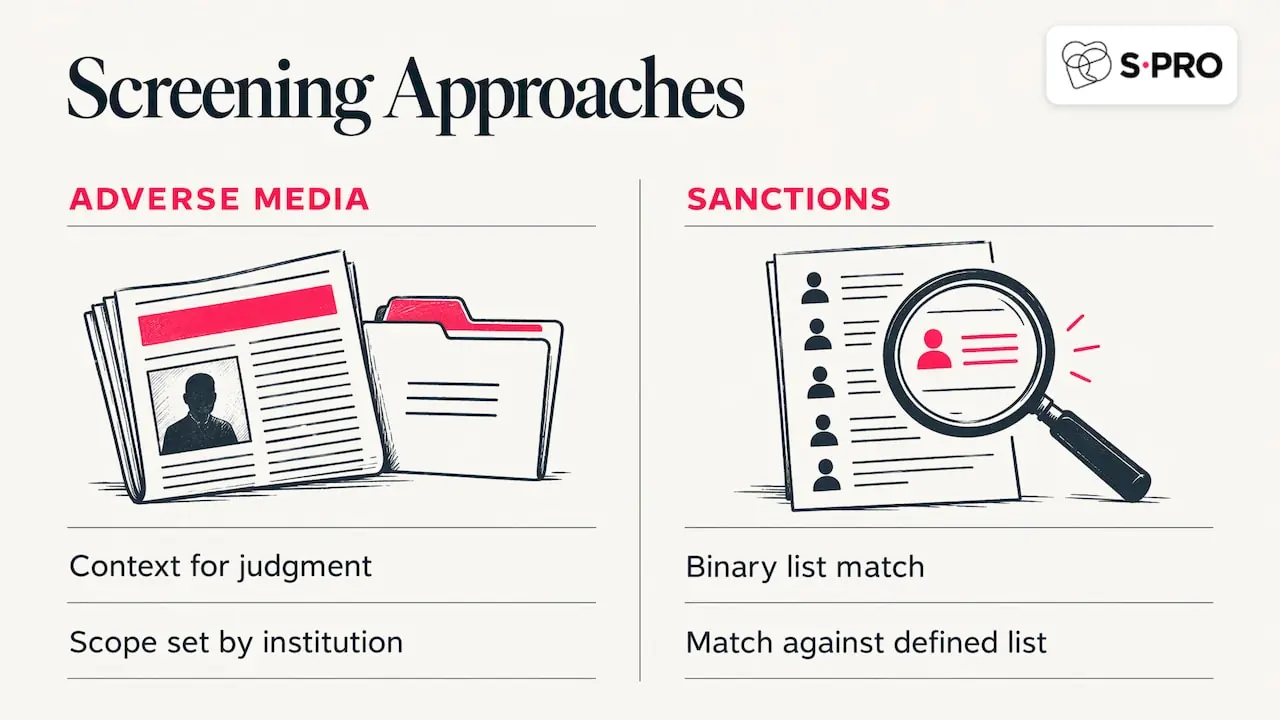
Two points follow for design. First, adverse media is context for a judgment, not a list match like sanctions screening. A sanctions hit is binary against a defined list. An article alleging fraud by someone with a similar name is not. Second, this page does not say screening is required in every case or in a given form. Your own risk assessment and your regulator’s expectations decide that.
Define the scope before you automate it
An agent can only apply a scope that someone has written down. Settle four decisions first, document them, and have compliance own them.
- Who is screened. Customers, beneficial owners, controlling persons, authorized signatories and, for some relationships, counterparties. Tie the population to your risk rating.
- Which topics count as adverse. Financial crime, corruption, fraud, organized crime, terrorism financing, tax offenses, serious regulatory sanctions and so on. A topic taxonomy gives the agent categories to classify against and gives reviewers a shared vocabulary.
- Which sources and languages. International and local press, court and regulator publications, and specialist data providers. For a Swiss private bank that means at least German, French, Italian and English, plus the languages of the client’s home markets.
- How far back, and how often. A look-back period at onboarding, then periodic and event-driven re-screening. Higher-risk relationships can justify a longer look-back and more frequent checks.
The Wolfsberg FAQs frame this as a risk-based exercise, which is the useful principle: more depth where the risk is higher, a lighter touch where it is not. The table below shows how that scope translates into agent behavior.
| Decision | What compliance sets | What the agent does with it |
|---|---|---|
| Population | Which persons and entities are in scope per risk tier | Builds the search list, including aliases and transliterations |
| Topics | Adverse categories and severity levels | Classifies each article against the taxonomy |
| Sources | Approved and excluded source types, languages | Retrieves only from the approved set and logs the source |
| Look-back | Time window per tier | Filters out articles outside the window, keeps a record of the rule |
| Frequency | Onboarding, periodic, event-driven triggers | Re-runs searches and flags only new material |
Where AI agents help, and where a human decides
Agents help most where the work is high-volume and rule-like: finding, matching, grouping and summarizing. A human decides wherever the output changes a customer’s risk rating, a relationship or a report to authorities.
The academic work on this task shows the shape of an agentic workflow. A University of Luxembourg paper on an adverse media agent describes an agent that searches the web, parses documents, checks whether the article is about the right person, scores negativity and records justifications. A related agentic LLM framework published on arXiv describes five steps: web search, document retrieval and parsing, retrieval-augmented identification of relevant passages, a structured playbook of assessment questions, and an aggregate score with natural-language justification.
That structure maps to a division of labor you can adopt:
| Step | Agent | Human |
|---|---|---|
| Collect articles for each name and alias | Yes | Sets sources and scope |
| Match the article to the customer | Proposes a match with evidence | Confirms in ambiguous cases |
| Classify the topic and severity | Proposes, with the passage that supports it | Confirms or overrides |
| Remove duplicates and syndicated copies | Yes | Spot-checks |
| Summarize and draft a rationale | Yes | Edits and owns the final text |
| Decide on risk rating, escalation or exit | No | Yes, with the decision recorded |
| Report to the authorities | No | Yes, under the MLRO |
The boundary is a design choice, and it is the one regulators and auditors will probe. We would keep it simple: the agent may recommend, the person decides, and the system records both.
Alert filtering without silent closure
The appeal of agents is alert reduction. The RiskON Challenge, an initiative of Zürcher Kantonalbank, starts from the observation that traditional rule-based systems struggle with data volume and ambiguity, which leads to false positives, missed alerts and inefficient manual reviews. Agents can address that by ranking and grouping alerts.
What matters is how they close alerts. Our view is that an agent should be allowed to deprioritize clearly unrelated hits, such as a different person with the same name, but each closure needs a stored reason, the source text and a sampling plan so that compliance can test the closed population. Quietly dropping hits without a sample review is how missed alerts accumulate. We do not quote accuracy or false-positive figures here, because they depend on your data, sources and thresholds and have to be measured in your own environment.

Source credibility is a control, not a detail
An agent that treats every web page as equal will produce confident summaries of poor evidence. Credibility needs to be an explicit input to the score and visible to the reviewer.
A workable approach is to tier sources and have the agent report the tier with each finding:
- Primary records: court decisions, regulator publications and official registers.
- Established news organizations: with editorial standards and corrections policies.
- Aggregators, blogs and forums: allegations that need corroboration before they count.
- Syndicated and duplicated copies: collapsed into one original so that ten reposts do not look like ten sources.
The reviewer should see the original publication date, the tier, whether the allegation is reported as fact or as an accusation, and whether there is an outcome such as acquittal or correction. An old, unproven allegation and a recent conviction should not look alike in the queue. The look-back rule from your scope document applies here too.
Name matching decides most of the workload
Most wasted effort in adverse media comes from matching the wrong person, and most dangerous misses come from matching too narrowly. Names are transliterated differently across scripts, shortened, reordered and shared by many people.
When the agent proposes a match, the reviewer needs the identifiers that supported it: date of birth, nationality, occupation, employer, location, and related companies mentioned in the article. A match based on name alone should be labeled as such. Where identity cannot be resolved, the right output is “unresolved, needs review” rather than a guess in either direction. For companies, add legal form variations and former names, and screen related parties from your KYC data so that the context is available to the matching step. This is where onboarding data quality and screening quality meet, which is why we treat KYC onboarding agents and screening as one workflow.
What FINMA’s 2026 release on Julius Bär means for review design
On 29 September 2026 FINMA published a release on Julius Bär that points to weak review of negative media. Read the release on the FINMA website for the findings in full. The practical reading for design is narrower than any headline: finding negative media is not enough, and the review of what was found has to be demonstrable.
That has three consequences for an agent-assisted process:
- Every item an agent surfaces must end in a recorded human disposition, or in a documented rule-based closure that is sampled.
- Reviewers need time, tools and authority to act on what they read. A queue that is too large to review is a control weakness, whoever or whatever fills it.
- Escalation paths from the analyst to the MLRO and to senior management need to be defined and used.
We would not describe this as a compliance guarantee for anyone. It is a reason to put the review step, not the search step, at the center of the design.
Evaluating a screening solution
A solution deserves selection when you can trace every output to its inputs, explain every match, and reproduce every decision. Use the following checklist in vendor discussions and in your own build decisions.
- Traceability. For each alert, can you see the query, the retrieved source, the passage relied on, the model or rule version, the score and the justification?
- Name matching. Does it handle transliteration, aliases, reordered names and company name variants, and does it show which identifiers supported a match?
- Source control. Can compliance configure approved sources, languages, source tiers and look-back per risk tier?
- Human review. Is there a queue with required dispositions, four-eyes options for high-risk cases and an escalation path to the MLRO?
- Override and feedback. Are reviewer overrides stored with reasons and used to retest the agent?
- Integration. Does it work alongside your existing screening and case management rather than replacing them?
- Data protection and hosting. Where do searches, personal data and model calls run, and which third parties are involved?
- Change control. Are model, prompt and source changes versioned, tested and approved before release?
Regulatory points for Swiss banks and fintechs
The AI system that screens your customers is itself subject to supervisory expectations. In Switzerland these come from FINMA’s expectations on AI, the revised data protection law, and, for activity touching the EU, the EU AI Act.
FINMA. According to Legal 500 (22 October 2024), FINMA’s Risk Monitor 2023 set out expectations for AI in four areas: governance and responsibility, robustness and reliability, transparency and explainability, and equal treatment. A practitioner guide from Gilliéron Avocat (17 May 2025) reads FINMA Communication 08/2024 as eight control areas: governance, inventory, data quality, testing, ongoing monitoring, documentation, explainability and independent verification. It also notes that FINMA expects data to be accurate, complete, representative and unbiased, which matters for training and evaluating a screening agent on historical alerts.
FADP. The revised Federal Act on Data Protection has been in force since 1 September 2023. According to Walder Wyss in Chambers’ 2025 financial services guide, AI models that process personal data need documentation for privacy by design and by default, and data flows to third-party clouds, APIs and AI vendors need to be mapped. Legal 500 reports that the FDPIC pointed to cases where an AI application may need a data protection impact assessment under Article 22 FADP, for example when sensitive personal data is processed at scale or the output significantly affects the people concerned. Adverse media on individuals can touch allegations and criminal proceedings, so check the assessment question for your design.
EU AI Act. For EU-facing activity, the AI Act applies to the AI system itself. The European Commission’s AI Act page is the reference for application dates. Under Regulation (EU) 2026/1744 (the AI Omnibus), in force since 27 July 2026, stand-alone high-risk obligations under Annex III apply from 2 December 2027, and high-risk AI embedded in products under Annex I applies from 2 August 2028. 2 August 2026 is the general application date, with exceptions, not the date for high-risk obligations. Whether a screening agent falls under high-risk rules is not something we classify here: check Annex III against the use case with your legal team.
Designing the agent with human review and an audit trail
A defensible design keeps the agent’s work, the reviewer’s decision and the evidence in one record. These design elements apply whether you build or buy.
- Scoped retrieval. The agent searches only approved sources for the in-scope names and aliases, within the look-back window, and logs each query.
- Evidence capture. It stores the retrieved page or a snapshot, the publication date, the source tier and the exact passage used.
- Structured assessment. It answers a fixed playbook of questions: is this the same person, what is alleged, who alleges it, what is the status, how recent is it, which topic category applies.
- Score with a reason. It gives a risk indication plus a natural-language justification the reviewer can read in seconds.
- Routing. Low-relevance items follow a sampled closure rule. Everything else goes to an analyst, and defined categories go straight to senior review.
- Reviewer decision. The person records a disposition and a reason. The system keeps the agent’s output and the person’s choice side by side.
- Monitoring. Compliance samples closed alerts, tracks overrides and retests the agent after any model, prompt or source change.
The Luxembourg paper records scores, justifications and metadata for each assessment, which is the same principle. An audit trail is not an add-on; it is the product of this design.
Piloting before production
Run a pilot against a defined question: can agent-assisted review reach the same or better dispositions than your current process, with a record that internal audit accepts? Gilliéron Avocat advises that before deployment the bank should check documentation, verify test results, replicate them where needed, look for bias and regulatory issues, and consider external specialists for critical systems. Use historical alerts with known outcomes, test multilingual and common-name cases deliberately, and agree before the pilot what result moves it to production. Our page on AI pilot to production covers that transition.
Problem in your screening queue? If reviewers face more adverse media hits than they can document, talk to our team about a review-first design.
Our perspective
We view adverse media as a judgment process that happens to start with a search. Our opinion is that the value of an agent is measured less by how many articles it finds than by how clearly it hands a reviewer the evidence needed to decide.
In our work on AI agents for banks, we favor designs where the agent never owns the disposition. It prepares the case, shows its sources and reasoning, and waits. The reviewer’s decision, the reason and the underlying evidence are stored together, so the process can be explained to internal audit, an external auditor or a supervisor.
We also believe agents should sit alongside existing AML and screening systems rather than replace them. That keeps your current controls in place while the agent improves the part that is slowest: reading and documenting.
These are our views, based on how we build for regulated institutions. Your own risk assessment and regulator set the final requirements.
The S-PRO team
Where S-PRO fits
S-PRO is a Swiss firm headquartered in Zurich, with R&D centers in Zurich and Łódź and more than 250 engineers. We build AI agents for banks and support the surrounding work in AML & transaction monitoring and KYC onboarding agents. Our team can help you scope adverse media screening, design the review step and audit trail, and take a pilot to production. We design solutions with EU AI Act, FINMA and DORA requirements in mind.
For AML-related screening and alert triage, see our work on AI agents for AML and transaction monitoring. For the onboarding side, see KYC onboarding agents for banks.
How S-PRO helps banks and financial institutions
S-PRO builds your solution on its own agentic platform, S-PRO Agents, and runs it as a service. We are ISO 27001 and ISO 27701 certified, and S-PRO is a Certified partner in the Claude Partner Network. We can start from your scope document, review the workflow with compliance and IT, and agree what the pilot must prove. Book a discovery call to discuss your adverse media process.
FAQ
Can an AI agent decide whether a customer has adverse media?
No, the agent should recommend and a person should decide. The agent can retrieve articles, propose an identity match, classify the topic and draft a rationale. A named reviewer then records the disposition and reason. That keeps accountability with the bank and gives auditors a clear record of who decided what.
Is there a standard definition of adverse media?
No, the Wolfsberg Group’s 2022 FAQs note there is no universal definition. Each bank therefore defines its own scope: which persons, topics, sources and languages are screened, and how far back. Write these decisions down and tie them to your risk-based approach, so the agent applies the same rules as your analysts.
What should we log for each adverse media alert?
Log the query, the source and its publication date, the passage relied on, the identifiers behind the name match, the agent version, the score and justification, and the reviewer’s decision and reason. Keep the original page or a snapshot too, since web content changes or disappears. Together these let you reproduce any decision later.
How do we start with a pilot?
Start with a defined scope, a set of historical alerts with known outcomes and a clear success decision. We offer a design thinking pilot from USD 20k, 2-4 weeks. It is a way to agree scope, data and review design before building. Production planning follows from what the pilot shows with your own data.
Sources
- The Wolfsberg Group, Negative News Screening FAQs (2022)
- University of Luxembourg, Adverse Media Screening in AML Compliance (AMI Agent)
- An Agentic LLM Framework for Adverse Media Screening in AML Compliance (arXiv)
- RiskON 2025 Final Report, University of Zurich
- Legal 500, AI Regulation in the Financial Sector (22 October 2024)
- Gilliéron Avocat, AI governance in Swiss banks (17 May 2025)
- Walder Wyss, Chambers Financial Services Regulation 2025, Switzerland
- European Commission, AI Act regulatory framework
Last updated 6 November 2026
Subscribe


Thank you!
Get ready! You will receive handpicked content right to your inbox.