
Executive dashboard
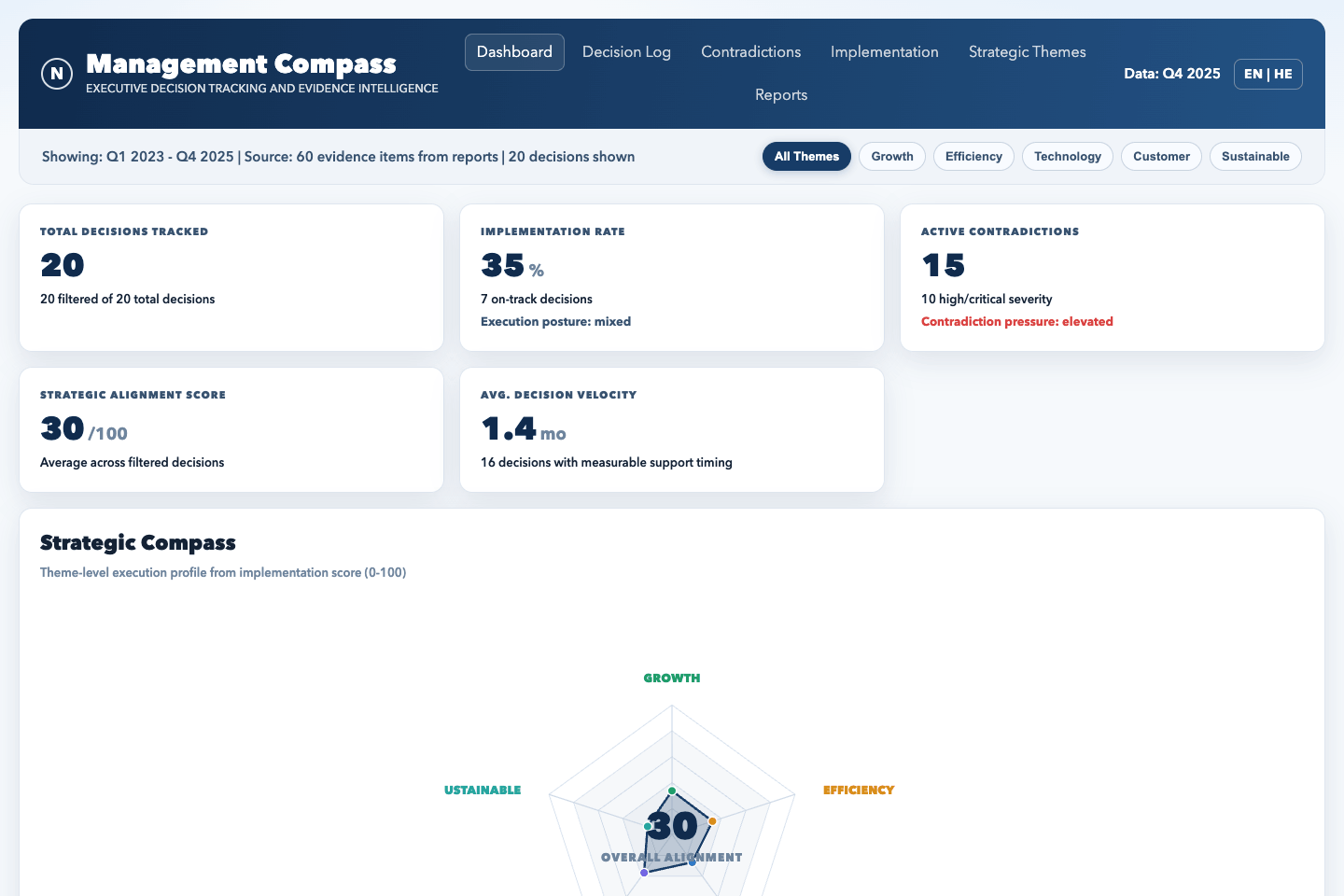
KPIs for tracked decisions, implementation rate, active contradictions and strategic alignment.
Internal Audit AI turns Management Compass into a product page and operating model: track every strategic decision, score it against real evidence, detect contradictions and package audit-ready workpapers before the next board review.
The proof that strategy is executing lives in systems no executive has time to reconcile. So the gap stays invisible until it is expensive.
Most decisions are reported as progressing, yet few are genuinely on track.
Evidence that conflicts with the plan rarely surfaces in time for management action.
"How do we know?" has no fast, traceable answer during board or audit review.
Workpapers and evidence packs are assembled after the risk has already matured.
Three connected views: from a single strategic alignment score down to the source record that proves or contradicts a decision.
KPIs for tracked decisions, implementation rate, active contradictions and strategic alignment.
Every decision carries an evidence verdict, contradiction load, implementation score and source reference.
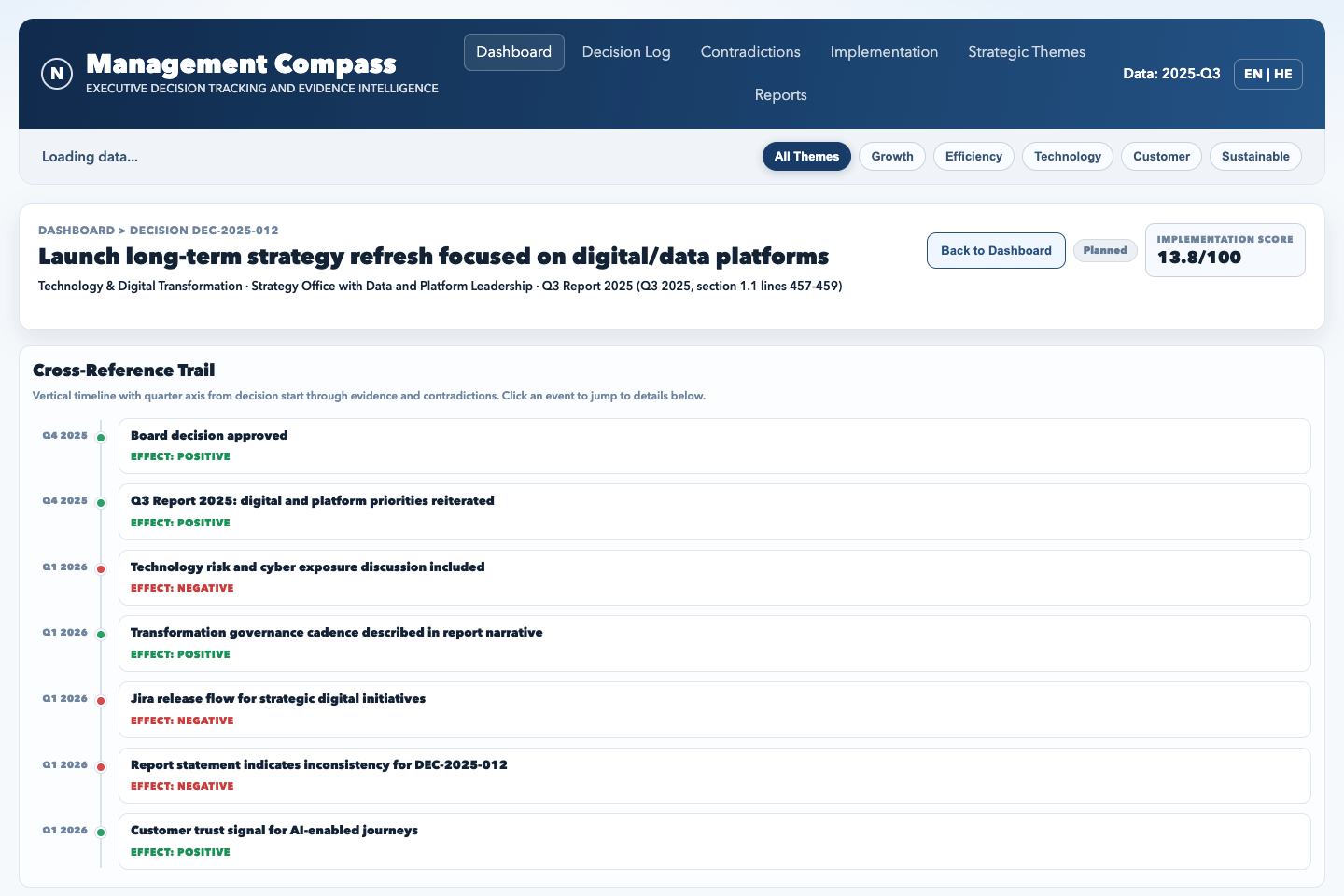
Quarter-by-quarter signals link back to source documents, confidence scores and mitigations.
Findings, evidence, owners and sign-off history are generated into audit-ready packages.
A client needs more than a dashboard. The product includes ingestion, scoring, contradiction detection, workflow and export layers so audit teams can operationalize the evidence.
Extract strategic decisions from board packs, committee notes, strategy decks, risk reviews and operating updates.
Classify evidence as strong, positive, weak, missing or contradicted, with source references and confidence levels.
Detect where operating reality no longer supports the management narrative or decision intent.
Assign evidence gaps to owners, track mitigation, add reviewer comments and maintain sign-off history.
Generate source-linked workpapers, exception packs, evidence trails and board-ready summaries.
Permissions, model versioning, prompt logs, source retention and reviewer overrides for defensible AI use.
The detail view shows the decision, status, implementation score and an evidence timeline. Auditors can see what changed, when it changed, and which source record supports the assessment.
Implementation starts by agreeing which sources are authoritative and how evidence should be weighted. The system can begin with documents, then expand into structured operational systems.
Internal Audit AI runs continuously across strategy notes, risk reviews, board packs and operating updates, then turns signals into audit evidence.
Board packs, strategy notes, risk reviews and operating updates are normalized.
Signals are classified as strong, positive, weak or contradicted with source links.
The system highlights decisions where reality no longer matches the narrative.
Workpapers, mitigations and owner follow-ups are produced for review.
Internal Audit AI can start as a controlled evidence-review pilot and then expand into continuous audit coverage across decisions, controls and management actions.
Choose the decision domain, source systems, evidence taxonomy and review workflow.
Load documents, configure source permissions and map structured systems or exports.
Align evidence verdicts, contradiction thresholds and reviewer override rules with audit methodology.
Validate findings with auditors and owners, then package outputs for committee review.
Know which decisions are drifting before the board asks for an explanation.
Move from sample-based after-the-fact testing to continuous evidence review.
Prioritize contradictions and weak evidence by business impact.
Show a defensible trail from decision to evidence to mitigation.
The product needs to pass internal scrutiny. We package the pilot plan, data boundaries, AI governance and output examples before scaling.
Use Management Compass as the first productized Internal Audit AI experience, with screenshots, workflow and evidence trail already ready for stakeholder review.