
A bank should expect an AI agent vendor to deliver more than working software. It should also deliver the evidence your governance, risk and audit functions need: a register entry, oversight and stop design, evaluation results, audit logs and a third-party exit plan. This article is written for CIOs and COOs in Switzerland, Germany and the US who are choosing a development partner. It is not a vendor ranking, and it is not legal advice.
Key Takeaways
- Ask every vendor for six deliverables: register entry, oversight and stop design, evaluation evidence, audit logging, a third-party exit plan and a pilot-to-production plan.
- FINMA Guidance 08/2024 points to the need for governance, inventory and controls around AI. It is supervisory guidance, not a checklist that certifies a system.
- Under the EU AI Act, human oversight (Art. 14) and deployer duties (Art. 26) shape how an agent is designed and run.
- In the US, the new model risk guidance does not cover generative or agentic AI.
- Agree the production criteria at the start of the pilot, not at the end.
Table of Contents
- What an AI agent development vendor should deliver
- Register entry: every agent is an inventoried asset
- Oversight and stop design: who approves, who can halt
- Evaluation evidence: results you can re-run
- Audit logging: reconstruct any decision
- Third-party exit plan: leaving must be possible
- Regulatory frame in Switzerland, the EU and the US
- From pilot to production: a checklist to agree up front
- Where agents are used in Swiss banks today
- Build agents with a partner who works to your controls
- Our perspective
- How S-PRO helps
- FAQ
- Sources
What an AI agent development vendor should deliver
A vendor should hand you a defined set of artifacts, each one usable by a person outside the project team. If a deliverable cannot be read by your risk officer or internal audit, it is not finished.
An AI agent, as Anthropic describes it, accesses data, processes information across systems and acts inside existing workflows. Its transaction monitoring example drafts a risk recommendation and routes it to an analyst for approval. That description already contains the engineering questions a bank must ask: which data, which systems, which actions and who approves.
| Deliverable | What you should receive | Who in the bank uses it |
|---|---|---|
| Register entry | Purpose, data, systems, owner, risk classification, model and tool versions | Risk, compliance, CIO office |
| Oversight and stop design | Approval points, escalation paths, a tested way to halt the agent | COO, business line, compliance |
| Evaluation evidence | Test sets, acceptance thresholds, results, known failure modes | Model risk, business owner |
| Audit logging | Records of inputs, tool calls, outputs and human decisions | Internal audit, security |
| Third-party exit plan | Data return, portability, replacement path, notice terms | Procurement, CIO, legal |
| Pilot-to-production plan | Criteria, owners, observability, operating model | CIO, COO |
The next sections take each in turn.
Register entry: every agent is an inventoried asset
The register entry is the first deliverable because nothing else can be governed until the agent is on the list. A vendor should prepare the entry with you, not leave it for your team to reconstruct after go-live.
FINMA Guidance 08/2024, published on 18 December 2024, points to the need for institutions to keep an inventory of their AI applications, assign clear responsibilities and manage the risks that follow. It is guidance, so treat its wording as a direction of supervision rather than a rule to quote.
A useful entry for an agent includes:
- The business purpose and the process it supports.
- The accountable owner on the bank side.
- The data it reads and the systems it can write to.
- The models and tools it uses, with versions.
- Where it runs and where data is stored.
- A risk classification, with the reasoning written down.
For EU-facing use cases, the classification step includes checking Annex III against the use case. Do not accept a vendor’s blanket statement that an agent is low risk. Ask for the reasoning and keep it in the register.
Oversight and stop design: who approves, who can halt
Good oversight design decides in advance which actions an agent may take alone, which need a person and how anyone can stop it. The vendor should specify this per workflow, not as a general principle.
The EU AI Act addresses this directly for high-risk systems. Article 14 covers human oversight: systems are to be designed so that natural persons can oversee them, understand their outputs and intervene or interrupt them. Article 26 sets obligations for deployers, which in practice means the bank: use according to instructions, assign competent oversight, monitor operation and keep logs under its control. Whether a given agent is high-risk depends on the use case, so check Annex III against the use case.
Ask the vendor to show you:
- An action matrix: read-only, draft, propose, execute, with the approver for each level.
- A stop mechanism that works without the vendor’s help, and who in your bank holds it.
- What the agent does when a tool fails, data is missing or its confidence is low.
- How reviewers see the evidence behind a recommendation, so approval is a real decision and not a click.
The Swiss Banking Association notes that trust in agents builds slowly through transparent and verifiable decisions, and that authorisation and liability questions must be clarified. Put those answers in the design, not in a side letter.
Evaluation evidence: results you can re-run
Evaluation evidence means test results your own team can reproduce, tied to acceptance thresholds agreed before testing starts. A demo is not evidence.
Expect the vendor to provide:
- A test set built with your business users, including edge cases and adversarial inputs.
- Acceptance thresholds per workflow, written before the first run.
- Results by case type, with the failures listed and explained.
- A regression suite that runs again whenever the model, prompt or tool changes.
- Observability that continues in production, so drift is visible.
The Swiss Bankers Association’s guide on generative AI in banking (April 2025) recommends involving IT development, IT operations, architecture, compliance, legal, data protection, risk and business users when building proofs of concept. It also says proofs of concept can validate technical requirements and support adherence to legal and regulatory requirements before implementation. Use that list as the review group for evaluation sign-off.
Audit logging: reconstruct any decision
Audit logging should let an auditor reconstruct what the agent saw, what it did and which person approved, for any case, after the fact. If the logs sit only in the vendor’s environment, your control is weaker than it looks.
Specify at minimum:
- Inputs, retrieved documents, tool calls, outputs and the version of each component.
- The human decision, the reviewer and the time.
- Retention periods set by the bank, not by default settings.
- Export in a format your own systems can read.
The Swiss Banking Association’s Cloud Guidelines (November 2025) are relevant to hosting. For critical data in the cloud they call for the ability to review where client data is processed and stored, advance disclosure of data flows, monitored and recorded access, and encryption keys that remain under the institution’s control. Ask the vendor how each of these maps to the agent’s architecture.
Third-party exit plan: leaving must be possible
An exit plan describes how you would move the agent to another provider or back in-house without losing data, logic or audit history. Agree it before signing, because leverage disappears once the agent is embedded.
A workable plan covers:
- Return of data, logs and configurations in documented formats.
- Ownership of prompts, evaluation sets, workflows and integration code.
- Dependencies on third-party models or platforms, and the fallback if one changes terms or is withdrawn.
- Notice periods and transition support.
- A tested procedure, not just a clause.
The same applies to model providers underneath the vendor. Ask which models the agent depends on, whether they can be swapped and how the evaluation suite proves a swap works.
Regulatory frame in Switzerland, the EU and the US
No single rule covers an AI agent in a bank, so you need to read the frame for each jurisdiction you operate in. None of the points below makes a vendor or a system compliant by itself.
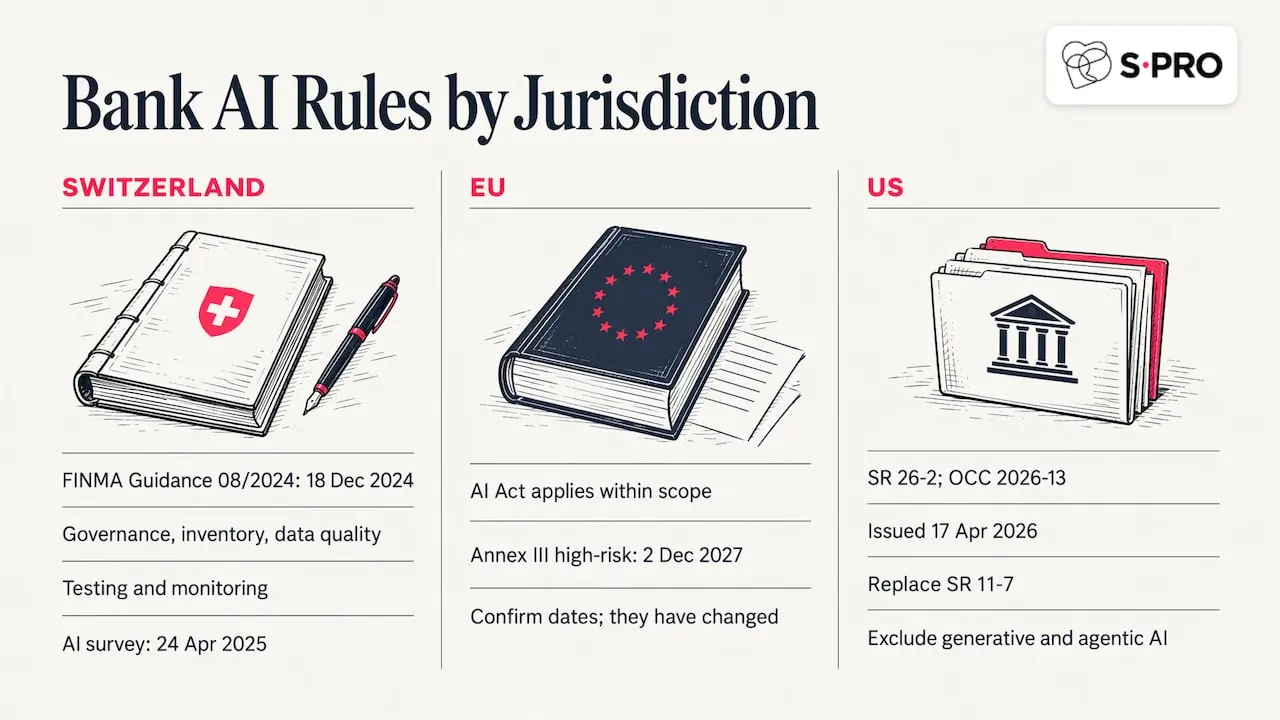
Switzerland. FINMA Guidance 08/2024, dated 18 December 2024, points to the need for governance, inventory, data quality, testing and monitoring for AI (see FINMA-compliant AI solutions for banks). FINMA also published a survey on AI use on 24 April 2025, which shows where supervisors are looking. Treat both as signals of supervisory expectations.
EU. The AI Act applies to agents that fall within its scope. Articles 14 and 26 are covered above. Article 113 sets the application dates. For stand-alone high-risk systems under Annex III, the Commission’s AI Act page gives, in its consolidation as at 27 July 2026, the date of 2 December 2027. Confirm dates there before planning, since they have changed before.
US. The Federal Reserve SR 26-2 and OCC 2026-13, issued on 17 April 2026, replace SR 11-7. They do not cover generative or agentic AI.
From pilot to production: a checklist to agree up front
A pilot becomes a production system when its exit criteria were written before it started (a wealth-management example: how to compare vendors for an AI pilot). Put these six items into the pilot contract.
- Name the business owner and the accountable executive.
- Write the acceptance thresholds and the evaluation set.
- Complete the register entry and the risk classification.
- Approve the oversight design and test the stop mechanism.
- Confirm logging, hosting and data-flow requirements with security and legal.
- Define the operating model: who monitors, who handles incidents, who approves changes.
The gap is real in Swiss finance. Swiss Fintech Innovations reports that 40% of AI initiatives sit in ideation or small pilots, 17% are deployed and 11% are scaling. Its recommendations include requiring production-ready architecture, governance and observability at proof-of-concept sign-off, and assigning measurable KPIs and accountable owners.
If your pilots stall between sign-off and go-live, talk to our team about a production plan.
Where agents are used in Swiss banks today
Most Swiss use is in internal productivity and compliance work, with client-facing advice still a smaller share. In a KPMG survey of Swiss private banks (Spring 2026), the largest group of use cases was employee productivity and document automation (more on AI trends in Switzerland), followed by compliance, KYC, AML and monitoring.
That pattern suits a staged approach: start where a human reviews every output, build evidence, then widen the agent’s remit. It also affects vendor selection, since hosting, cybersecurity and data sovereignty rank among the leading criteria Swiss institutions use when choosing vendors.
Build agents with a partner who works to your controls
We build AI agents for banks on our own agentic platform, S-PRO Agents, and can run them as a service. Our work starts from the controls described above, so that your risk, compliance and audit teams have what they need from the first pilot. You can read more about our AI agent development approach.
If you are comparing vendors, use the six deliverables as your request-for-proposal structure and ask each vendor to show a sample of every one.
Our perspective
We think the vendor question is mostly a question of evidence. A bank that asks for the register entry, the oversight design, the evaluation results, the logs and the exit plan in the first conversation quickly learns who has built agents for regulated institutions and who has built demos.
We design agents so that a person stays in charge of consequential decisions and can stop the system. That is an engineering choice made per workflow, and it makes later supervision and audit simpler rather than slower.
We also believe pilots should be built as the first version of a production system. When architecture, observability and ownership are in the pilot, moving to production is a decision, not a rebuild.
The S-PRO team
How S-PRO helps
We help banks and financial institutions move AI agents from idea to a governed production service. We build each solution on S-PRO Agents, our own agentic platform, and run it as a service, with the deliverables in this article prepared alongside the software: register entry inputs, oversight design, evaluation evidence, audit logging and an exit plan.
Our AI agent development page describes the approach. To discuss your use case, book a discovery call with S-PRO.
FAQ
Does FINMA require a specific process for AI agents?
No. FINMA Guidance 08/2024 points to the need for governance, inventory, testing and monitoring of AI, but it is supervisory guidance and not a certification scheme. Banks apply it within existing technology-neutral rules. Document your reasoning for each agent in the register so supervisors and auditors can follow it.
Does the US model risk guidance cover AI agents?
Not expressly. Fed SR 26-2 and OCC 2026-13, issued on 17 April 2026, replace SR 11-7 and do not cover generative or agentic AI. US banks should therefore keep their own agent governance, covering evaluation, oversight and logging, rather than assume the guidance addresses it.
What does a pilot cost and how long does it take?
We offer a design thinking pilot from USD 20k, 2-4 weeks. It is used to define the use case, the oversight design and the acceptance criteria before build begins. The scope of a production project depends on your systems, so we agree it after the pilot.
What is S-PRO’s track record with AI agents?
S-PRO has delivered 100+ AI projects, of which 30+ are agentic. We build client solutions on our own platform, S-PRO Agents. Reference details depend on each client’s consent, so we describe them in a discovery call rather than in public material.
Sources
- Building AI agents for financial services, Claude
- FINMA survey on AI use, 24 April 2025
- Regulation (EU) 2024/1689, EUR-Lex
- European Commission, AI Act regulatory framework
- Federal Reserve SR 26-2
- Swiss Banking Association, AI-driven advice with MCP
- Swiss Bankers Association, Generative AI in Banking, April 2025
- Swiss Banking Association, Cloud Guidelines, November 2025
- Swiss Fintech Innovations, Bridging the AI PoC-Production Gap
- KPMG, Swiss Private Banks in the Age of AI, Spring 2026
Last updated 5 November 2026
Subscribe


Thank you!
Get ready! You will receive handpicked content right to your inbox.