

The institution stays responsible for what its AI agent does. A Swiss bank cannot hand that responsibility to the agent, to the model provider or to the engineering partner that built the system, so the useful question for a board and a COO is what the bank must be able to show after something goes wrong.
This article is a question list for that discussion, not legal advice. It covers ownership of the agent, what it may do, what evidence exists after an error, what the vendor contract can and cannot cover, and it ends with a design for an agent register and a decision log. If you are scoping agents for client advisory, onboarding or reporting, our AI agents for banks work starts from the same questions.
Key Takeaways
- An AI agent has no legal personality. Under the Swiss Code of Obligations the bank answers for an agent it uses to perform a client obligation as if the bank had acted itself.
- Board duties on overall direction and supervision cannot be delegated to an algorithm, so uncontrolled delegation of consequential decisions is itself an organisational risk.
- A vendor contract allocates risk between the bank and the supplier. It does not remove the bank’s duties to clients, data subjects or the regulator.
- What protects the institution after an error is evidence: a register of agents, authority limits, human sign-off points and a tamper-resistant decision log.
- Switzerland has no AI-specific liability statute in force. General contract, tort, data protection and financial market law apply, and the EU AI Act can matter for Swiss institutions with an EU nexus.
Table of Contents
- Who is responsible when an AI agent makes a mistake?
- Question 1: Who owns the agent?
- Question 2: What may the agent do?
- Question 3: What evidence exists after an error?
- Question 4: What does the vendor contract cover?
- Does the EU AI Act reach a Swiss bank?
- Agent register and decision log design
- Our perspective
- How S-PRO helps
- FAQ
- Sources
Who is responsible when an AI agent makes a mistake?
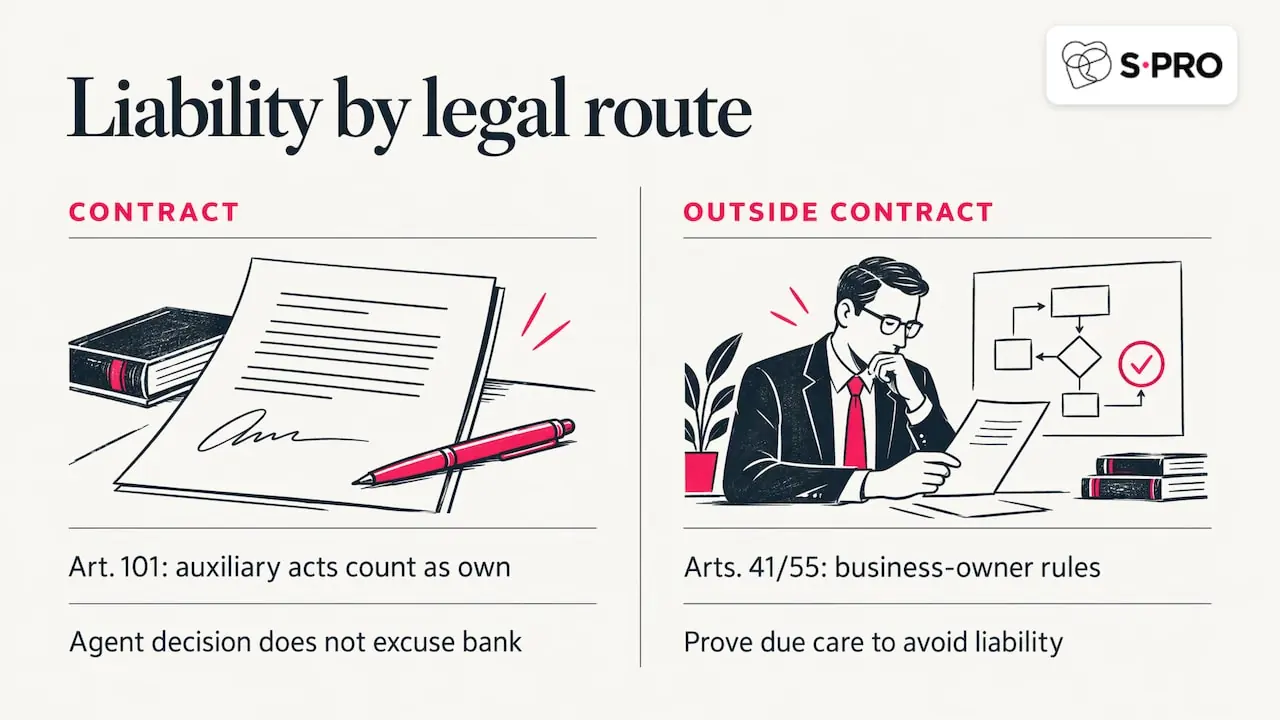
The bank is responsible. Under Article 101 of the Code of Obligations, a person who has an auxiliary perform an obligation answers for the auxiliary’s acts as if they were their own. Swiss commentary applies this to AI agents: a firm cannot escape contractual liability by saying that the system decided (Legal 500, Peter Ruggle, 10 July 2026).
Outside a contract, the business-owner rules in Articles 41 and 55 of the same code point the same way. The business owner can avoid liability only by proving due care in selecting, instructing and supervising. For an agent, those three words translate into questions you can answer with documents: why this model and this use case, what instructions and limits were set, and how it was watched.
There is no AI-specific liability regime in force in Switzerland. General product, contractual and tort liability, data protection law and sector rules apply (Legal 500 Country Comparative Guides 2026). That is why a board cannot wait for a dedicated AI act before assigning ownership.
What FINMA has said
FINMA published Guidance 08/2024 on governance and risk management when using AI on 18 December 2024. According to the regulator’s press summary, it points to increasing third-party dependencies and to legal and reputational risks. We do not attribute any further content to it here. Guidance is not a ruling on agent liability, and nothing in it transfers responsibility away from the supervised institution.
Question 1: Who owns the agent?
Every agent needs one named accountable owner at the bank, and that person must be able to pause or override it. Ownership is a role with authority, not a project team name.
Article 716a of the Code of Obligations gives the board non-transferable duties: overall direction, organisation and supervision of management. Article 754 exposes board and management members to personal liability toward the company, shareholders and creditors. Commentary reads uncontrolled delegation of consequential decisions to autonomous systems as a potential organisational failing (Legal 500, 10 July 2026). Where AI failures trace back to weak governance, personal supervisory responsibility of compliance officers and senior managers continues (Legal 500, 12 May 2026).
Questions for the COO to put to each agent:
- Who is the named business owner, and who is the deputy?
- Which board or executive committee approved the use case, and when?
- Who can switch the agent off, and how fast?
- Which independent function validates it, separate from the team that built it?
Question 2: What may the agent do?
An agent should act only inside written authority limits that match the sensitivity of the process. The tightest limits belong where actions are fast and hard to reverse, such as payments and trading. Client-facing advice engages suitability and data protection duties directly, and AML and KYC screening must keep a defensible, auditable basis for every automated escalation and filing decision (Legal 500, 10 July 2026).
The same source lists the limits worth writing down: monetary thresholds, transaction types, client categories, and approval thresholds that require human sign-off. Uncertainty should route to a named person.
| Use case | What the agent may do | Where a human signs off | Main liability exposure |
|---|---|---|---|
| Client advisory support for relationship managers | Prepare briefings, summarize documents, draft proposals | Every recommendation that reaches a client | Suitability and appropriateness duties apply whether a person or an agent produced the recommendation |
| KYC and onboarding | Collect and cross-check documents, flag inconsistencies | Acceptance, rejection and risk rating decisions | Defensible basis for each screening and escalation decision |
| Client reporting | Assemble data, draft commentary | Release of reports to clients | Accuracy, data protection, errors repeated across many clients |
| Payment or trading actions | Narrow, capped actions only if at all | Above the set thresholds, and on any exception | Speed and irreversibility of action |
The automated-decision rule in data protection law adds a second layer. Where an agent takes a decision with legal or similarly significant effects on a person, the revised Federal Act on Data Protection requires that the person is informed, can state their view and can ask for review by a natural person. Fines of up to CHF 250,000 can apply to responsible individuals who intentionally omit that information, and supervisors who fail in high-level oversight can face criminal liability for violations by subordinates (University of Geneva open archive, 2024).
Question 3: What evidence exists after an error?
After an incident, the bank needs a record that shows what the agent saw, what it did, which limits applied and who approved or overrode it. Without that record, the due-care defense under Articles 41 and 55 has nothing to stand on, and a regulator or client has little reason to accept the account of events.
The controls commentary lists the building blocks: model and system documentation covering purpose, data, limits and known weaknesses; complete, tamper-resistant decision logging; independent validation before deployment and again after material updates; ongoing monitoring, backtests and stress tests; and an incident process with a reliable way to disable the agent (Legal 500, 10 July 2026). FINMA’s expectations, as summarized by the same author, run along seven dimensions: accountability at individual level, inventory and risk classification, data quality, testing and monitoring, documentation, explainability and independent review, all proportionate to materiality (Legal 500, 12 May 2026).
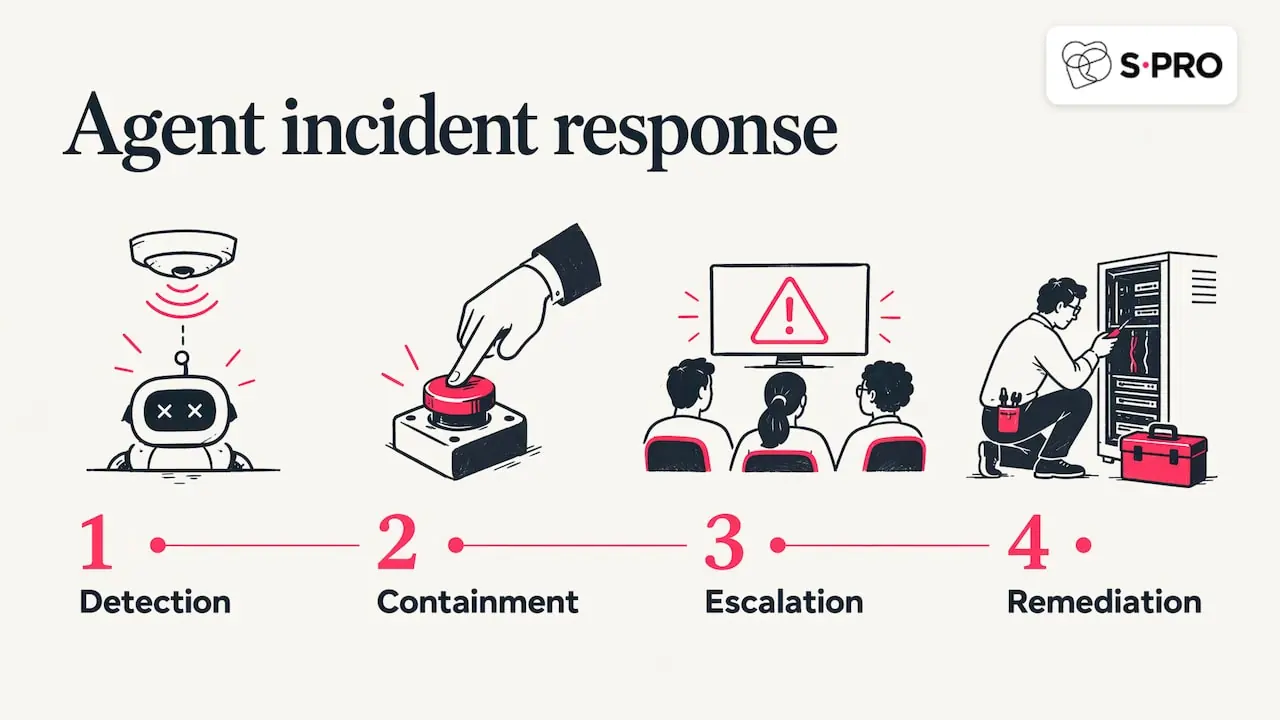
Incident clocks also apply. Swiss banks and investment firms must report certain cyber-attacks within 24 hours of becoming aware and submit a full report within 72 hours (Chambers Cybersecurity 2026). An agent that touches sensitive systems has to fit into that process, so detection, containment, escalation and remediation steps for agent failures should be written before go-live.
Human oversight in practice
Human oversight is not yet generally mandated by Swiss law, but FINMA already requires supervised institutions to govern and control AI applications, including autonomous ones (Chambers Artificial Intelligence 2026). The same guide notes that as human input into an agent’s actions shrinks, assigning responsibility gets harder. The practical answer is to place human checkpoints at decisions with consequences, not at every step.
Question 4: What does the vendor contract cover?
The contract moves risk between the bank and its supplier, but the bank remains liable to the client and the regulator. A supplier may owe the bank damages for defects or breach of warranty, yet recourse needs its own legal basis and does not pass the bank’s liability on to the customer (Legal 500, 12 May 2026). Contracts also cannot override statutory duties toward third parties or data subjects (Chambers Artificial Intelligence 2026).
Where an agent supports a significant function, the outsourcing rules in FINMA Circular 2018/3 apply. Each entity remains responsible for outsourced areas and must select, instruct and control the supplier properly. The written contract must assign responsibilities clearly and give audit and inspection rights, and foreign outsourcing must keep restructuring or resolution in Switzerland possible (Chambers Fintech 2026).
For agent projects, the clauses worth negotiating are:
- Warranties on training data and disclosure of model lineage.
- Notification of model changes, since a changed model can change behavior.
- Audit rights and security incident notification.
- Disclosure of sub-processors.
- Exit and reversibility terms.
The list follows the contract points in Legal 500’s Swiss fintech analysis.
Liability exclusions in bank terms need care. Article 100 of the Code of Obligations limits them, and a judge could hold void a clause excluding slight negligence by the bank. Article 101 paragraph 3 allows excluding minor negligence of auxiliaries, but whether an LLM supplier, developer, integrator or operator counts as an auxiliary needs concrete analysis of each role (CDBF, Alexandre Jotterand, 22 October 2024). Take that question to your counsel, who can advise on your own terms.
Does the EU AI Act reach a Swiss bank?
It can, depending on whether the system’s output is used in the EU, and counsel should confirm that for each use case. Switzerland has no AI act of its own, so the EU rules are the only dedicated AI statute a Swiss institution with EU clients or EU entities may meet.
The EU AI Act was amended by Regulation (EU) 2026/1744 (the AI Omnibus), in force since 27 July 2026. The general application date of 2 August 2026 is not the date for high-risk obligations. Stand-alone high-risk systems listed in Annex III apply from 2 December 2027, and high-risk AI embedded in products under Annex I applies from 2 August 2028 (Council of the EU timeline). We do not classify use cases here: check Annex III against the use case with your counsel.
Agent register and decision log design
The register and the log are the two artifacts that answer the questions above. Build them before the second agent goes live, not after the first incident.
The agent register
One row per agent, owned by the COO or the function you name, reviewed on a fixed cycle.
| Field | What it records |
|---|---|
| Agent ID and purpose | What it is for and which process it supports |
| Accountable owner and deputy | Named people, with authority to pause or override |
| Risk classification | Materiality rating and the reasoning behind it |
| Authority limits | Monetary thresholds, transaction types, client categories |
| Human sign-off points | Which outputs need approval, by whom |
| Model and data lineage | Model version, data sources, known weaknesses |
| Validation status | Date of independent validation and re-validation triggers |
| Third-party dependencies | Model provider, hosting, sub-processors, contract reference |
| Regulatory checks | FADP automated-decision review; Annex III check where relevant |
| Kill switch | Who can disable it and how |
The decision log
One entry per agent action or recommendation, written so it cannot be altered afterwards.
- Timestamp, agent ID and model version.
- Input: the data and documents the agent used, by reference.
- Output: the action taken or the recommendation made.
- Limit check: which authority limit applied and whether it was met.
- Confidence or uncertainty flag and where it was routed.
- Human step: reviewer, decision (approve, change, reject) and time.
- Override or pause events, with reason.
- Link to the client file or case where the output was used.
With these two artifacts, the answer to “who owned it, what could it do, what happened and who checked” is a lookup, not a reconstruction.
Talk to our engineers about scoping an agent with these controls built in.
Our perspective
Responsibility is easier to keep when it is designed in at the start. In our delivery of AI agents for banks, the questions in this article are the starting brief: who owns the agent, what it may do, what it records, and where a person decides.
We build each solution on S-PRO Agents, our own agentic platform, and our solutions are designed with EU AI Act, FINMA and DORA requirements in mind. For a private bank or wealth manager, that means the register and the decision log are part of the system scope, not an afterthought added to satisfy an audit.
The bank keeps the accountability. Our job is to give the COO and the board the structure and records that let them exercise it with confidence.
The S-PRO team
How S-PRO helps
S-PRO is an international Swiss-American firm with offices in Zurich and Salt Lake City, and global delivery. We have delivered 100+ AI projects, 40+ of them agentic AI projects, and we are ISO 27001 and ISO 27701 certified. Our team includes Claude-certified engineers and architects.
For banks and wealth managers, we build AI agents for banks on S-PRO Agents and run them as a service, with the controls in this article defined in the scope. If you want to walk through an agent register for your own use cases, book a discovery call.
FAQ
Can a vendor take over our liability for an AI agent?
No. A supplier may owe the bank damages under the contract for defects or breach of warranty, but the bank stays liable to its clients and the regulator. Recourse against a supplier needs its own legal basis. Contracts also cannot override statutory duties to data subjects or third parties.
Has FINMA ruled on who is liable for AI agents?
No. FINMA Guidance 08/2024 of 18 December 2024 addresses governance and risk management when using AI, including third-party dependencies and legal and reputational risks. It is guidance, not a ruling on agent liability. General Swiss contract, tort and financial market law continues to apply to supervised institutions.
Do board members face personal liability for AI agents?
Potentially. Article 716a of the Code of Obligations gives the board duties that cannot be delegated, and Article 754 sets out personal liability for board and management members. Commentary treats uncontrolled delegation of consequential decisions to autonomous systems as a possible organisational failing. Ask your counsel to assess your own governance.
What would a first step look like with S-PRO?
A first step can be a short design thinking pilot: design thinking pilot from USD 20k, 2–4 weeks. It lets a bank define the use case, owner, authority limits and records before building further. Scope and next steps are agreed in a discovery call.
Sources
- Swiss Code of Obligations, Fedlex
- Federal Act on Data Protection, Fedlex
- Council of the EU, AI Act timeline
- Legal 500, Control, Responsibility And Governance Of Autonomous AI Agents (10 July 2026)
- Legal 500, Artificial Intelligence In FinTech: The Swiss Regulatory Landscape (12 May 2026)
- Legal 500 Country Comparative Guides 2026, Switzerland: Artificial Intelligence
- Chambers Artificial Intelligence 2026, Switzerland
- Chambers Fintech 2026, Switzerland
- Chambers Cybersecurity 2026, Switzerland
- CDBF, Deploying banking chatbots (22 October 2024)
- University of Geneva open archive, Intelligence artificielle et automatisation des décisions (2024)
Last updated 23 November 2026
Subscribe


Thank you!
Get ready! You will receive handpicked content right to your inbox.