


A Swiss bank checks an AI agent provider against seven criteria, each tied to a FINMA text: supervisory mapping, outsourcing terms, data location and access, exit, test evidence, traceability and independent review. For each criterion the table below names the artefact to ask for and the red flag that should stop the procurement.
Last updated: 28 October 2026
Key takeaways
- FINMA expects a provider’s evidence to map to Guidance 08/2024 on AI governance and risk management, sections 2.1 to 2.7, and to its outsourcing and operational resilience circulars.
- Ask for documents, not assurances: a mapping, the contract clauses, a data-location statement, an exit plan, test reports, trace logs and an independent review.
- Providers fall into a few types. Each type has a typical strength and a typical gap, so compare by type before comparing by offer.
- The EU AI Act matters for Swiss banks serving EU clients or using EU-linked systems. Annex III stand-alone high-risk obligations apply from 2 December 2027.
- Keep consequential decisions with people. Swiss industry guidance says human specialists stay responsible for reasoned decisions.
Table of Contents
- What Swiss banks use AI agents for today
- Seven criteria and the FINMA texts behind them
- Criterion by criterion: what good looks like
- Provider types compared
- Swiss banks, and banks in Germany or Austria
- Our perspective
- Where to start with a shortlist
- FAQ
- How S-PRO helps banks and financial institutions
- Sources
What Swiss banks use AI agents for today
Swiss banks have concentrated their AI use on a short list of tasks. Swiss Banking reported in February 2025 that current use centers on transaction monitoring for anti-money-laundering, fraud detection, customer identification, document processing and querying internal knowledge databases.
The Swiss Bankers Association’s generative AI paper adds internal knowledge retrieval, client-document summarization, drafting and translation, data entry and validation for onboarding, and compliance report generation. It also says consequential financial decisions should remain subject to human scrutiny.
Its data-handling guideline describes AI support for KYC and onboarding: identifying relevant data, compiling risk reports, deduplicating information and flagging potential risks, with human specialists responsible for reasoned decisions. The same guideline notes that machine-learning systems can relate unusual transaction changes to criteria such as high-risk countries and sanctions, potentially reducing false positives.
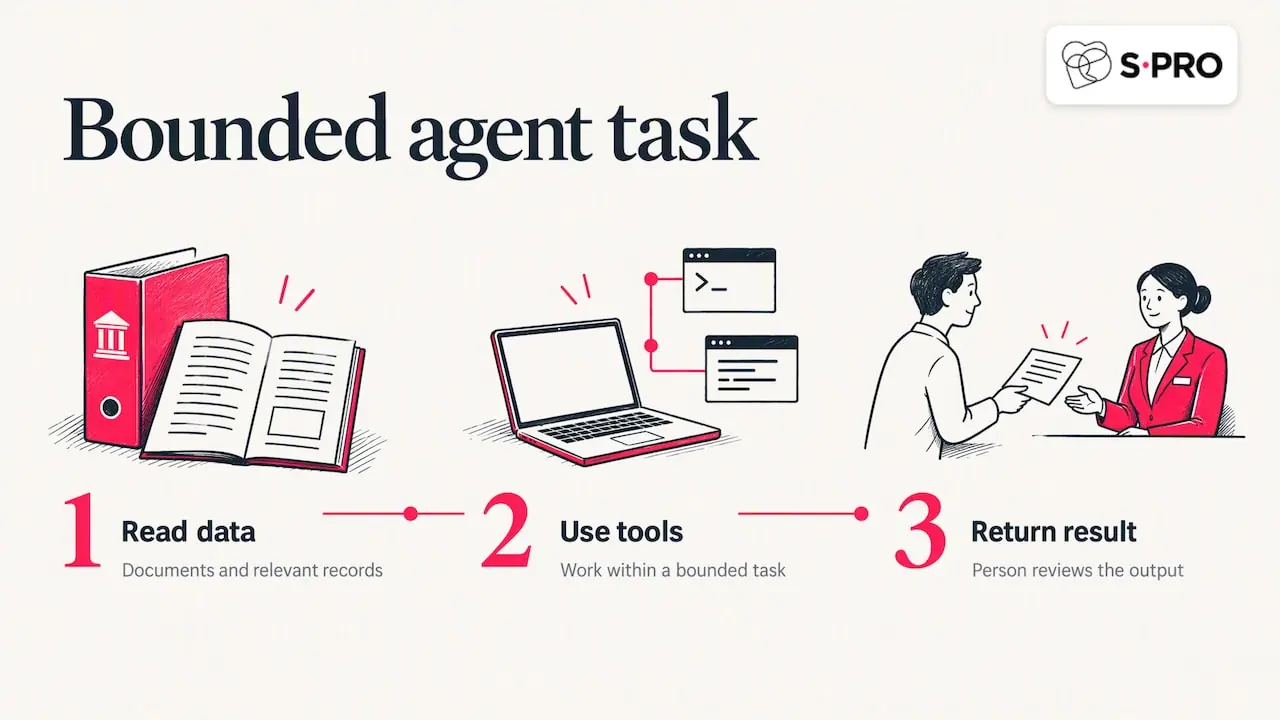
An agent here is a system that takes a bounded task, uses tools and documents, and returns a result for a person to review. That definition shapes every criterion below, because the control points sit where the agent reads data, calls tools and hands over to a human.
Seven criteria and the FINMA texts behind them
The scorecard ties each criterion to a FINMA source. Three notes on reading it:
- FINMA expects these points. Where a row says “expects”, it reflects the supervisory text, not a certificate a provider can hold.
- Circular 2018/3 is cited in the version of 1 January 2021. The English wording of Rz 26 is our translation.
- The traceability row is our inference from the guidance on documentation and explainability, not a stated FINMA rule.
| Criterion | FINMA source | Artefact to ask for | Red flag |
|---|---|---|---|
| 1. Supervisory mapping | Guidance 08/2024, s. 2.1 to 2.7 | A document that maps the provider’s controls to each section 2.1 to 2.7 | A generic compliance brochure with no section-level mapping |
| 2. Outsourcing terms | Circular 2018/3, Rz 21, 26, 29, 33 | Draft contract with the clauses on these margin numbers, including sub-contractor handling | Sub-contractors undisclosed or changeable without notice |
| 3. Data location and access | Circular 2023/1, Rz 79, 82 | Statement of hosting location, access model and support-access rules | Support staff or model vendors can reach client data from unspecified locations |
| 4. Exit | Circular 2018/3, Rz 18.1 | Exit plan covering data return, deletion and transition support | Data formats or prompts that cannot be exported |
| 5. Test evidence | Guidance 08/2024 (testing and ongoing monitoring) | Test reports on accuracy, robustness and failure cases, plus a monitoring plan | Only vendor demos, no test set or acceptance thresholds |
| 6. Traceability (inference) | Guidance 08/2024 (documentation and explainability) | Sample log of one case: inputs, retrieved sources, tool calls, outputs, human action | Logs that record outputs but not the sources behind them |
| 7. Independent review | Guidance 08/2024 (independent review) | Evidence of review by a function or party independent of development | The team that builds the agent is the only one that checks it |
Scope limits to check before you apply the table
Two scope limits in Circular 2023/1 change what applies to your institution. Rz 79 does not apply to institutions under Art. 47a to 47e CAO. Rz 80 does not apply to categories 4 and 5. Confirm your FINMA category and institution type first, then drop or keep the rows accordingly.
How to use the scorecard in a procurement
Send the artefact column to every shortlisted provider as a document request, with a fixed return date. Score each provider on whether the artefact exists, whether it is specific to your use case, and whether your second line and internal audit have read it.
Treat the red flags as stop conditions during due diligence. A provider can fix a missing log sample, but a provider who cannot name its sub-contractors has a structural problem.
Criterion by criterion: what good looks like
Supervisory mapping
Guidance 08/2024 sets out expectations in seven areas: governance, inventory and risk classification, data quality, testing and monitoring, documentation, explainability and independent review. A useful mapping names the control, the owner on each side and the evidence. If the provider cannot show who owns each control, your bank will own all of them by default.
Outsourcing terms
An AI agent that processes client files for a bank is often an outsourcing arrangement. Check whether the contract addresses the points FINMA expects at Rz 21, 26, 29 and 33 of Circular 2018/3, and have legal counsel review the wording against the current text. Ask how the provider handles changes to the underlying model, since a model update can change behavior without a code release.
Data location and access
Swiss data hosting is the question most boards ask first, so make it concrete. Ask where prompts, retrieved documents, embeddings and logs are stored, and who can access each. Include the model provider in the question: if the agent calls a hosted model, the data path extends to that vendor. Rz 82 of Circular 2023/1 is the anchor for access to critical data.
Exit
An exit plan for an AI agent covers more than a database export. It should cover prompts, evaluation sets, tool configurations, logs and the documentation your auditors will need after the contract ends. Ask the provider to show the plan, not to describe it.
Test evidence
Request the test set, the acceptance thresholds and the results. For a KYC document agent, that means extraction accuracy by document type, error handling for poor scans and a record of cases escalated to a person. Ask what triggers re-testing, such as a model version change.
Traceability
For each case, a reviewer should be able to reconstruct what the agent read, what it retrieved, which tools it called and what it proposed. This is our reading of the documentation and explainability expectations, and it is also what an internal auditor will ask for in practice.
Independent review
Guidance 08/2024 expects review independent of development. Ask whether the provider supports your internal audit or an external reviewer with access to documentation, test data and logs, and whether that access is written into the contract.
Provider types compared
The table compares types of provider, not named companies, and it does not rank them. A Swiss bank will usually mix types: a platform for common tasks and a specialist for regulated workflows.
| Provider type | Typical strength | Typical gap to test | Fit |
|---|---|---|---|
| Core banking or PMS vendor with built-in AI | Close to existing data and workflows | Roadmaps ahead of production capability; limited control over models | Banks that want one vendor and accept its pace |
| Global cloud and model platform | Broad tooling and fast prototyping | Data location, sub-processing and Swiss supervisory mapping need proof | Teams with strong internal engineering and a clear data-residency design |
| Horizontal AI or conversational vendor | Mature customer-service agents | Less depth in KYC, AML and wealth workflows | Service and contact-center use cases |
| Consultancy-led program | Governance and change management | Build capacity and long-term run ownership | Banks that need a framework before they build |
| Specialist engineering partner for regulated finance | Pilot-to-production delivery, integration with core systems, documentation | Smaller brand footprint than global platforms | Banks that want custom agents inside their own infrastructure |
The first row deserves attention. Julius Baer has published an assessment of AI readiness among portfolio-management-system providers (see Sources). Treat any vendor claim the same way: ask for a production reference, not a roadmap slide.
Swiss banks, and banks in Germany or Austria
The seven criteria are built on FINMA texts. A bank in Germany or Austria faces a different supervisory base, so the FINMA column changes while the artefact column mostly carries over. Banks operating across the border should keep one evidence pack per supervisor rather than one pack stretched across both.
The EU AI Act applies to any provider or deployer within its scope, which can include Swiss institutions serving EU clients. Regulation (EU) 2026/1744 (the AI Omnibus) is in force since 27 July 2026. According to the Commission’s AI Act page, the general date of application is 2 August 2026, with exceptions. For high-risk AI the dates are later:
- Stand-alone high-risk (Annex III) obligations apply from 2 December 2027.
- High-risk AI embedded in products (Annex I) applies from 2 August 2028.
This article does not classify any use case. Check Annex III against the use case with your legal and compliance teams, and keep the provider’s technical documentation ready for that review.
Our perspective
Most agent pilots in banking do not fail on model quality. They stall at the point where a pilot has to meet outsourcing review, data-location sign-off and an audit trail that a second line can read. We therefore treat those artefacts as part of the build, not as paperwork added at the end.
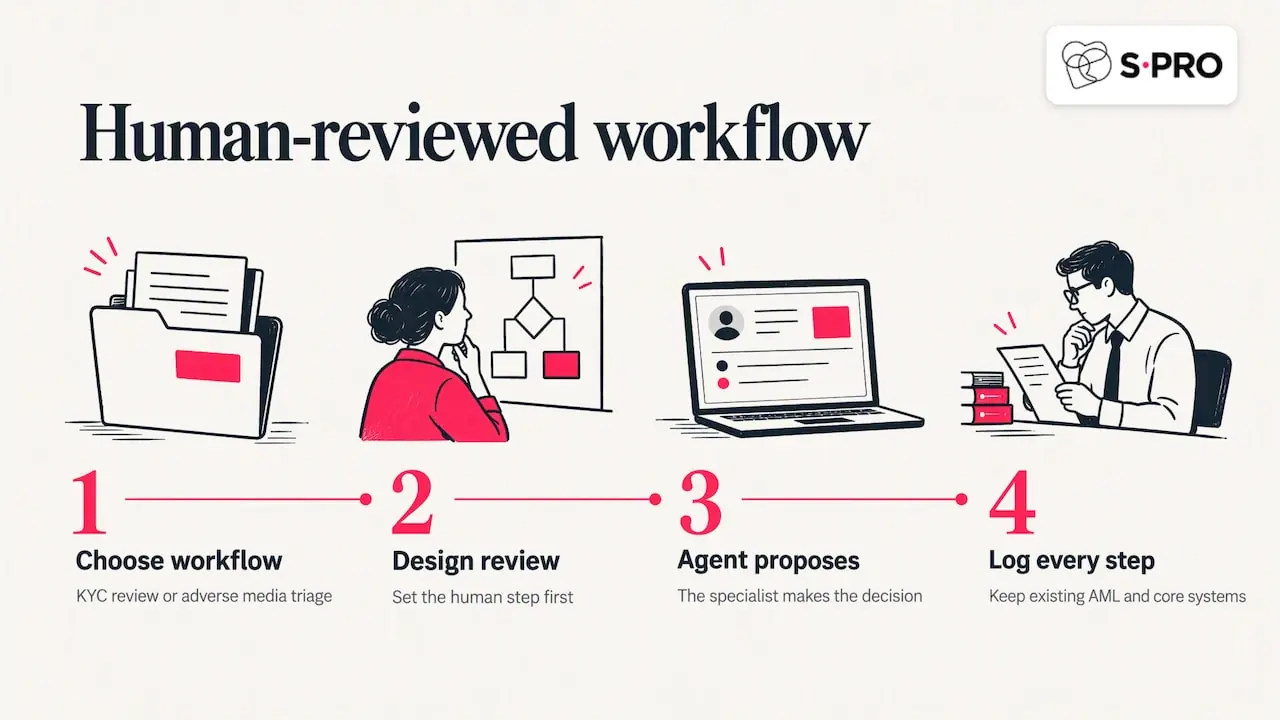
Our approach is to choose one bounded workflow, such as KYC document review or adverse media triage, and design the human-in-the-loop step first. The agent proposes, the specialist decides, and every step is logged. Existing AML and core systems stay in place, and the agent connects to them.
When you test any provider, including us, ask for the seven artefacts before you ask for a demo.
Where to start with a shortlist
If you want a provider that builds agents inside your own infrastructure with controls, documentation and human review designed in, our AI agent development for banks practice is built for that. We take a pilot to production against the criteria in this article. For monitoring workflows, see AI agents for AML and transaction monitoring.
Bring your FINMA category, your target workflow and your hosting constraints to the first conversation. We can then walk through the scorecard against your own situation.
FAQ
Does FINMA require a specific certification for AI agent providers?
No certification is named in the texts cited here. FINMA expects institutions to govern AI risks, manage outsourcing and protect critical data, and the institution remains responsible. Certifications such as ISO 27001 can support your due diligence but do not replace the artefacts in the scorecard.
Is an AI agent always an outsourcing under Circular 2018/3?
Not automatically. It depends on whether the provider performs a function, in whole or in part, that you would otherwise perform yourself, and on its significance. Have legal and compliance assess each arrangement against the current circular text.
Can an agent make KYC or credit decisions on its own?
Swiss Bankers Association guidance points the other way. It says human specialists remain responsible for reasoned decisions in KYC and that consequential financial decisions should remain subject to human scrutiny. Design the agent to prepare and propose, with a named person approving.
Which EU AI Act dates matter for a Swiss bank?
If the Act applies to you, the dates are 2 December 2027 for stand-alone high-risk (Annex III) obligations and 2 August 2028 for high-risk AI embedded in products (Annex I). Check Annex III against the use case before relying on either date.
How S-PRO helps banks and financial institutions
S-PRO is a Zurich-based software development company, founded in 2014, with 250+ engineers and ISO 27001 and ISO 27701 certification. We build AI agents for banks and financial institutions, from pilot to production, with audit trails, human-in-the-loop controls and documentation prepared for the EU AI Act, FINMA and DORA. S-PRO is a Certified partner in the Claude Partner Network, and our team includes Claude-certified engineers and architects.
Sources
- FINMA Guidance 08/2024 on governance and risk management when using AI
- FINMA circulars (2018/3 Outsourcing, 2023/1 Operational risks and resilience)
- Swiss Banking: Federal Council sets out its approach to AI regulation (February 2025)
- Swiss Bankers Association: Generative AI in Banking (2025)
- Swiss Bankers Association: Guideline on handling data in day-to-day business
- Julius Baer: AI readiness among PMS providers
- European Commission: AI Act regulatory framework
Subscribe


Thank you!
Get ready! You will receive handpicked content right to your inbox.