

A bank integrates an AI system into its core systems and data without breaking controls by deciding, in writing, what the AI may read and write, giving it its own access rights, keeping test and production separate, and naming a human who owns it in operation. The model matters less than these decisions, and each one needs an owner and a piece of evidence.
This article covers the work that starts after your bank has decided to build. It is written for CIOs, COOs, heads of compliance and heads of private banking at Swiss banks and wealth managers.
Key Takeaways
- Integration is a control exercise: every AI connection to a core system needs a defined scope, an access role, an environment, a sign-off and a named run owner.
- FINMA Circular 2023/1 requires development and test environments to be separate from the ICT production environment. The circular does not mention AI, so it applies as general ICT and operational-risk law.
- For core banking systems, the Swiss Bankers Association (SBA) advises running generative AI passively with human-in-the-loop oversight and starting with a limited scope.
- Responsibility for decisions cannot be delegated to AI or to a third party, so a human role must be named for each use case.
- The table below turns the work into steps, owners and the evidence an auditor will ask for.
Table of Contents
- What integration means once the decision to build is made
- The regulatory baseline you integrate against
- The integration plan: step, owner, evidence
- Step 1 and 2: decide what the AI may read and write
- Step 3: give the AI its own identity and access rights
- Step 4 and 5: separate environments and test by criticality
- Step 6: review the providers behind the system
- Step 7 and 8: human oversight and sign-off
- Step 9: assign a named run owner
- Where the work usually stalls
- Who this means what for
- How we approach it
- How S-PRO helps
- FAQ
- Sources
What integration means once the decision to build is made
Integration is the work of connecting an AI system to the applications, data and people of a bank so that it can do a defined job inside existing controls. It is different from choosing a model and from running a pilot on an extract of data.
The Swiss Finance Institute’s October 2026 roundup separates three kinds of AI in banking: universal assistants that augment employees, generative technology pointed at a defined job with guardrails, and single-purpose machine learning models that banks have trained on their own data for years. The first two become agentic when they get access to tools or the ability to execute steps. That access is exactly what integration work has to govern.
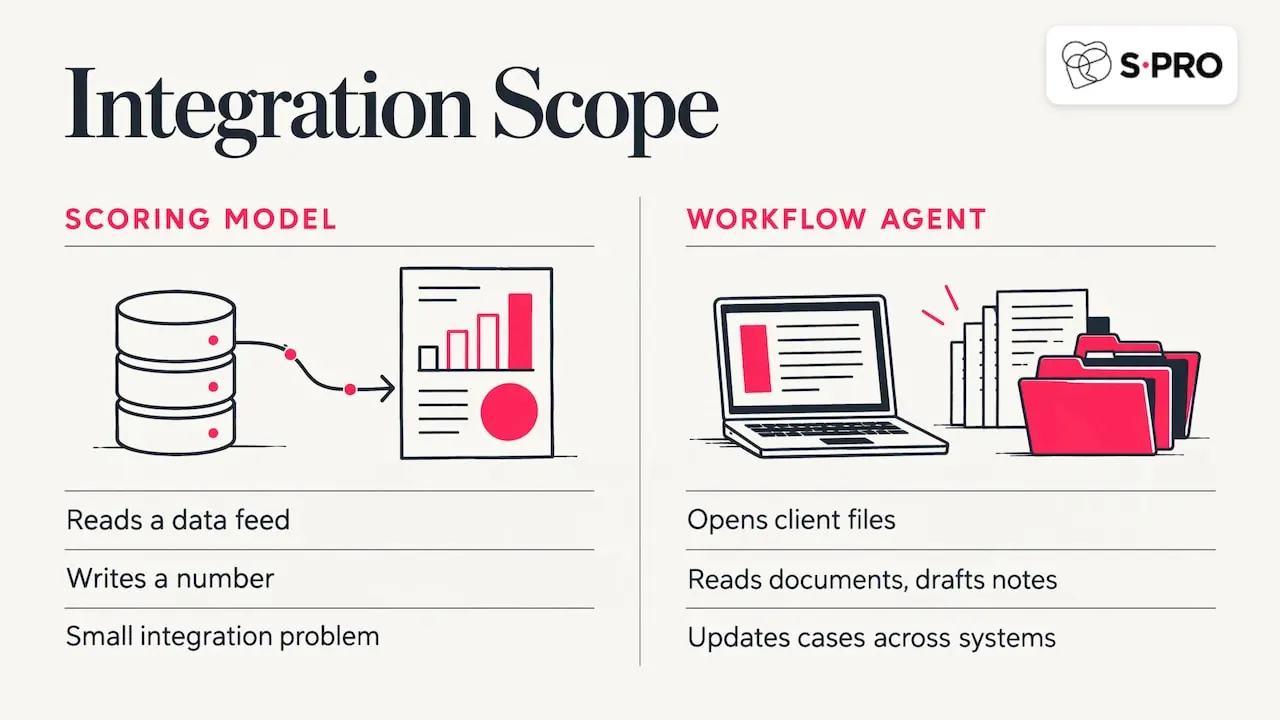
A scoring model that reads a feed and writes a number is a small integration problem. An agent that opens a client file, reads documents, drafts a note and updates a case in your workflow tool is a larger one, because it touches several systems with several kinds of authority.
The same roundup quotes a banker saying that value comes from building AI into a process end to end, not from adding a single tool. A tool bolted onto an unchanged process will not produce a fundamental shift, as Markus Leippold puts it there. For integration, this means the process owner is part of the project from the first week, not only the IT team.
The regulatory baseline you integrate against
In Switzerland, no AI-specific banking statute governs integration. Existing technology-neutral rules apply, and your controls must show how you meet them for the AI use case.
Three reference points matter for most banks:
- FINMA Circular 2023/1, Operational risks and resilience. FINMA published the circular in December 2022 for banks, and it has been in force since 1 January 2024. It says development or test environments must be separate from the ICT production environment, and that requirements must be tested and validated based on their criticality. The circular does not mention AI. It still applies to an AI component the way it applies to any other ICT change.
- FINMA Guidance 08/2024 on AI. The Legal 500 2025 guide summarises its seven control areas: governance with a central inventory and risk classification, data quality, testing and monitoring, documentation, explainability, and independent review of model development. A guidance sets out supervisory expectations. It is not a circular and it does not approve any system.
- The revised Federal Act on Data Protection (FADP). According to the SBA’s Generative AI in Banking paper (April 2025), development, training and use of generative AI must follow purpose limitation, accuracy and data security. Where a decision rests exclusively on automated processing with legal or considerable adverse effect, the person concerned may ask for a review by a natural person. Banks serving EU/EEA customers must also meet GDPR.
FINMA does not approve AI systems. Your institution owns the classification, the controls and the evidence. If your AI system also falls under the EU AI Act, check Annex III against the use case with your legal team.
The integration plan: step, owner, evidence
Each integration step needs a named owner and an artefact that can be shown to internal audit or to FINMA. The table lists the steps in the order we work through them.
| Integration step | Owner | Evidence |
|---|---|---|
| 1. Define the use case and its process | Business process owner | Process map with the AI step marked, and the decision it supports |
| 2. Record read and write scope per system and data class | Head of data / data owner | Data-access matrix: system, data class, read or write, purpose |
| 3. Create AI service identities and access roles | CISO / IAM lead | Role definitions, approval tickets, access review log |
| 4. Separate test and production environments | CIO / head of platform | Environment diagram, deployment rules, change records |
| 5. Test against requirements by criticality | Test lead with business owner | Test plan, results, defect log, validation note |
| 6. Review providers and outsourcing | Procurement, legal, operational-risk function | Provider assessment, contract terms, exit and fallback plan |
| 7. Define human oversight and fallback | Business owner with compliance | Oversight design, escalation path, manual fallback procedure |
| 8. Sign-off before go-live | Cross-departmental committee | Signed decision, risk classification, open-issues list |
| 9. Operate and monitor | Named run owner | Monitoring reports, incident log, periodic review |
The sections below explain what each step takes and where it commonly goes wrong.
Step 1 and 2: decide what the AI may read and write
Start with a data-access matrix: for every system the AI touches, list the data classes, whether it may read or write, and why. Reading is the safer default, and writing needs its own justification.
The SBA paper recommends implementing generative AI first in domains where core business is unaffected, so the bank can experiment without endangering critical operations. For core banking systems it advises running generative AI passively with human-in-the-loop oversight. In practice, passive means the AI reads, drafts and proposes, and a person executes the change in the system of record.
A practical split looks like this:
- Read only: client master data, documents, transaction history, policy texts. Mask or exclude what the use case does not need, which is also what FADP purpose limitation asks for.
- Write to a staging area: draft notes, proposed classifications, suggested case dispositions. A person reviews them before they reach the core.
- Write to the core: only after sign-off, with a technical limit on what fields and what amounts, and a log entry for every write.
Where this goes wrong: teams reuse the pilot’s broad data extract in production because it worked. Data that was fine for a closed experiment is often wider than the use case needs. Cut scope back before go-live, not after an incident.
Swiss banks also tend to hold client identifying data under strict confidentiality rules. Decide early whether the AI works on pseudonymised data, and where the model and its logs are hosted. Those choices shape the architecture more than any model feature.
Step 3: give the AI its own identity and access rights
Treat every AI component as a non-human user with its own service identity, a least-privilege role and a periodic access review. Never let it borrow the credentials of the relevant employee.
This matters for three reasons. An audit trail that says “user X changed this” is misleading when an agent acted. Permissions tied to an employee drift as that person changes role. And a shared service account makes it impossible to switch off one use case without affecting others.
A workable pattern:
- One service identity per use case, not per team.
- Roles built from the data-access matrix, with write rights granted field by field.
- Calls to core systems pass through an integration layer, such as an API gateway, that enforces the role and logs the request, instead of the AI connecting to databases directly.
- Every action is logged with the use case, the input reference and the human who approved it, if any.
The integration layer is also where legacy systems hurt. Older cores often expose batch files or limited interfaces, so a safe API layer has to be built before an agent can work with them. That is why integration projects at many banks lead into core and legacy modernization work, even when the original goal was only an AI use case.
Step 4 and 5: separate environments and test by criticality
Keep development and test environments apart from production, and test each requirement in proportion to the criticality of the process. This is what Circular 2023/1 sets out for ICT generally, and it applies to an AI component in the same way.
For AI, separation has some specific consequences:
- Data in test. Use synthetic or masked data for development. If a test needs real data, treat the test environment as a production-grade data store with matching access controls.
- Model and prompt versions. Prompts, retrieval configurations, model versions and tool permissions are all part of the system. Promote them through environments together, with change records, like code.
- Tool connections. In test, the agent’s tools point to sandbox instances of the core, never to the live one. A single mis-set endpoint is how a test run ends up in a client account.
- Test depth by criticality. An internal knowledge-base assistant needs less testing than an agent that proposes sanctions-alert dispositions. Write down the criticality rating and the test depth it triggers.
The SBA paper lists robustness and reliability among the FINMA challenges for AI, naming data quality risks, model drift and IT security from outsourcing and cloud. Your test plan should therefore include data-quality checks at the interface, not only model accuracy checks. It should also include a defined way to detect behavior changes after a model or provider update.
Step 6: review the providers behind the system
Every external provider in the chain needs the same review as other material service providers: model provider, hosting, integration partner and any tool the agent calls. Decision-making responsibility cannot be delegated to AI or to third parties, as the SBA paper notes in describing FINMA’s expectations.
A provider review should cover:
- where data is processed and stored, and whether client identifying data leaves Switzerland;
- what the provider does with your inputs and outputs, including any retention or training use;
- subcontractors and the location of support access;
- change notification when a model version is replaced or retired;
- exit: how you move to another model or host, and what the manual fallback is meanwhile.
The last point is often missed. If an agent becomes part of a process, a provider outage or a model withdrawal becomes a process outage. The fallback procedure belongs in the evidence pack, with an owner who has tried it.
Step 7 and 8: human oversight and sign-off
Name the point at which a person decides, and make that decision real, with the information needed to overrule the AI. Then take the whole package through a sign-off body that includes risk, compliance, IT and the business.
Fernando Perez-Cruz argues in the Swiss Finance Institute roundup that the decisive question for agentic systems is whether decisions are final and irrevocable or advisory. Human final authority over outcomes is the distinction that matters for banks. Applied to integration: design the workflow so that the AI’s output is a proposal, and so that overriding it is easy and logged.
The SBA paper recommends evaluating generative AI initiatives through a cross-departmental committee. A sign-off pack for that committee can be short:
- The use case, the process step and the risk classification.
- The data-access matrix and the role definitions.
- Test results by criticality, with open defects.
- The provider assessment and the fallback plan.
- The oversight design and the named run owner.
- Monitoring metrics and the review date.
The SBA also notes that customers must be informed about AI usage and that results must be verifiable. Check how each client-facing or client-affecting use case meets that, and document it here.
Talk to our engineers about integrating AI with your core systems
Step 9: assign a named run owner
One person owns the system in operation: its performance, incidents, access reviews, provider changes and retirement. A committee signs off the launch, but a named individual runs it.
The run owner needs three things. First, monitoring that shows the agent’s actions, the share overridden by humans and data-quality alerts at the interface. Second, authority to stop the use case, with the manual fallback ready. Third, a calendar: access reviews, provider reviews and re-validation after any model, prompt or data-source change.
Governance expectations in FINMA Guidance 08/2024 include a central inventory with risk classification and ongoing monitoring. The run owner is the person who keeps the inventory entry true. Without that role, a use case that passed sign-off in month one is unmanaged by month six.
Where the work usually stalls
The SFTI/OST report on the Swiss financial industry, Bridging the AI PoC-Production Gap (29 October 2025), found 17% of institutions at deployment and 11% at scaling. Among production cases, 65% met or exceeded expectations. We do not repeat the reasons pilots fail here. The point for integration is that the steps above are the pre-deployment work, and a bank that has the evidence pack ready moves faster than one that assembles it at the end.
The SBA also lists prerequisites that Swiss banks name for AI: secure infrastructure, trusted high-quality data and digital skills. Each of these shows up in the table: infrastructure in steps 3 and 4, data in step 2, skills in steps 7 to 9.
Who this means what for
The same steps apply across institution types, with different emphasis:
- Private banks and wealth managers: client confidentiality and data location dominate. Start with read-only copilots for relationship managers, with drafts reviewed before anything reaches a client or the core.
- Retail and universal banks: legacy interfaces and criticality testing dominate. Build the integration layer once and reuse it.
- Compliance and operations teams: audit trails and human decision points dominate. Keep existing AML systems in place and let the agent prepare cases for people to decide.
- Fintechs and digital banks: a modern core makes access control easier. The discipline of separate environments and named owners still applies.
How we approach it
We see integration as an engineering and governance task done together. Our engineers work from the data-access matrix and the sign-off pack, because a design that the bank’s risk and audit teams can read is a design that reaches production.
Our view is that AI should enter a bank passively first: reading, drafting and proposing, with people making the final decision, and with write access added use case by use case. That is consistent with the SBA’s advice for core banking systems, and it keeps the integration layer simple enough to reason about.
We build AI agents for banks on our own agentic platform, S-PRO Agents, and run them as a service, designed with FINMA, DORA and EU AI Act requirements in mind. That gives a bank one accountable partner for the integration layer, the agent and its operation, while the bank keeps the named run owner and the final authority.
The S-PRO team
How S-PRO helps
S-PRO is an international Swiss-American firm with offices in Zurich and Salt Lake City, and global delivery. We were founded in 2014, have 250+ engineers, and are ISO 27001 and ISO 27701 certified. We have delivered 100+ AI projects, 40+ of them agentic AI projects.
For integration work, our teams provide AI agents for banks, core and legacy modernization where the core needs an interface layer, and AI pilot to production support. We build the client’s solution on S-PRO Agents and run it as a service. Our team includes Claude-certified engineers and architects, and S-PRO is a Certified partner in the Claude Partner Network.
If you are planning an integration, book a discovery call and bring your target systems and the use case. We will go through scope, access and environments with you.
FAQ
Does FINMA Circular 2023/1 cover AI?
The circular does not mention AI. It applies to banks’ ICT and operational risks generally, so it covers an AI component as it covers any other system. It has been in force since 1 January 2024 and requires, among other things, that development and test environments are separate from production.
Does FINMA approve AI systems before a bank goes live?
No. FINMA does not approve individual AI systems. Your bank classifies the use case, designs the controls and keeps the evidence. FINMA Guidance 08/2024 sets out supervisory expectations on governance, data quality, testing, documentation, explainability and independent review, which your sign-off pack should address.
Should the AI be allowed to write to the core banking system?
Start with read access and drafts. The SBA advises running generative AI passively, with human-in-the-loop oversight, for core banking systems. Add write access only for specific fields after sign-off, with technical limits and a log for each write, and keep a person responsible for the outcome.
Who should own an AI system once it is live?
One named run owner, in the business or in the function that uses it. This person monitors performance, handles incidents, reviews access and provider changes, and can stop the use case. Responsibility for decisions cannot be delegated to the AI or to a third party.
Sources
- FINMA, Circular 2023/1 Operational risks and resilience, press release, 13 December 2022
- Swiss Bankers Association, Generative AI in Banking, April 2025
- Swiss Finance Institute, AI roundup, October 2026
- Legal 500 Country Comparative Guides 2025, Artificial Intelligence, Switzerland
- SFTI/OST, Bridging the AI PoC-Production Gap, 29 October 2025
- Swiss Bankers Association, Artificial intelligence and Big Data
Last updated 19 November 2026
Subscribe


Thank you!
Get ready! You will receive handpicked content right to your inbox.