

An AI agent for transaction monitoring alert triage can be built by an engineering partner that integrates with your existing monitoring system, keeps analysts and the MLRO in the decision seat, and logs every step. S-PRO builds such agents for banks as part of its AML & transaction monitoring work. The agent summarizes and prepares each alert. It never closes an alert and never files a report.
Key Takeaways
- Alert triage sits after your rule engine: the agent works on alerts that already exist, so the monitoring system stays in place.
- The agent gathers context, finds similar past cases and drafts a narrative. The analyst decides, and the MLRO decides on any report to MROS.
- Every agent action and every human decision is logged, so a case can be reconstructed for audit or for FINMA.
- A pilot is judged against your own rule-based baseline, with thresholds and overrides agreed before go-live.
- Choose a builder on integration, data hosting, logging and experience in production, not on a promised reduction in alert volume.
Table of Contents
- The alert queue in plain steps
- Why triage, and why now
- What the agent prepares, what the analyst decides
- Controls a Swiss bank should keep
- Who can build it, and what to ask
- From pilot to production
- How alert triage connects to KYC and screening
- How S-PRO helps banks with alert triage
- Our view on the alert queue
- FAQ
- Sources
The alert queue in plain steps
The queue has six steps, and the agent supports the first four while people own the last two. Here is the path of a single alert at a private bank or universal bank.
- Alert. Your existing rule engine flags a transaction or a pattern. Nothing about this changes. The alert lands in the queue as it does today.
- Context gathering. The agent pulls what the analyst would otherwise collect by hand: the customer profile, the risk rating, the account history, recent transactions, linked parties and notes from earlier reviews. It puts them in one view.
- Similar past cases. The agent searches your own closed cases for alerts with comparable features and shows how they were resolved, with a link to each file.
- Draft narrative. The agent writes a short, structured summary: what triggered the alert, what the context shows, which past cases resemble it, and which facts are missing.
- Analyst decision. A named analyst reads the draft and the underlying data, then closes the alert, requests more information or escalates.
- The MROS question. For escalated cases, the MLRO (money laundering reporting officer) decides whether the facts call for a report to MROS, the Swiss Money Laundering Reporting Office. The agent can assemble the case file. It does not make that decision and does not submit anything.
The same split appears in published research on scoring models above a rule engine. The 2025 study in the Journal of Money Laundering Control describes a model that scores rule-generated alerts. Low-risk alerts were hibernated, medium-risk alerts went to a first-level review team, and high-risk alerts went straight to second-level investigators, who prepared the suspicious activity report for a third level to submit. The rule system itself was unchanged.
Why triage, and why now
Triage targets the part of the process where analyst hours go: reading alerts that turn out to be harmless. A 2021 SWIFT study on AML and fraud detection reports that false-positive rates in transaction monitoring typically fall between about 70% and 95%, with only 2% to 10% of alerts converting into suspicious transaction reports. The same study notes that these figures have barely moved over decades.
The SWIFT authors suggest one reason: institutions tend to look for suspicious patterns inside their own data, rather than for change against what is known about a client’s normal behavior. That is the information a triage agent puts in front of the analyst. An unusual payment looks different when it sits next to the client’s known financial situation, past transfers and earlier case notes.
For a private bank this matters in a specific way. Client relationships are long and well documented, and the context that explains a transfer often sits in an RM’s notes, a review file or an onboarding record. Bringing those sources together at the moment of the alert is a job for an agent connected to your systems.

What the agent prepares, what the analyst decides
The division of labor is the core design decision. The table below shows it for each step, along with what is logged.
| Step | Agent prepares | Analyst or MLRO decides | Logged |
|---|---|---|---|
| Prioritization | Orders the queue and shows the reasons for each position | Whether to work the queue in that order | Score, inputs and model version |
| Context | Customer profile, history, linked parties, prior notes | Whether the context is complete and relevant | Sources queried and time of access |
| Similar cases | Closed cases with comparable features and their outcomes | Whether a past case really applies | Cases shown and cases the analyst opened |
| Narrative | Draft summary with references to source data | Edits, accepts or rewrites the text | Draft, final text and the differences |
| Alert outcome | Nothing: the agent does not close alerts | Close, request information or escalate | Analyst, decision and rationale |
| MROS question | Case file assembled for the MLRO | Whether to report to MROS | MLRO decision and file contents |
Three rules keep this arrangement honest. The agent has no permission to change an alert’s status. The narrative cites its sources so the analyst can check each statement. And the analyst’s rationale is written by the analyst, not generated.
Controls a Swiss bank should keep
Switzerland has no AI-specific financial law, so existing governance and risk-management duties apply to AI in the same way they apply to other technology. FINMA Guidance 08/2024 on AI addresses, among other topics, model risk, third-party risk, legal risk and reputational risk. Read the full guidance against your own setup, and treat it as the baseline for the controls below.
Research from a Swiss university on AI in transaction monitoring reaches a similar view: responsibility stays with the financial intermediary, and AI can support complex checks only in a preparatory way, such as gathering background information. The bank has to know the limits of automation and keep the processes documented, traceable and open to sampling checks.
In practice, that translates into this list:
- Human decision on every outcome. No automatic closure of alerts and no automatic reporting.
- Explainable inputs. Each score or summary shows which data it drew on.
- Complete audit trail. Agent actions, data accessed, model version, analyst edits and final decisions are all logged and retrievable.
- Sampling. Reviewers regularly sample alerts the agent ranked as low priority, to check that nothing important sits there.
- Validation and drift monitoring. Models are validated before use and revalidated when behavior or data change.
- Third-party and data controls. Where a vendor or a hosted model is involved, you know where data is processed, who can access it and how the arrangement is governed.
- Overrides. Hard rules that keep certain alerts at full review regardless of any score.
The overrides deserve a closer look. In the study cited above, alerts for customers with a prior suspicious activity report, or with two recent hibernated alerts, could not be hibernated. That is a concrete example of a guardrail written as a rule rather than left to the model.
If the agent is part of a system used in the EU, for example for a German subsidiary, the EU AI Act applies to the AI system itself, and each use case needs its own check against Annex III. Dates and obligations should be read from the Commission’s AI Act page or EUR-Lex, not from summaries.
Who can build it, and what to ask
A bank has three realistic routes: a module from the vendor of the existing monitoring system, an in-house build, or a custom build with an engineering partner. The first is bounded by the vendor’s roadmap, the second by your engineering capacity and AI skills. A partner is the route when you want an agent integrated with the systems you already run, with logging and governance designed to your standards.
Whatever route you take, these are the questions that separate a credible builder from a demo:
- Integration. Can the agent read alerts from your current monitoring system, case management and client data without replacing any of them?
- Human-in-the-loop by design. Is the analyst’s decision a required step, with the rationale captured?
- Hosting and data. Where does processing happen, and does it meet your Swiss data requirements?
- Logging. Can you reconstruct any alert, including what the agent saw and wrote, months later?
- Governance support. Does the builder help produce the model documentation your validation and compliance teams need?
- Production record. Has the team taken AI agents beyond pilots into live operations?
S-PRO is an international Swiss-American firm with offices in Zurich and Salt Lake City, and global delivery, with 100+ AI projects delivered, 40+ of them agentic AI projects. The firm’s AI agents for banks practice covers this kind of build.
From pilot to production
A triage pilot should answer one question: does the agent make analysts better informed without weakening detection? The way to answer it is to define the evidence before the pilot starts.
A professional white paper from the Dutch Banking Association on machine learning in transaction monitoring makes a useful point: a parallel run is not a default requirement. What counts is showing that the new approach is effective and efficient on a risk basis, using the same effectiveness analyses you would use for any monitoring change. All stakeholders should agree up front on the evidence, criteria and governance, and accept that the standard is net improvement rather than zero misses.
The JMLC study offers a concrete pilot shape: six months of real-time operation with a light-touch review of low-risk alerts, monitoring of how model scores matched analyst decisions, then phased threshold changes with overrides. A workable plan for a bank looks like this:
- Baseline. Measure today’s queue: volumes, handling time, escalation rate and conversion to reports.
- Shadow mode. The agent prepares drafts; analysts work as usual and compare.
- Assisted mode. Analysts start from the agent’s draft. Every decision stays manual.
- Review. Compare against the baseline with compliance, risk and validation in the room.
- Phased scope. Extend to more alert types only after the evidence supports it.
Our AI pilot to production page describes how S-PRO approaches this move.
Book a discovery call to scope your alert triage pilot
How alert triage connects to KYC and screening
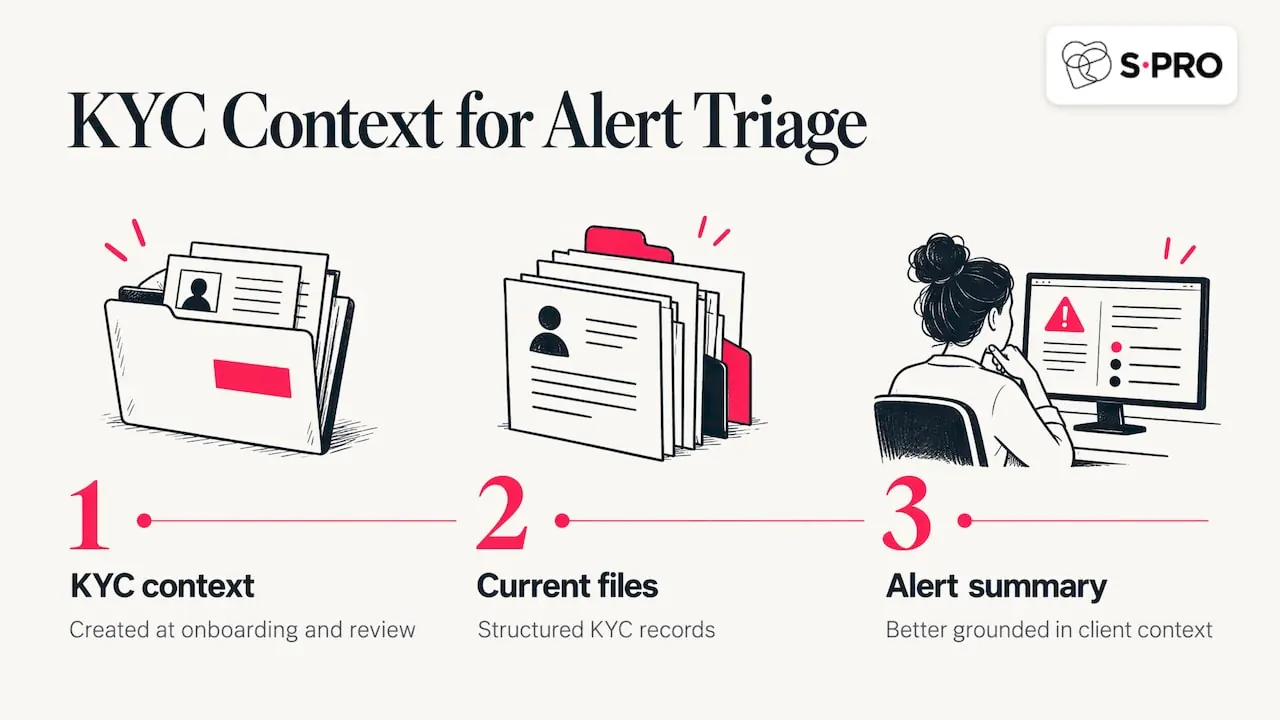
The context an agent gathers for an alert is the same context created at onboarding and in periodic review. When KYC files are structured and current, the agent’s summary is better grounded. That is why banks often look at KYC onboarding agents and alert triage together, with one logging and governance model across both. This article stays on the alert queue.
How S-PRO helps banks with alert triage
S-PRO builds AI agents for AML and transaction monitoring that work alongside the monitoring system a bank already runs. S-PRO builds the client’s solution on its own agentic platform, S-PRO Agents, and runs it as a service. Our team includes Claude-certified engineers and architects, and S-PRO is a Certified partner in the Claude Partner Network. S-PRO is ISO 27001 and ISO 27701 certified, and its solutions are designed with EU AI Act, FINMA and DORA requirements in mind.
If you are weighing a triage agent for your alert queue, start with AML & transaction monitoring, or go straight to a conversation with our engineers.
Our view on the alert queue
We think the strongest triage agents are the ones that do less than people expect. They gather, compare and draft. They do not decide.
That boundary is what lets a compliance officer sign off on the design. It also lets an analyst trust the draft, because the analyst knows every statement can be traced to a source and every decision remains their own.
We build agents on S-PRO Agents, our own agentic platform, and we run them as a service, so logging, access control and change management are part of the build from the first sprint, not added at the end. For a Swiss bank this is what turns a pilot into something the MLRO, the validation team and the CIO can all accept.
Start with the queue as it is, define what evidence would convince your compliance function, and build only what that evidence supports.
The S-PRO team
FAQ
Who can build an AI agent for transaction monitoring alert triage?
An engineering partner with experience in banking systems and production AI agents can build it, working on top of your existing monitoring system. S-PRO builds these agents as part of its AML & transaction monitoring work. The agent prepares alerts; analysts decide, and the MLRO decides on reports to MROS.
Does the agent replace our transaction monitoring system?
No. The agent works on the alerts your rule engine already generates. It adds context, similar past cases and a draft narrative to each one. Your monitoring system, case management and detection logic stay as they are, which keeps the scope of validation and change management focused on the new layer.
Can the agent close alerts or file a report to MROS?
No. The agent summarizes and prepares. An analyst closes or escalates every alert, and the MLRO decides whether a case goes to MROS. The agent has no permission to change an alert’s status or submit a report, and each human decision is logged with its rationale.
Does FINMA require AI for transaction monitoring?
No. Swiss rules are technology-neutral, and FINMA Guidance 08/2024 applies existing governance and risk-management expectations to AI, including model, third-party, legal and reputational risks. Using an AI agent is the bank’s choice, and responsibility for the outcome stays with the bank.
How do we start, and what does it cost?
Start with a short scoping engagement on one alert type and your current baseline. S-PRO offers a design thinking pilot from USD 20k, 2–4 weeks. The outcome is a defined scope, an integration plan and the evidence criteria your compliance and risk functions need to judge the pilot.
Sources
- Developing a scoring model for managing money laundering alerts, Journal of Money Laundering Control, 2025
- SWIFT, AML and fraud detection study, May 2021
- FATF, Opportunities and Challenges of New Technologies for AML/CFT, July 2021
Last updated 27 November 2026
Subscribe


Thank you!
Get ready! You will receive handpicked content right to your inbox.