

AI can prepare most of the evidence work in AML customer due diligence (CDD), such as reading documents, collecting sources and drafting the risk file. The compliance officer keeps every decision, and every step is logged. For a Swiss bank or wealth manager, the practical route is to add KYC onboarding agents to the AML controls you already run, not to replace them.
Key Takeaways
- AI fits CDD as a preparation layer: it gathers, reads and drafts, while a named compliance officer approves, rejects or escalates.
- Swiss banks are cautious: the Swiss Banking Association reports that transaction monitoring comes first, with customer identification and process automation as further areas of interest.
- The Swiss AML framework changed on 1 October 2026, and the Swiss Banking Association’s new due diligence agreement (CDB 27) applies from 1 January 2027. Check the design of any AI workflow against both.
- If your AI system falls under the EU AI Act, stand-alone high-risk (Annex III) obligations apply from 2 December 2027. Check Annex III against the use case.
- Start with one CDD workflow, one risk tier and a full audit trail, then widen the scope once the controls hold.
Table of Contents
- What AI does in AML customer due diligence
- Where Swiss banks stand today
- Which CDD tasks AI can prepare, and which it cannot decide
- A working model: agent prepares, officer decides, system logs
- How agentic AI differs from conventional AML automation
- Benefits and limits to plan for
- Swiss and EU rules to design against
- From a CDD pilot to production
- Fitting AI into the AML systems you already run
- Our perspective: preparation by agents, accountability by people
- Build a CDD agent with an engineering partner
- How S-PRO helps banks and financial institutions
- FAQ
- Sources
What AI does in AML customer due diligence
AI in CDD takes over the reading, matching and drafting that consume analyst hours, and leaves the risk decision with people. It does not replace your AML system or your compliance function.
CDD has three recurring parts. At onboarding you establish who the customer is, who owns and controls them, and what the relationship is for. During the relationship you keep that picture current. When risk is higher you go deeper, and you document why.
Each part involves unstructured material: passports, commercial register extracts, articles of association, source-of-wealth narratives, press coverage and sanctions lists. A rule-based system handles structured fields well and struggles with this material. Machine learning, language models and agentic AI are good at it. An academic review published by the International Anti-Corruption Academy (IACA) in February 2026 assesses these techniques for customer due diligence, transaction monitoring and risk assessment. It concludes that AI is not a cure-all, but with safeguards, transparency and human oversight it can strengthen the AML regime considerably.

That conclusion matches how a private bank should plan it: AI shortens the path to a decision, and the accountable person still makes the decision.
Where Swiss banks stand today
Swiss banks are adopting AI in AML step by step. According to the Swiss Banking Association, they currently concentrate on AI-supported transaction monitoring, with customer identification, process automation and querying in-house knowledge bases as other areas of interest.
The same page lists what banks need in place first: secure infrastructure, high-quality trusted data, enough skilled people and technology-neutral, principles-based law. It also notes that banks’ existing experience with trusted data processing and operational-risk management is the base for a targeted approach to AI risks.
For a CCO or COO this has a clear implication. You do not need to start from zero. The controls you already operate for data quality, access rights, change management and incident handling are the controls an AI workflow will be measured against. A CDD agent that plugs into them is easier to approve internally than a new standalone tool.
Which CDD tasks AI can prepare, and which it cannot decide
AI can prepare identity checks, ownership mapping, screening reviews and risk-file drafts. It cannot be the one who accepts a customer or signs off a risk rating.
The legal text explains why. Under Article 3 of the Swiss Anti-Money Laundering Act (AMLA), a financial intermediary must verify the customer’s identity with a document of evidentiary value when establishing a business relationship. For a legal entity, it must acknowledge the provisions regulating who may bind the entity and verify the identity of the persons entering the relationship on its behalf. These duties sit with the intermediary. An agent can read the document and compare it with the register, but the intermediary carries the obligation.
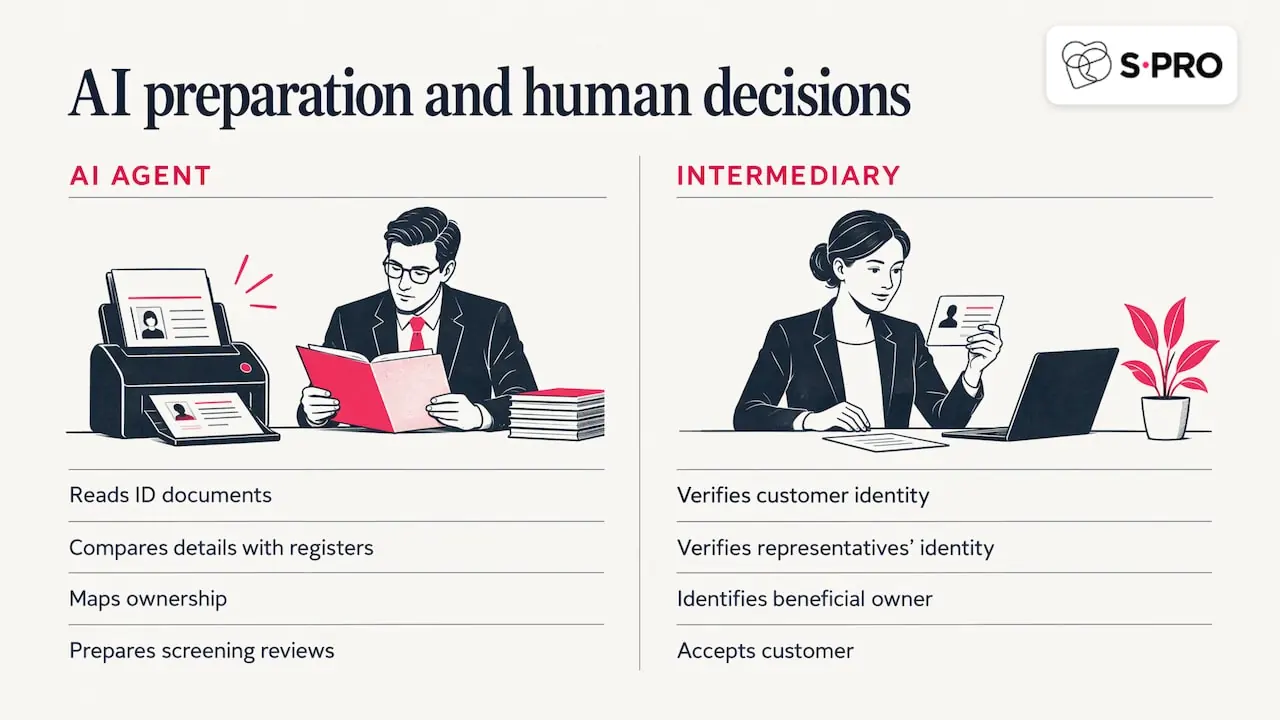
The same Act, in Article 8b, requires advisers to verify identity, identify the beneficial owner, keep records and clarify the background and purpose of a transaction or service where high risks justify it. Records and reasons are the core of the file, which is exactly what an audit trail must preserve.
Tasks that suit an agent
- Document intake: reading identity documents, extracts and corporate documents, and flagging missing or inconsistent fields.
- Ownership mapping: assembling the ownership chain from provided documents and registers, and highlighting gaps for a person to resolve.
- Screening review: collecting adverse-media and sanctions hits, removing obvious name mismatches and summarizing the rest with the source.
- File drafting: writing the first version of the purpose-of-relationship and source-of-wealth narrative from the evidence collected.
- Periodic review: comparing a client file with new information and listing what changed.
Decisions that stay with people
- Accepting, rejecting or exiting a relationship.
- Approving a politically exposed person or any high-risk client.
- Deciding whether an unclear fact is resolved.
- Filing a suspicious activity report.
A working model: agent prepares, officer decides, system logs
The most reliable pattern is a three-column rule for every CDD step: what the agent prepares, what the compliance officer decides and what the system records. The table below applies it to the three levels of depth most Swiss institutions use.
| CDD level | Agent prepares | Compliance officer decides | Logged |
|---|---|---|---|
| Standard due diligence | Extracts identity and entity data, checks completeness, runs screening, drafts the client profile | Confirms identity and beneficial owner, accepts the profile | Documents read, fields extracted, screening hits, the officer’s approval and time |
| Simplified or reduced checks, where your policy allows | Confirms that the conditions for the lower level are met, assembles the evidence | Approves use of the lower level | Which conditions were checked, evidence used, approval |
| Enhanced due diligence for higher-risk clients | Builds the ownership chain, collects adverse media, drafts source-of-wealth narrative with cited sources | Judges plausibility of source of wealth, decides on acceptance, sets monitoring | All sources cited, the draft, the officer’s edits, the decision and the rationale |
| Periodic review | Compares the file with new data, lists changes | Confirms or changes the risk rating | The changes found, the rating decision |
Three design rules follow from the table.
- Every agent output cites its source. A summary without a link to the document or register behind it cannot be reviewed.
- The officer’s edits are kept. The gap between the draft and the final file shows you where the agent is weak and gives a reviewer evidence of real oversight.
- The agent cannot close a case. Approval is a separate, permissioned action by a named person.
The IACA paper makes the same point about oversight: experienced compliance officers should detect and report anomalies in the AI system’s work so the system can learn from proper data.
How agentic AI differs from conventional AML automation
Conventional automation follows a fixed rule on a fixed input, while an agent works through a task in several steps and adapts to what it finds. In CDD that difference matters most for the messy cases.
A rule-based screen flags a name match and stops. A CDD agent can take the hit, open the source, compare date of birth and nationality with the client file, check whether the press item concerns the same person, and write a short note with the evidence. It then hands the case to the officer. Because it uses tools and several steps, its behavior must be bounded: you define which systems it may read, which it may write to and when it must stop and ask.
This is why we design agents with narrow permissions, human checkpoints and complete step logs. A well-bounded agent is more useful to a compliance team than a broad one, because its output can be reviewed in minutes.
Benefits and limits to plan for
The main benefit is analyst time on higher-value judgment. The main risks are explainability, data quality and over-trust in outputs. Plan for them in the design, not afterwards.
The IACA paper describes the weakness of traditional systems as a false-positive rate of around 95%, where most alerts do not correspond to real threats. It argues that AI should target these areas, so human expertise can focus on investigation. That 95% figure comes from older industry studies cited in the paper, so treat it as context for the problem and measure your own alert and review data before setting targets.
On the skills side, a New York City Bar Association report of 11 March 2024 observes that AI and machine learning are more complex than traditional AML tooling. They require skills such as explainability, awareness of model bias and correct use of model outputs, which many compliance teams may not yet have. Build that training into the rollout. Compliance officers who understand what the agent did can challenge it properly.
A short list of controls covers most of the risk:
- Data quality: define the sources the agent may use and monitor their completeness.
- Explainability: require a cited rationale with every proposed outcome.
- Bias and drift: review samples of agent output by customer segment at a regular interval.
- Fallback: keep the manual process available if the agent is unavailable.
- Ownership: assign a named business owner for the agent, as for any model or critical tool.
Swiss and EU rules to design against
The Swiss AML framework was amended recently, and EU AI rules may apply to your AI system. Design the workflow against both from day one.
Swiss AML framework. According to the Swiss Banking Association, the revised AMLA and the related transparency legislation entered into force on 1 October 2026. The association published the Agreement on the Swiss banks’ code of conduct with regard to the exercise of due diligence (CDB 27) on 30 October 2026. It enters into force on 1 January 2027 and replaces CDB 20. If your CDD agent was specified against earlier wording, review its checkpoints against the new text before go-live.
Video and online onboarding. Loyens & Loeff reports that the existing FINMA circular treats video identification as face-to-face onboarding, with decryption of the machine-readable zone and checks of security features, while pure online onboarding counts as non-face-to-face and needs additional checks. FINMA’s proposed revision was in consultation until 27 February 2026. If your agent supports remote identification, confirm the status of the circular with your compliance and legal teams before you fix the design.
Swiss AI regulation. Bär & Karrer reports that Switzerland ratified the Council of Europe’s AI Convention in March 2025 and is preparing an AI bill for consultation, expected by the end of 2026. Follow it, because it may shape how you document AI use.
EU AI Act. If you serve EU clients or run EU operations, the EU AI Act may apply to your AI system. According to the European Commission’s AI Act page, the Act entered into force on 1 August 2024 and applies in stages. Under Regulation (EU) 2026/1744 (the AI Omnibus), in force since 27 July 2026, stand-alone high-risk (Annex III) obligations apply from 2 December 2027. High-risk AI embedded in products (Annex I) applies from 2 August 2028. The general application date of 2 August 2026 is not the date for high-risk obligations. We do not classify your use case here: check Annex III against the use case with your legal team.
From a CDD pilot to production
Start with one workflow, one customer segment and one risk tier, run it beside the manual process, and promote it only when the officers trust the evidence it produces.
A plan that works for a private bank or wealth manager looks like this:
- Pick the workflow. Onboarding of legal-entity clients is usually a good candidate because document volume is high and the ownership chain is slow to assemble by hand.
- Map the controls. List each CDD obligation in the workflow, the existing control and the point where the agent will support it.
- Define the agent’s boundaries. Fix its data sources, read and write permissions and stop conditions.
- Set the review rule. Decide what the officer reviews in each case and what is sampled.
- Run in parallel. Compare the agent’s draft files with manual files and record the differences.
- Document for validation. Prepare the description of the system, its data, its controls and its owner for internal audit and, where relevant, the supervisor.
- Go live in one segment. Extend to other segments only after the review data supports it.
The step that most often fails is the second: teams build the agent first and map controls afterwards, which forces rework. Our AI pilot to production approach starts from the control map for this reason.
If the problem you recognize is a CDD backlog that sits between onboarding and compliance, talk to our engineers about your onboarding workflow.
Fitting AI into the AML systems you already run
An agent should sit around your existing transaction monitoring, screening and case management tools and use them through their interfaces. You keep the system of record, and the agent adds preparation and drafting.
This approach reduces change risk. Your screening engine continues to produce alerts, your case tool continues to hold the file, and your core banking system continues to hold the client data. The agent reads from these, drafts, and writes back only what its permissions allow. The Swiss Banking Association points to customer identification and process automation as the areas banks look at after transaction monitoring, and that sequence fits this integration-first approach.
For the monitoring side of the same program, see our work on AML & transaction monitoring. Sharing the evidence layer between onboarding and monitoring means a risk change found in one process reaches the other.
Our perspective: preparation by agents, accountability by people
We see CDD as the place where AI earns trust in a bank, because the output is a file that a person can read, challenge and sign. The agent’s job is to make that file complete and sourced sooner.
Our position is simple. Keep your AML systems. Put an agent around them that reads documents, assembles the ownership picture and drafts the rationale. Give every step a log and every decision a name.
We build each solution on our own agentic platform, S-PRO Agents, and run it as a service, so the controls we discuss here (permissions, step logs, human checkpoints) are part of the design from the first workflow. Our solutions are designed with EU AI Act, FINMA and DORA requirements in mind, and we work with your compliance and legal teams so the documentation matches your internal model governance.
The measure of success is not how much the agent does. It is how quickly a compliance officer can reach a well-founded decision.
The S-PRO team
Build a CDD agent with an engineering partner
We build AI agents for banks that prepare CDD evidence, with human approval and a full audit trail. Our AI agents for banks work covers the design, integration with your existing systems and operation as a service.
We have delivered 100+ AI projects, 40+ of them agentic AI projects. S-PRO is a Certified partner in the Claude Partner Network, and our team includes Claude-certified engineers and architects, which is relevant if you want a Claude-based CDD assistant. We are ISO 27001 and ISO 27701 certified.
How S-PRO helps banks and financial institutions
S-PRO is an international Swiss-American firm with offices in Zurich and Salt Lake City, and global delivery. Founded in 2014, we have 250+ engineers and R&D centers in Zurich and Łódź.
For AML customer due diligence, we build the solution on S-PRO Agents and run it as a service: KYC onboarding agents for document intake, ownership mapping and file drafting, connected to the AML systems you already have. Human-in-the-loop approval and audit trails are part of the design.
If you want to scope a first workflow, book a discovery call with S-PRO.
FAQ
Can AI replace the compliance officer in customer due diligence?
No. AI prepares evidence and drafts files, but accepting a client, approving a high-risk relationship and filing a report remain decisions for named people. The Swiss AMLA places duties such as identity verification on the financial intermediary. A well-built agent shortens preparation and keeps a log of what the officer reviewed and decided.
Do we need to replace our existing AML systems to use AI agents?
No. An agent can work around your screening, monitoring and case management tools, reading from them and writing back within set permissions. This keeps your system of record intact and limits change risk. Your compliance team keeps the controls it already trusts, while the agent handles document reading, source collection and first drafts of the file.
What should we log for an AI-assisted CDD decision?
Log the documents and sources the agent used, the fields it extracted, the draft it produced, the officer’s edits, the final decision with its reasoning and the time of each step. This lets internal audit and compliance reconstruct the decision later. It also shows where the agent needs correction, which supports ongoing model oversight.
Which EU AI Act dates matter for a CDD agent?
Stand-alone high-risk (Annex III) obligations apply from 2 December 2027, and high-risk AI embedded in products (Annex I) from 2 August 2028, under Regulation (EU) 2026/1744, in force since 27 July 2026. Whether a CDD use case is in scope depends on the use case, so check Annex III against the use case with your legal team.
How do we start a CDD pilot?
Start with one workflow, such as onboarding of legal-entity clients, and map your CDD controls to the agent’s tasks before building. We offer a design thinking pilot from USD 20k, 2–4 weeks, to define scope, controls and architecture. After that, you run the agent beside the manual process and compare results before going live.
Sources
- Artificial Intelligence in Anti-Money Laundering, IACA research paper, February 2026
- Artificial intelligence and Big Data, Swiss Banking Association
- Combating money laundering, Swiss Banking Association
- Federal Act of 10 October 1997 on Combating Money Laundering (AMLA), Fedlex
- Digital onboarding revisited, Loyens & Loeff
- FinTech Laws and Regulations 2026, Switzerland, Bär & Karrer
- Artificial Intelligence and Machine Learning in Financial Services, New York City Bar Association, 11 March 2024
- AI Act regulatory framework, European Commission
Last updated 23 November 2026
Subscribe


Thank you!
Get ready! You will receive handpicked content right to your inbox.