
A Claude implementation partner for a Swiss bank should be judged on evidence you can inspect: the data route it designs, the FINMA outsourcing points it can map to your contract, and the production systems it has run. Membership in the Claude Partner Network is not on that list. Anthropic announced the network on 12 March 2026 and membership is free, so it shows a firm is in the program. It does not show that the firm fits a bank. Below are ten questions, each with the reason, a source and the evidence to request.
Last updated: 2 November 2026
Key Takeaways
- Treat Claude Partner Network membership as a starting fact, not a bank-fit credential. Ask for delivery evidence next to it.
- Ask which data route the partner designs (Anthropic API, Amazon Bedrock or Google Vertex AI) and in which region processing runs, then get that in writing.
- Map the engagement to FINMA’s outsourcing circular 2018/3 and, where it applies to you, circular 2023/1 before the contract is signed.
- Pilots stall more often than they fail. A Swiss study of 24 financial institutions found 40% of AI initiatives still in ideation and feasibility analysis, a further 33% in pilot or PoC, so ask how the partner gets to production.
- Ask for artifacts (diagrams, logs, templates), not claims.
Table of Contents
- What the Claude Partner Network does and does not tell you
- The 10 questions at a glance
- Questions 1 to 4: credentials and data route
- Questions 5 and 6: FINMA outsourcing and operational resilience
- Questions 7 to 10: delivery, pilots and operations
- What the partner types look like
- Our perspective
- Where to read more
- Turn the questions into an RFP
- How S-PRO helps banks and financial institutions
- FAQ
- Sources
What the Claude Partner Network does and does not tell you
The network is Anthropic’s program for firms that help organizations adopt Claude. According to Anthropic’s announcement, joining costs nothing. That is useful for a firm’s access to training and materials. For a bank it is a weak filter, because a free badge cannot separate a team that has run a regulated deployment from one that has not.
So the bank tests the partner itself. The questions below do that in the order a procurement discussion usually runs: credentials, data, regulation, delivery, operations.
The 10 questions at a glance
The table keeps each question next to its reason, its source and the document you can ask for. FINMA “expects” or “recommends” in its circulars; read the exact wording with your legal and compliance teams. Anthropic documentation notes are “per Anthropic docs, 26 Oct 2026” and cover the routes named here only.
| # | Question | Why | Source | Evidence to ask |
|---|---|---|---|---|
| 1 | What does your Claude Partner Network status show, and what else do you offer? | Membership is free, so it is a starting fact, not proof of bank readiness. | Anthropic, 12 Mar 2026 | Delivery references for regulated clients, named certified engineers and their roles on your project |
| 2 | Which route do you design for: Anthropic API, Amazon Bedrock or Google Vertex AI? | The route decides who processes data, under which terms and where. | Anthropic docs, 26 Oct 2026 (routes covered here) | Architecture diagram showing every hop, with the contracting party for each |
| 3 | In which region does inference run, and can it be restricted? | Endpoint choice changes where prompts and outputs are processed. | Anthropic docs, 26 Oct 2026 | Written region configuration and the vendor’s current documentation page |
| 4 | If we use Bedrock in Zurich, what does that mean for Claude? | Our reading: a Zurich Bedrock region offers Global or EU endpoints for Claude, so the Zurich location alone does not settle where inference runs. | Anthropic docs, 26 Oct 2026 (our reading) | Confirmation of the exact endpoint type per model in your design |
| 5 | How do you map the work to FINMA circular 2018/3 (Rz 14, 18.1, 20-21, 26, 33)? | FINMA expects banks to manage outsourced functions, including provider selection, instruction, monitoring and audit access. | FINMA circulars | A table of these margin numbers against contract clauses and your outsourcing inventory |
| 6 | Does circular 2023/1 Rz 79 and Rz 82 apply, and how does your design support it? | Rz 79 does not apply to institutions under Art. 47a-47e CAO; Rz 82 should be checked for the rest. | FINMA circulars | Your own legal reading, plus the partner’s view of how the design fits |
| 7 | How do you handle audit trails and human oversight? | Reviewers and supervisors need to reconstruct what an agent did and who approved it. | SFTI-OST study, 29 Oct 2025 | Sample log schema, approval flow and named accountable owners |
| 8 | Which parts of the EU AI Act apply to the system you build? | Swiss banks serving EU clients or markets should check this. | European Commission AI Act page | An Annex III check against the use case, written down |
| 9 | How do you move from pilot to production? | Many pilots never scale. | SFTI-OST study, 29 Oct 2025 | Pilot exit criteria, monitoring plan, model cards and a handover or run model |
| 10 | Who runs it after go-live, and how do we exit? | Outsourcing guidance centers on control and a workable exit. | FINMA circulars | Exit plan, run-book and support model in the contract |
Questions 1 to 4: credentials and data route
Start with credentials, but ask for more than a logo. A partner can show named engineers who hold Claude certifications, the projects those engineers worked on and the roles they would play on yours. Ask who sits in your team and who sits in a bench.
Then move to the data route, because it drives everything after it. Claude is available through Anthropic’s own API and through the cloud platforms Amazon Bedrock and Google Vertex AI. Anthropic’s documentation, as read on 26 October 2026 for the routes covered here, describes endpoint and region options per platform. Each route changes the contracting parties, the terms and the region.
Our reading of that documentation is that Zurich on Bedrock means Global or EU endpoints for Claude models, not a Switzerland-only processing guarantee. That is why we advise asking the question in precise terms: which endpoint type, which model, which region, confirmed against the current documentation at signing. Avoid accepting a general statement about where data lives. A bank needs a configuration it can show an auditor.
A public case study from Anthropic about a Swiss private bank gives a useful picture of what such controls look like in practice. According to that case, the bank’s risk, information-security and data-protection teams were involved, its AI policy built on its existing risk framework, business use cases had EU or Switzerland processing limits, and data did not persist for model training. Those are the kinds of facts to ask any partner to document for you.
Questions 5 and 6: FINMA outsourcing and operational resilience
FINMA’s outsourcing circular 2018/3 is the main reference when a bank brings in an external provider for a function. The margin numbers worth working through are Rz 14, 18.1, 20-21, 26 and 33. We recommend a simple exercise: put each margin number in a row, write the contract clause or design feature that answers it, and mark any gap. Ask the partner to prepare the first draft of that table, and have legal and compliance review it. The partner supports the mapping; the bank owns the conclusion.
For circular 2023/1, Rz 79 is not for institutions under Art. 47a-47e CAO, so check whether you are one before the partner spends time on it. Rz 82 deserves a look by everyone else. Avoid any partner that describes its offering as “FINMA-compliant”. Compliance is a property of how your bank operates and documents the service, not a label a vendor can hand over.
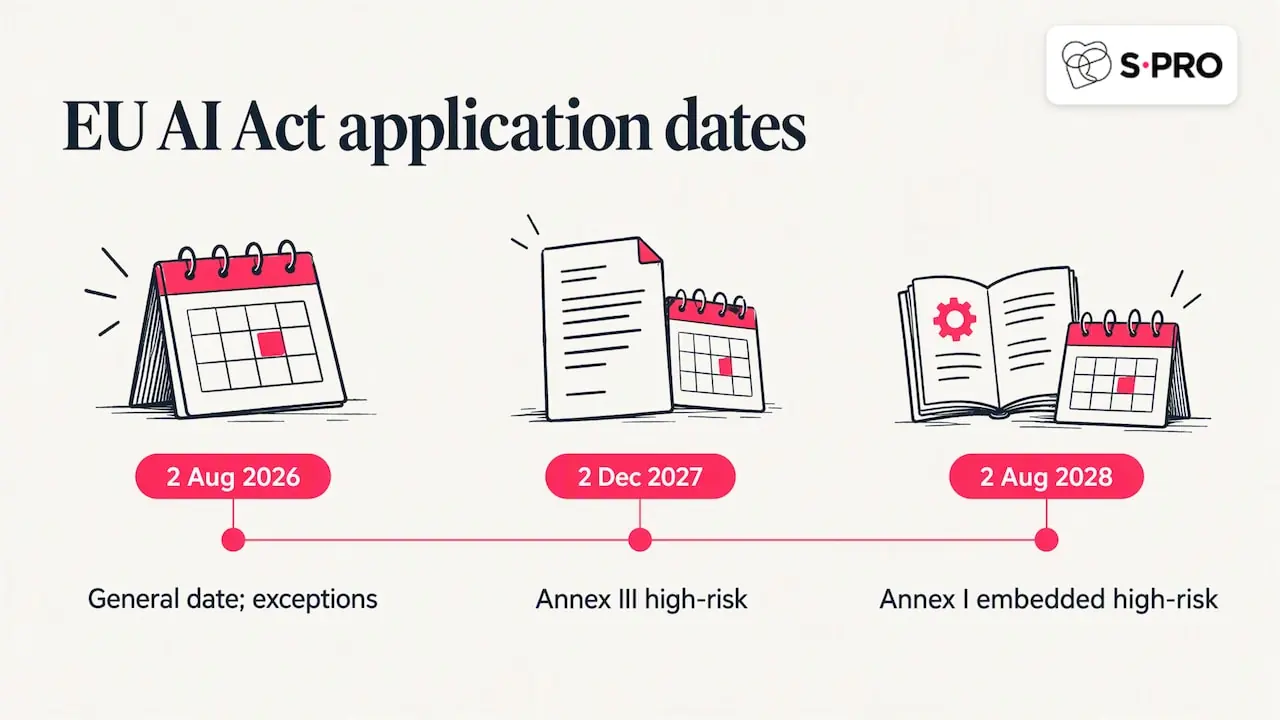
The EU AI Act matters if your bank has EU clients or EU group entities. Under Regulation (EU) 2026/1744 (AI Omnibus), in force 27 July 2026, stand-alone high-risk (Annex III) obligations apply from 2 December 2027, and high-risk AI embedded in products (Annex I) applies from 2 August 2028, as set out on the Commission’s AI Act page. The general application date, 2 August 2026, has exceptions and is not the date for high-risk obligations. Whether a given use case falls into Annex III is not something we settle here: check Annex III against the use case, with counsel.
Questions 7 to 10: delivery, pilots and operations
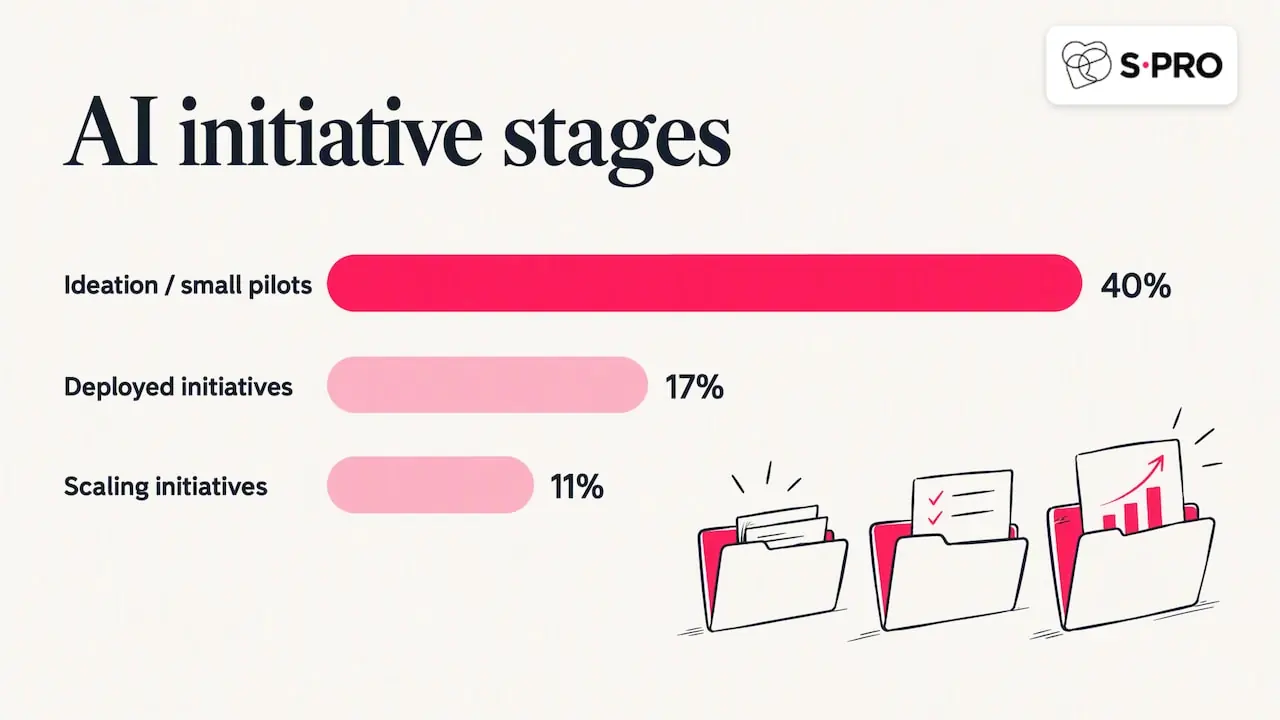
The SFTI-OST study, released 29 October 2025, is the best Swiss data point on why this matters. Of 24 financial institutions surveyed, 40% of AI initiatives sat in ideation and feasibility analysis and a further 33% in pilot or PoC, 17% were deployed and 11% were scaling. Where AI reached production, 65% of cases met or exceeded expectations. Barriers named include privacy, security and data quality, regulatory uncertainty, weak business cases, legacy dependencies and technical limits. Hosting and cybersecurity each counted for 17% of vendor-selection criteria, and data sovereignty for 15%.
The same study recommends deployable architecture, governance and observability at proof-of-concept sign-off, reproducible pipelines, automated monitoring, standardized model cards, policy-by-design and accountable owners. Turn that list into a checklist for your partner:
- Do pilot exit criteria exist before the pilot starts?
- Is monitoring part of the pilot scope, or added later?
- Who is the named owner of each agent in production?
- How are model changes tested before release?
- What does a human reviewer see, and what can they overrule?
Integration is the next test. A partner should name the systems it has connected Claude to and the method. In the Swiss private bank case, the partner trained staff on MCP integrations, and business data passed through a purpose-built API gateway; the case names no core-banking or wealth-management system. Expect your partner to be more specific about yours.
What the partner types look like
Banks usually choose between four types of partner, and each fits a different job.
| Type | Strong at | Ask especially about |
|---|---|---|
| Global consultancy | Program management, change across large organizations | Who actually builds, and how much of the team is local |
| Training and enablement specialist | Upskilling developers and business teams on Claude | What happens after the workshops, and who runs production |
| Cloud reseller or platform integrator | Procurement and infrastructure on one cloud | Model-level design, audit trails and human oversight |
| Specialist engineering firm for financial institutions | Build, integration with core systems, running the solution | Delivery references and regulated-industry experience |
An enablement example shows the difference. In the Swiss private bank case, the partner delivered 25 workshops, trained more than 500 people, and about 700 people had access to Claude Code and Claude Cowork. That is valuable for developer capability. It is a different job from building and operating a client-facing agent in a regulated process, and a bank should know which job it is buying.
Our perspective
We think the strongest signal in a partner search is the first production system, not the first slide. Banks can often get a convincing demo quickly. What takes work is the audit trail, the human review step, the data route and the run model, and these decide whether a use case survives a risk committee.
That is why we build solutions on our own agentic platform, S-PRO Agents, and run them as a service. A bank gets one accountable team for build and operations, and the controls described in the questions above are designed in from the start, with FINMA outsourcing expectations and the EU AI Act in mind.
Use the table in this article on us as well. A partner worth hiring welcomes the questions.
The S-PRO team
Where to read more
If you are comparing how the Claude Partner Network is organized, our page on Claude Partner Network levels for banks covers what a bank can reasonably infer from them. For the services behind this article, see our page on the Claude implementation partner for financial services.
Turn the questions into an RFP
If you are preparing a vendor shortlist, send the ten questions above as the core of your RFP and score each answer on the evidence supplied, not on the confidence of the reply. Our team can walk through your use case, data route and FINMA mapping with you; start from our Claude for financial services page.
How S-PRO helps banks and financial institutions
S-PRO is a Certified partner in the Claude Partner Network. We are a Swiss international firm headquartered in Zurich, founded in 2014, with 250+ engineers, and we are ISO 27001 and ISO 27701 certified. Our team includes Claude-certified engineers and architects.
We work with banks, wealth managers, asset managers and fintechs on Claude for financial services, AI pilot to production, AI agents for banks and core & legacy modernization. We build each solution on our agentic platform, S-PRO Agents, and run it as a service. You can bring the ten questions to us; we will answer them with documents.
FAQ
Is Claude Partner Network membership enough to choose a partner?
No. Membership is free, so it shows that a firm joined the program, not that it can deliver in a regulated bank. Ask for delivery references, named engineers and the artifacts in the table above.
Where is data processed when a bank uses Claude?
That depends on the route and the endpoint: Anthropic API, Amazon Bedrock or Google Vertex AI. Per Anthropic docs of 26 October 2026, region options differ by platform, so get the exact configuration in writing and check it against the current documentation.
Does FINMA require a specific approach for Claude?
FINMA’s circulars do not name Claude. Circular 2018/3 on outsourcing expects banks to manage outsourced functions, and circular 2023/1 covers operational risks and resilience. Your legal and compliance teams decide how they apply to your case.
When do EU AI Act high-risk obligations apply?
Under Regulation (EU) 2026/1744, stand-alone high-risk (Annex III) obligations apply from 2 December 2027, and high-risk AI embedded in products (Annex I) from 2 August 2028, per the Commission’s AI Act page. Check Annex III against the use case.
Sources
Subscribe


Thank you!
Get ready! You will receive handpicked content right to your inbox.