


Customer onboarding in banking is the process that turns an applicant into an active, verified customer: collecting data, identifying the person or company, running AML and KYC checks, opening the account and getting the client to a first meaningful transaction. In 2026 the hard part is no longer putting a form online. It is building a flow that satisfies FINMA and EU rules, stays fast for low-risk clients, and keeps working when the rules change.
This guide is written for CTOs, CIOs and heads of digital at banks and wealth managers. It covers what the process contains, what Swiss and EU regulators expect, where architecture decisions matter, and how to measure whether onboarding actually works.
TL;DR
- Onboarding is a lifecycle, not a form: the data captured on day one feeds KYC refreshes, product offers and service for years.
- In the EU, the EBA guidelines on remote customer onboarding set the benchmark. In Switzerland, FINMA Circular 2016/7 governs video and online identification; the revised version applies from 1 November 2026.
- A hybrid model works best: automated identification for the mass market, human-assisted checks for complex corporate and high-net-worth cases.
- Build the regulatory logic as configurable rules, not hard-coded steps, so a circular change does not force a rebuild.
- Measure drop-off, time to first transaction and customer sentiment during the journey, not only the number of accounts opened.
Table of Contents
- What customer onboarding in banking includes
- Why onboarding is a business problem, not only a compliance task
- The regulatory frame: Switzerland and the EU
- Identification methods compared
- A reference onboarding flow, step by step
- Architecture choices that decide whether it scales
- Listening to customers during onboarding
- Common mistakes
- Our perspective: onboarding is where architecture shows
- How S-PRO can help
- FAQ
- Sources
What customer onboarding in banking includes
The search results for this topic mostly define onboarding the same way: the steps between a prospect’s first interest and a fully active account. In practice a bank’s onboarding journey has six building blocks.
- Data capture. Personal or company data, tax residency, purpose of the relationship, expected transaction volumes.
- Identification. Verifying that the person is who they claim to be, in a branch, by video, or online with document and biometric checks.
- KYC and AML screening. Sanctions, politically exposed persons (PEP), adverse media, beneficial owner identification for legal entities, and a risk classification.
- Contracting. Terms, disclosures and signatures, increasingly with electronic signatures.
- Account set-up. Account opening in the core banking system, card and online banking provisioning.
- Activation. The first deposit, first payment, first login to the app. This is where many banks lose clients who passed every compliance check.
Our own overview of KYC requirements for banks goes deeper into the compliance blocks. Here we focus on how the whole journey fits together.
Why onboarding is a business problem, not only a compliance task
A widely cited banking onboarding playbook argues that onboarding is a pivotal point in the customer journey and still a major source of friction at many institutions. Its authors describe a shift from treating onboarding as a necessary compliance burden to using it as a differentiator, with a “living profile” of the customer that serves later processes.
For a bank, that view has three concrete consequences:
- Abandonment is a revenue leak. Every applicant who quits at the document upload step had already decided to choose you. Acquisition spend is gone and no account is opened.
- Poor data quality compounds. If onboarding data is keyed twice, or sits in a PDF, every later KYC refresh, product offer and audit request has to repair it.
- The first 30 days shape loyalty. A client who needs three weeks and two phone calls to start using an account is a weak candidate for a second product. See our thoughts on building customer loyalty in digital banking.
The regulatory frame: Switzerland and the EU
An onboarding flow is only as good as its compliance basis. Two frameworks matter most for institutions operating across Switzerland and Europe.
EU: the EBA remote onboarding guidelines
The EBA Guidelines on the use of Remote Customer Onboarding Solutions (EBA/GL/2022/15) are the common benchmark across the EU. According to the guidelines themselves, remote identification has to be as secure as in-person identification, and identity-proofing solutions must reach “substantial” or “high” assurance levels under eIDAS or rely on qualified trust services. Biometric capture, liveness detection and secure, time-stamped storage are part of the expectation.
For a Swiss bank with EU clients or an EU subsidiary, that means your onboarding stack may need to satisfy two rule sets at once.
Switzerland: FINMA Circular 2016/7 revised, in force from 1 November 2026
In Switzerland, FINMA Circular 2016/7 on video and online identification defines how institutions may onboard clients without physical presence. FINMA consulted on a partial revision from 16 December 2025 to 27 February 2026, adopted the revised circular on 23 September 2026, and the amendments enter into force on 1 November 2026. A transitional period of one year from entry into force applies to the place-of-residence verification and liveness detection processes for online identification with qualified electronic signatures. The consultation draft took into account the Federal Act on Electronic Identity Credentials, which would give the Swiss e-ID the status of an identity document.
Law firm commentary on the draft points to two developments: the shift toward remote application of rules for qualified electronic signatures, and the arrival of the governmental e-ID. The same analysis notes that the consultation draft proposed an additional address verification requirement that goes beyond international practice and may break the digital flow unless geolocation proves workable. Check how the final text treats this point.
The practical lesson is not about one circular. It is that definitions inside an onboarding journey move. A flow in which “QES equals face-to-face equivalent” is wired into the code will need emergency re-engineering when that classification changes. Check the final circular, in force from 1 November 2026, against your own flow with your compliance and legal teams before you freeze a design.
For the wider picture, see our summary of digital banking regulatory compliance and our page on security and compliance for financial institutions.
Identification methods compared
No single method suits every client segment. This table compares the main options on criteria that matter to an architect and a head of compliance.
| Method | Speed for the client | Assurance level | Typical fit | Main watch-out |
|---|---|---|---|---|
| Branch or in-person | Slow | High | Private banking, complex structures | Cost per client, geographic reach |
| Video identification with an agent | Medium | High when done per circular | High-net-worth, corporate | Agent capacity, scheduling |
| Automated online identification (document, selfie, liveness) | Fast | Depends on solution and risk class | Retail, mass market | Deepfakes, document fraud, edge cases |
| Electronic identity (such as the planned Swiss e-ID) | Very fast | High, once available and recognized | Retail and SME | Regulatory acceptance, address checks |
| Qualified electronic signature based | Fast | High for signing, identification rules in flux | Contracting step | Reclassification under revised rules |
Industry providers of certified identification in Switzerland describe a hybrid approach: automated checks for the mass market and human-assisted remote identification for complex or high-risk profiles, which balances speed against the verification FINMA and the EBA expect. That principle is a sound basis for design. The routing decision, which client goes down which path, should be a rule your compliance team owns, not a developer.
A reference onboarding flow, step by step
Below is a reference flow to start from when designing onboarding for a bank. It is deliberately modular, so each step can be swapped without breaking the next.
- Entry and pre-qualification. Short questions on client type, residency and product interest. This decides the risk path early and avoids asking a corporate client for retail documents.
- Consent and data minimization. Explain what you collect and why. Ask only for what the risk class requires.
- Identification path selection. Rules route the applicant to automated, e-ID, video or branch identification.
- Document and biometric verification. Authenticity checks, liveness detection, and data extraction written straight into structured fields.
- Screening and risk scoring. Sanctions, PEP and adverse media checks run in parallel, not one after another. The output is a risk class and a decision: auto-approve, manual review or reject.
- Manual review with context. The analyst sees the full case, the evidence and the reason it was flagged, instead of a bare alert.
- Contracting and signature. The signature type is a configurable parameter, since signature classification can change.
- Core banking provisioning. Customer record, account, cards and digital access created through APIs, with no re-keying.
- Activation journey. Guided first login, first payment and first funding, with nudges tied to what the client has not yet done.
- Living profile. Onboarding data becomes the base of an ongoing customer record, refreshed on events rather than only on calendar dates.
The weak points in most banks are steps 4 to 6 (manual rework) and step 8 (integration with a core system that was never designed for real-time account opening). That is why onboarding projects are often legacy modernization projects in disguise.
Architecture choices that decide whether it scales
Keep regulatory logic configurable
Separate the rules engine from the user interface and from integrations. Identification methods, signature types, address verification requirements and risk thresholds should be parameters with version history. When FINMA or the EBA changes a requirement, you change a rule, test it and release, rather than reopening the codebase.
Integrate with the core through an orchestration layer
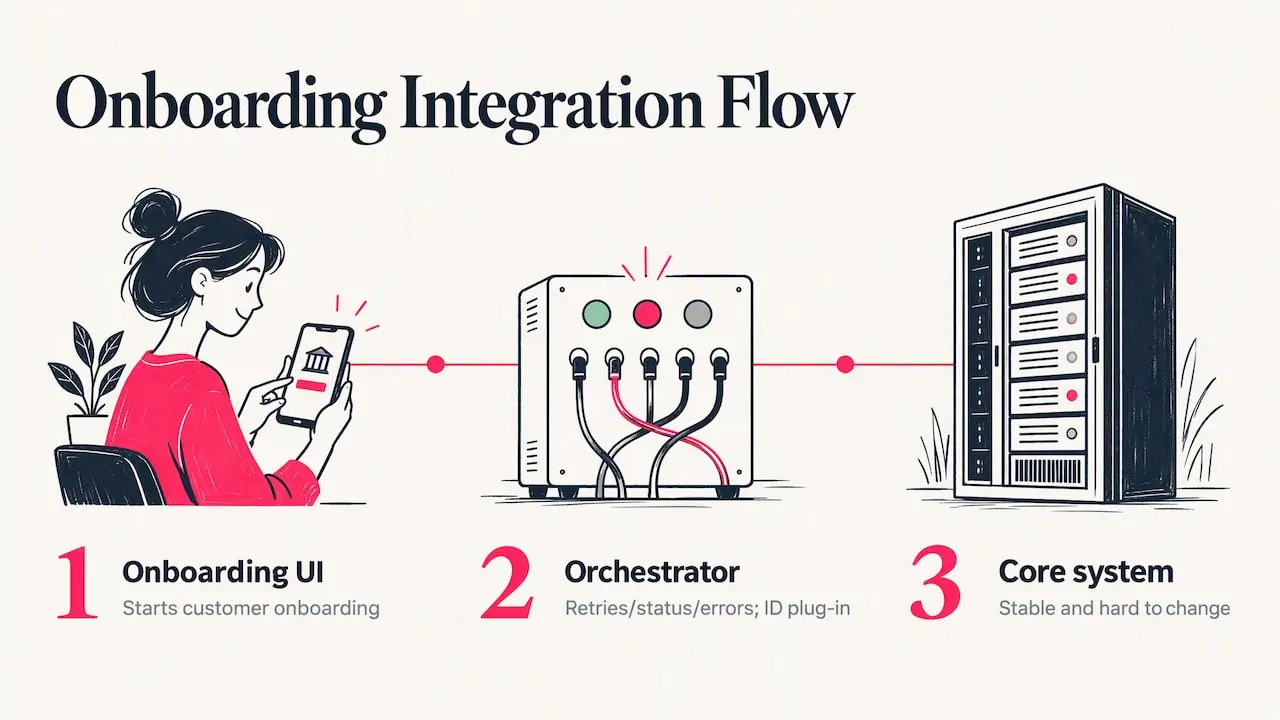
Most Swiss and European banks run a core system that is stable and hard to change. An orchestration layer sits between the onboarding front end and the core, handling retries, status tracking and error cases. It also lets you add a new identification provider without touching the core.
Plan for AI where it removes manual work
The best use of AI in onboarding is rarely the front door. It is the back office: extracting structured data from corporate documents, summarizing adverse media hits for analysts, and drafting the case file for a reviewer. Humans keep the decision for borderline and high-risk cases. If you are weighing this, our pages on KYC onboarding AI agents for banks, AI agent development and AI services describe how we approach it for financial institutions.
Build the first version small
A full onboarding platform is a large program. A narrow first release, for example one client segment and one product, validates assumptions with real applicants. Our guide to MVP in banking explains how to scope this, and the financial product life cycle article covers what comes after launch.
Listening to customers during onboarding
Two of the related queries readers type concern social listening and customer sentiment analysis. They belong in an onboarding discussion because onboarding friction is often visible in public before it shows up in your funnel report.
Industry commentary describes social listening in banking as having moved from brand monitoring toward regulatory and business intelligence: analyzing unstructured data from social platforms to spot emerging consumer protection issues, PR crises and even unauthorized entities acting in the market. For onboarding, that gives you an early signal when a verification step fails for a particular phone model, or when applicants complain about waiting times.
A data analytics vendor makes a related point: the most sophisticated banks link social interactions to transactional data after identifying the customer, which turns reactive monitoring into proactive customer journey management. In a Swiss setting, that linkage needs a clear legal basis and consent, so involve your data protection officer before you connect any external channel to customer records.
What to track in practice:
- Completion rate per step, split by device and identification path.
- Time from application start to account approval, and from approval to first transaction.
- Reasons for manual review, ranked by volume. The top reason is usually your next automation target.
- Sentiment from support tickets, app reviews and survey comments, tagged to the onboarding step they mention.
- Share of applicants who pass checks but never activate.
Our customer experience trends for fintech article shows how banks use this kind of analysis in product decisions.
Common mistakes
- Digitizing the paper form. Moving the same twenty fields online without questioning them keeps the friction and adds mobile usability problems.
- Treating every client alike. A sole proprietor and a trust structure with four beneficial owners need different paths.
- Hard-coding compliance. Each circular revision becomes a project.
- Ignoring the manual queue. A fast front end feeding a slow review team gives customers the same waiting time as before.
- Stopping at account opening. Without activation measures, you pay for applicants who never become active clients.
- Buying components without an integration plan. Identification, screening and signature tools each work. The cost sits in the glue between them and your core.
Our perspective: onboarding is where architecture shows
A common pattern is that the visible onboarding screen is rarely the bottleneck. The bottleneck is a core system that cannot create an account in real time, a screening process that returns unstructured alerts, or a rule set buried in application code that nobody dares to touch.
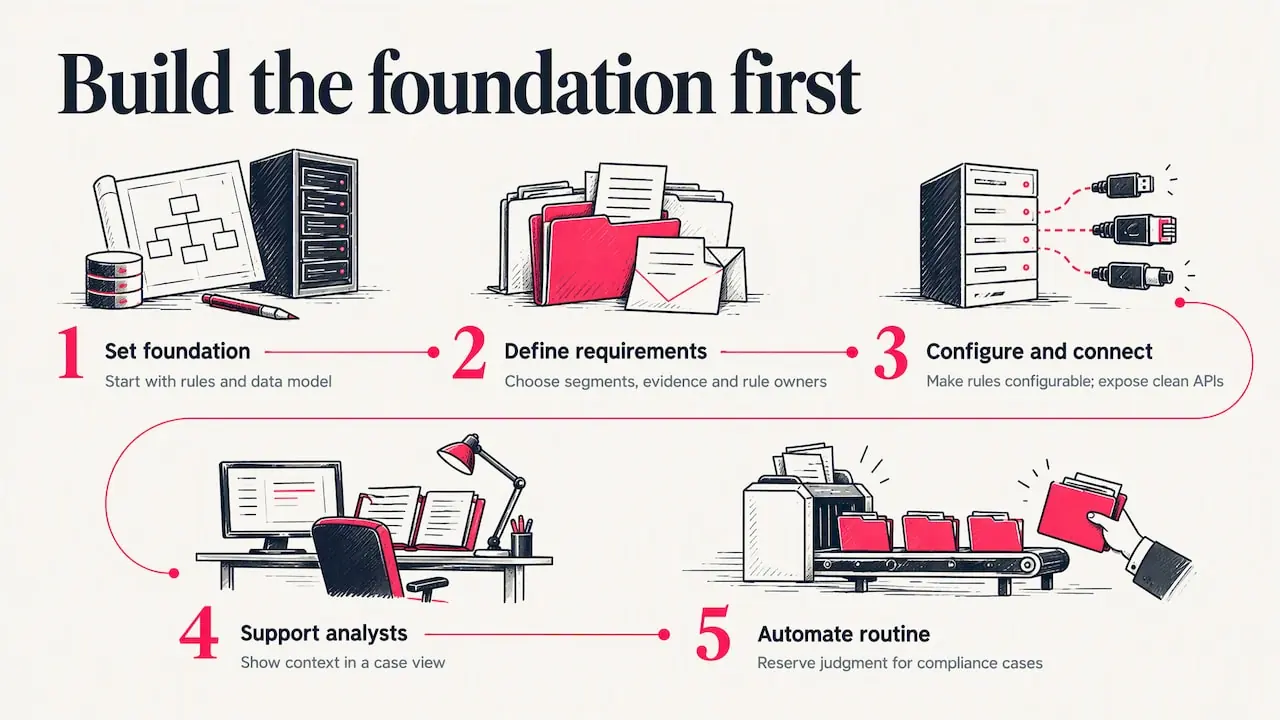
Our view is that you should start with the rules and the data model, then build the screens. Decide which client segments you serve, what evidence each risk class requires, and who owns each rule. Then make those rules configurable, expose clean APIs to your core, and give analysts a case view that shows context. The interface becomes comparatively simple once the foundation is clear.
A hybrid model is the sensible default. Automation should handle the routine and give the compliance team time for the cases that need judgment. In a market where FINMA’s expectations on identification and signatures are still moving, the ability to change a rule quickly is worth more than a feature list.
— Igor
How S-PRO can help
S-PRO is a Zurich-based fintech software development company. For onboarding programs we can support you with digital banking platform development, integration with existing banking infrastructure, AI agents for compliance and operations work, and technology consulting to define the target architecture and roadmap. If you want a defined first step, tell us your client segments and your core banking landscape through our contact page, and we will outline a scope together.
FAQ
What is customer onboarding in banking?
It is the process of verifying a new client, assessing their risk, opening the account and helping them start using it. It covers identification, KYC and AML checks, contracting and activation. Modern approaches treat it as the start of an ongoing customer relationship rather than a one-time event.
Is fully digital onboarding allowed in Switzerland?
Yes, within the limits of FINMA Circular 2016/7 on video and online identification, which defines how institutions may onboard clients without physical presence. The circular was partially revised: FINMA adopted the new version on 23 September 2026 and it applies from 1 November 2026. Confirm the current version with your compliance team before you design a flow.
What do EU banks have to consider for remote onboarding?
The EBA guidelines on remote customer onboarding solutions require that remote identification is as secure as in-person identification. They also expect solutions that meet substantial or high assurance levels under eIDAS or rely on qualified trust services. Biometric checks with liveness detection and secure, time-stamped storage are part of that picture.
Should a bank automate onboarding completely?
Not for every client. Automation fits low-risk retail cases well, while complex corporate structures and high-net-worth clients usually benefit from human-assisted identification and review. A rules-based routing layer lets you apply the right path to each profile.
How do you measure whether onboarding works?
Look beyond accounts opened. Track completion by step, time to approval, time to first transaction, manual review rate and the share of approved clients who never activate. Add sentiment from support and reviews, tagged by onboarding step, to see why people drop out.
Sources
- EBA Guidelines on the use of Remote Customer Onboarding Solutions
- FINMA Circular 2016/7 “Video and online identification”, revised version of 23 September 2026
- FINMA: consultation on partially revised Circular 2016/7
- Digital Onboarding Revisited: FINMA proposes amendments (Mondaq)
- Onboarding Is the Foundation of Digital Transformation (banking onboarding playbook)
- Certified online identification and hybrid approach (fidentity)
- Market monitoring and social listening (CGAP)
- From Tweets To Trust (Teradata)
Recommended
Subscribe


Thank you!
Get ready! You will receive handpicked content right to your inbox.