

The Digital Omnibus on AI, Regulation (EU) 2026/1744, moves the high-risk obligations of the EU AI Act to 2 December 2027 for stand-alone (Annex III) systems and to 2 August 2028 for AI embedded in products (Annex I). A bank that wants AI agents or RM copilots in production needs an engineering partner who builds to that timeline today, and S-PRO builds AI agents for banks with these dates in view.
The delay gives you time, but not a reason to wait. Governance, logging, human oversight and documentation take longer to build than the model itself, and the dates below are the planning frame for that work.
Key Takeaways
- Regulation (EU) 2026/1744 has been in force since 27 July 2026. It sets 2 December 2027 for Annex III high-risk obligations and 2 August 2028 for Annex I product-embedded systems.
- The general application date of the AI Act, 2 August 2026, was not moved. Only the high-risk obligations were deferred.
- Whether an AI agent is high-risk depends on the use case: check Annex III against the use case before you fix a build plan.
- The extra time is best spent on audit trails, human-in-the-loop design and documentation, so a pilot can move to production without a rebuild.
- Swiss institutions should confirm with legal counsel how the EU rules reach them, and should treat FINMA expectations as a separate, parallel track.
Table of Contents
- The post-Omnibus timeline: which dates apply
- What the delay does not change
- Use cases to check against Annex III
- A build plan that works with the extra time
- What this means for Swiss private banks and wealth managers
- Why a staged approach beats waiting for 2027
- Promo: AI agents built for regulated workflows
- How S-PRO helps banks and financial institutions
- FAQ
- Sources
The post-Omnibus timeline: which dates apply
The dates that matter are 2 December 2027 for Annex III high-risk systems and 2 August 2028 for Annex I systems. Both come from Regulation (EU) 2026/1744 on EUR-Lex, which has been in force since 27 July 2026 and replaces the original 2 August 2026 and 2 August 2027 dates for these obligations.
The European Commission’s AI Act page gives the same picture from the Commission’s side. The table sets out the sequence.
| Date | What applies | Source |
|---|---|---|
| 1 August 2024 | AI Act enters into force | European Commission |
| 2 February 2025 | Prohibited practices and AI literacy | European Commission |
| 2 August 2025 | Governance rules and general-purpose AI model obligations | European Commission |
| 2 August 2026 | General application date, with exceptions | European Commission |
| 2 December 2027 | High-risk obligations for stand-alone systems (Article 6(2), Annex III) | Regulation (EU) 2026/1744 |
| 2 August 2028 | High-risk obligations for AI embedded in products (Article 6(1), Annex I) | Regulation (EU) 2026/1744 |
Two points are easy to get wrong. First, 2 August 2026 is the general application date, not the date for high-risk obligations. Second, the Omnibus moved only the high-risk requirements (Chapter III, Sections 1 to 3), not the whole Act.
Why the dates moved
The recitals of the regulation, published in the Official Journal text, tie the delay to the late availability of standards, common specifications and guidance, and to the late set-up of national competent authorities. They also state that the Commission commits to having support measures in place in due time. For a bank, the practical reading is that the technical yardsticks for high-risk systems are still being finished, so design choices made now should be flexible enough to absorb them.
The Council of the EU timeline also records that the Council gave final approval to the simplification regulation and that the national AI regulatory sandbox deadline moved to 2 December 2027.
What the delay does not change
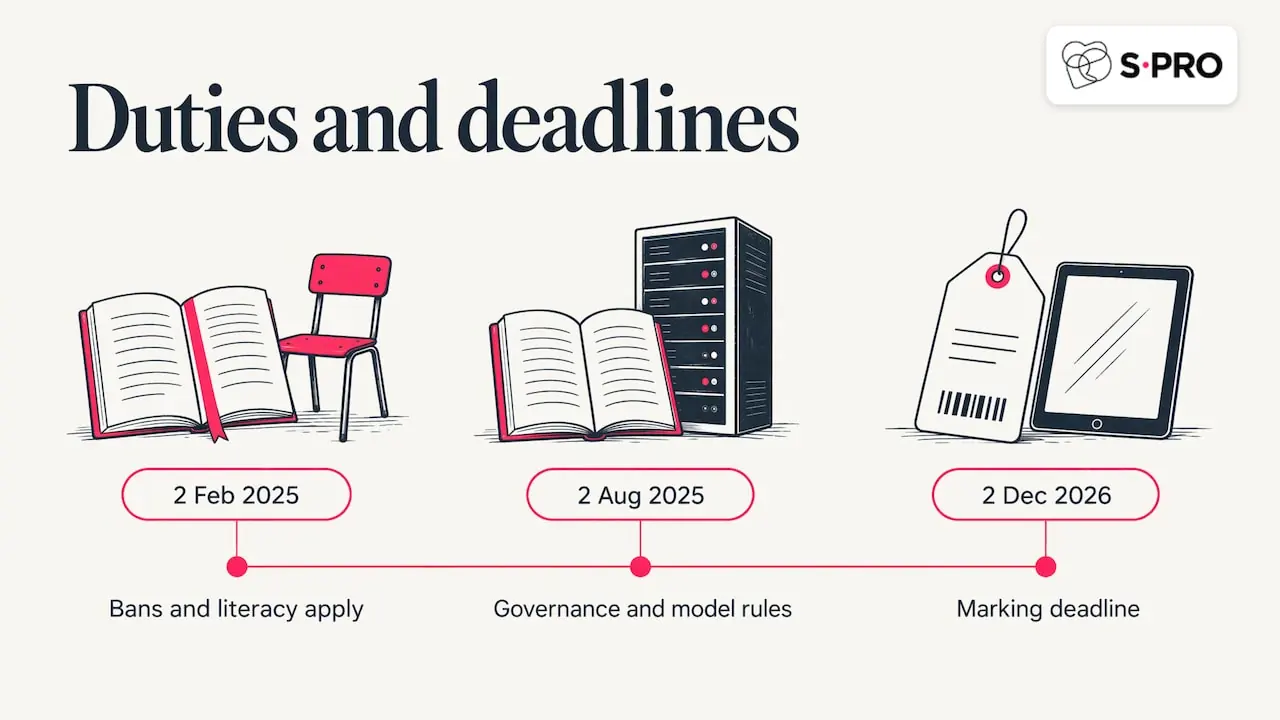
The prohibitions, AI literacy duties, governance rules and general-purpose AI model rules continue on their own schedule, and so does the general application date. According to the Commission’s AI Act page, prohibited practices and AI literacy have applied since 2 February 2025, and governance and general-purpose AI model rules since 2 August 2025.
For teams running copilots built on a third-party foundation model, that matters in two ways. Staff who use or oversee AI systems need the literacy the Act asks for, and the model provider’s obligations sit alongside your own as the deployer.
Transparency duties were also not delayed. The text of Regulation (EU) 2026/1744 provides only a transitional marking deadline of 2 December 2026 for generative systems that were already on the market before 2 August 2026. A client-facing assistant that produces text or images should have its disclosure and marking design settled well before then.
Use cases to check against Annex III
Whether a bank’s AI agent is high-risk is decided use case by use case, so the right step is to check Annex III against the use case, with legal counsel, before you commit to a build scope. The table lists four common bank use cases and the question to ask of each. It does not classify any of them.
| Use case | Where it sits in the bank | What to do |
|---|---|---|
| Customer chatbot | Client service, advisory support | Check Annex III against the use case; review transparency duties for AI that talks to people |
| KYC document agent | Onboarding, periodic review | Check Annex III against the use case; define what the agent prepares and what a compliance officer decides |
| Credit-scoring tool | Lending, mortgage and Lombard credit | Check Annex III against the use case; note which customers (natural persons or companies) the tool assesses |
| Fraud model | Transaction monitoring, payments | Check Annex III against the use case; document the purpose and the model’s role in alert decisions |
One detail from the official side helps with credit tools. The EU AI Act Service Desk explains on its horizontal issues page that assessing the creditworthiness of companies from balance sheets and financial statements is not the Annex III 5(b) use case, which targets natural persons. Your own scope decision still needs a documented legal assessment.
A build plan that works with the extra time
Use the delay to build the controls a high-risk system would need, whichever way your use case is assessed. The sequence below keeps a pilot from being rebuilt later.
- Inventory every AI use case. List each agent, copilot and model in use or planned, with its owner, its data and the decision it informs.
- Check Annex III against each use case. Record the assessment and the reasoning with legal counsel, and revisit it when the use case changes.
- Define the human role. For each agent, state what it prepares, what a person approves and how the person can override it.
- Design the audit trail first. Log inputs, sources, outputs, versions and approvals so that a reviewer can reconstruct any result.
- Plan the data location. Decide where data is hosted and which model endpoints are reached, in line with your FADP and FINMA obligations.
- Write the documentation as you build. Technical documentation, risk notes and test results are cheaper to keep current than to reconstruct.
- Set exit criteria for the pilot. Agree accuracy, review effort and control targets before the pilot starts, so production is a decision rather than a debate.
Steps 3 to 6 are where pilots usually stall, because they are engineering work, not model work. That is the reason to treat them as part of the first sprint.
Talk to our engineers about your AI agent plan
What this means for Swiss private banks and wealth managers
For a Swiss institution, the EU timeline is one frame among several: you should confirm with legal counsel whether and how the EU AI Act reaches your business, and plan for FINMA and data protection requirements in parallel. The Omnibus changes EU dates, not Swiss supervisory expectations.
In practice, the use cases private banks and independent wealth managers raise most often are:
- RM copilots that prepare meeting briefs, summarize client history and draft follow-ups.
- KYC and onboarding agents that read identity and source-of-wealth documents and assemble the file for review.
- Reporting agents that draft periodic client reports for relationship manager review.
Each one can be designed with a person in the loop and a complete log. Where a copilot supports advisory conversations, the checks in the table above apply: assess the use case, decide the human role, and keep the record.
For banks, the same plan carries over to alert triage and screening work. A pilot that fits next to an existing AML system, rather than replacing it, keeps the control environment you already have.
Why a staged approach beats waiting for 2027
The extra year does not shorten the work, and starting now lets you shape a system with the final rules in mind. Standards and guidance are still arriving, as the recitals of the regulation note, so a modular design lets you adapt the controls without changing the agent’s core.
Three choices reduce the risk of rework:
- Separate the agent logic from the model. If the model or its version changes, the workflow, logging and approvals stay in place.
- Keep the human step explicit. A reviewer’s decision recorded in the log is evidence of oversight, and it is easier to add at the start than at the end.
- Integrate with core systems early. An agent that works only in a sandbox tells you little about production behavior.
This is the case for taking an AI agent from pilot to production as a single engineering program, with AI agents for banks designed around the controls from the first sprint.
Promo: AI agents built for regulated workflows
If you are choosing a partner, look for one that builds AI agents for banks and takes them from pilot to production inside a regulated environment. S-PRO is an international Swiss-American firm with offices in Zurich and Salt Lake City, and global delivery, founded in 2014, with 250+ engineers and ISO 27001 and ISO 27701 certification. Our solutions are designed with EU AI Act, FINMA and DORA requirements in mind.
S-PRO has delivered 100+ AI projects, 40+ of them agentic AI projects. You can see how we approach AI agents for banks on our service page.
Our view: build the controls before the deadline asks for them
We see the Omnibus as a change of schedule, not of direction. The obligations for high-risk systems are deferred, while the expectation that a bank can explain what its AI did, who approved it and on what data is already part of how supervisors and boards think.
That is why we start an agent engagement with the audit trail and the human-in-the-loop design, then add the model and the workflow. An agent built this way is easier to assess against Annex III, easier to document and easier to move from pilot to production.
We also believe the extra time favors institutions that use it to put one well-controlled agent into production, rather than running several pilots that never leave the lab. Our team includes Claude-certified engineers and architects, and S-PRO is a Certified partner in the Claude Partner Network, so a Claude-based solution is one of the options we can build and run with you.
The S-PRO team
How S-PRO helps banks and financial institutions
S-PRO builds AI agents for banks, wealth managers and fintechs on its own agentic platform, S-PRO Agents, and runs the solution as a service. Our services in this area are AI agents for banks, KYC onboarding agents, AML & transaction monitoring, RM & wealth copilots, and AI pilot to production.
We design each solution with EU AI Act, FINMA and DORA requirements in mind, and we start with the use case, the human role and the audit trail. If you want to map your AI use cases against the post-Omnibus timeline, book a discovery call with S-PRO.
FAQ
What is the deadline for high-risk AI systems after the Omnibus?
The deadline is 2 December 2027 for stand-alone high-risk systems under Annex III and 2 August 2028 for high-risk AI embedded in products under Annex I. Both dates come from Regulation (EU) 2026/1744, in force since 27 July 2026. They replace the earlier 2 August 2026 and 2 August 2027 dates for these obligations.
Did the Omnibus delay the whole AI Act?
No. The general application date of 2 August 2026 stands, with exceptions, and prohibited practices, AI literacy, governance and general-purpose AI model rules continue on their own dates. Only the high-risk obligations of Chapter III, Sections 1 to 3 were deferred. A transitional marking deadline of 2 December 2026 applies to certain generative systems already on the market.
Is my bank’s AI agent high-risk?
That depends on the use case. Check Annex III against the use case, with legal counsel, and document the result. A KYC document agent, a customer chatbot, a credit-scoring tool and a fraud model each raise different questions, and none can be settled by its label alone. We do not classify use cases for clients and do not give legal advice.
Does the delay matter for Swiss institutions?
It can, if your business reaches the EU market, so confirm the scope with legal counsel. Swiss supervisory expectations from FINMA and data protection duties under the FADP continue regardless of the EU dates. A single design with logging, human oversight and clear documentation serves both tracks.
How can we start without a long commitment?
A short design pilot is a practical first step: we offer a design thinking pilot from USD 20k, 2–4 weeks. It is used to select the use case, define the human role and the audit trail, and set exit criteria for moving to production. Scope for a full build is agreed after that work.
Sources
- Regulation (EU) 2026/1744, EUR-Lex
- Official Journal text of Regulation (EU) 2026/1744, EUR-Lex
- AI Act, European Commission, Shaping Europe’s digital future
- Timeline of the AI Act, Council of the EU
- Horizontal issues for listed use cases, EU AI Act Service Desk
Last updated 23 November 2026
Subscribe


Thank you!
Get ready! You will receive handpicked content right to your inbox.