


SIX is keeping the Swiss Payment Standards (SPS) 2026 go-live on 14 November 2026, a Saturday, with 13 November as the last execution date for payments carrying unstructured addresses. Swift and the EPC took a different route: in summer 2026 both suspended their own November 2026 deadline for structured and hybrid addresses, at the request of market participants.
So Swiss payment teams face two clocks. The Swiss clock did not move. The cross-border clock did, for addresses. This article sets out what SIX has published, where its own documents appear to disagree, and what to verify with your bank before the weekend of 14 November.
Key Takeaways
- The Swiss date stands: SIX confirmed that SPS 2026 and the QR-bill guidelines (version 2.4) remain valid from 14 November 2026.
- Swift and the EPC suspended their own address deadline, so a payment can be allowed on one layer and still be at risk on another.
- SIX documents give two readings: a factsheet says non-compliant payments can no longer be processed, while the SIC platform waives address validation. Which one you meet depends on the layer.
- The practical step is to ask your bank for its own cut-off and to clean up standing orders, templates and master data now.
- LSV+/BDD direct debits are a separate track and end on 30 September 2028.
Table of Contents
- ISO 20022 migration: the basics in two paragraphs
- Why SIX and Swift now differ
- The Swiss dates, from SIX sources
- Where the SIX documents seem to disagree
- What the structured address changes in a payment message
- A readiness checklist for 14 November
- Cross-border: the Swift side
- Integrating ISO 20022 with core banking and payment hubs
- Our view: treat 14 November as a data project
- How S-PRO helps banks and financial institutions
- FAQ
- Sources
ISO 20022 migration: the basics in two paragraphs
ISO 20022 is an industry-validated language for financial messaging, launched by ISO in 2004. It standardizes data objects, rules and processes so that banks, market infrastructures and end users can exchange richer, structured data. The BIS Committee on Payments and Market Infrastructures describes the migration as work on messaging interfaces, payment systems and operational processes, with the payoff in straight-through processing and compliance.
Migration is not one event. Each market infrastructure sets its own schedule, and the BIS brief names the management of parallel timelines and data integrity during coexistence among the main challenges. Switzerland is a clear example: the Swiss rules are set by SIX and the Payments Committee Switzerland (PaCoS), which are separate from the global cross-border rules.
Why SIX and Swift now differ
Three layers matter for a Swiss institution:
- Customer-to-bank messages. The Swiss Implementation Guidelines SPS 2026 define what corporates, private clients and software send to their bank.
- Interbank clearing. The SIC platform clears Swiss franc payments between banks. SIC release 5.3 is dated 13 November 2026.
- Cross-border. Swift cross-border payments have used ISO 20022 since the end of the coexistence period on 22 November 2025. The EPC rulebooks cover SEPA.
The address rule sits across all three. Under the SPS, structured or hybrid addresses become mandatory from November 2026 for all parties and all payment types: “D” for domestic, “S” for SEPA, “X” for cross-border and foreign-currency domestic payments. From that date the address elements Town Name and Country must be populated with correct content whenever an address is given. This is stated on the SIX Swiss Payments page.
When Swift and the EPC suspended their deadline, PaCoS decided no change to the Swiss date was needed, because structured and hybrid addresses are already largely established in Swiss and Liechtenstein payment traffic. The migration to structured addresses and the discontinuation of unstructured ones continues as planned.
The Swiss dates, from SIX sources
The table below uses SIX publications only. It sets out the dates that matter for planning.
| Date | What happens | Source |
|---|---|---|
| 22 Nov 2025 | Start of the transition phase: the Swiss standards move on with the hybrid address available, and structured addresses already widespread in Swiss traffic | SIX Swiss Payments |
| 13 Nov 2026 | Last execution date for payments with unstructured addresses; standing orders and templates must be cleaned up by this date; SIC release dated this day | SIX factsheet, 19.08.2025 |
| 14 Nov 2026 (Saturday) | SPS 2026 and QR-bill guidelines 2.4 valid; structured or hybrid addresses mandatory; parallel phase for message versions 2009 and 2019 ends | SIX Swiss Payments |
| Nov 2027 | Advance notice of the next Swiss Payment Standards release, as the SIX roadmap sets out; confirm scope on the SIX page | SIX Swiss Payments |
| End Sep 2028 | LSV+/BDD direct debits discontinued; last CHF collections on 28 September, last processing date 29 September | SIX LSV+/BDD page |
The parallel phase for the older (2009) and newer (2019) ISO 20022 message versions was extended by PaCoS until November 2026, which is why the same date also closes the version overlap.
Where the SIX documents seem to disagree
This is the point most Swiss treasury and operations teams need to understand before the weekend.
Reading one: the factsheet. The SIX factsheet of 19.08.2025 on address adjustment and migration to new message versions says that payments not meeting the new requirements can no longer be processed from 14 November 2026. It adds that when an unstructured address is used, the desired execution date must be before 14 November 2026, and that financial institutions must adjust standing orders and templates by 13 November. The text is on the SIX factsheet itself.
Reading two: the SIC release. The current SIX page says the SIC release of 13 November 2026 goes ahead with an adjusted scope. To avoid obstructing forwarding from or into the Swift network, address validation is waived. Payment orders with unstructured addresses may therefore continue to be received, as the page notes with reference to the SIC Platform Release 5.3 release notes. The change request CR2026-SIC-0001 is not part of release 5.3.
How to reconcile them. Both can be true because they speak to different layers:
- The customer-to-bank layer is governed by SPS 2026. Your bank’s channels, file validation and e-banking can reject a pain.001 file with an unstructured address, as the factsheet describes.
- The interbank layer (SIC) will not validate addresses in release 5.3. A payment that already sits in the interbank flow, for instance one arriving via Swift, is not stopped by SIC for its address alone.
The factsheet has not been withdrawn, and the SIX page does not say it is superseded. The safe conclusion is narrow: the Swiss customer-to-bank rule applies on 14 November, and the interbank layer will not be the enforcement point. Whether a particular payment is rejected on your side depends on your bank’s own validation and cut-off.
What to ask your bank. Put three questions in writing:
- From which cut-off will your channel reject files with unstructured addresses?
- Does the bank reject, repair or pass through incoming cross-border payments with unstructured addresses?
- Which message versions (2009 or 2019) does it accept after 14 November 2026?
Banks set their own transitional rules, so one institution can be stricter or looser than the SIX baseline. Do not treat a colleague’s experience at another bank as your answer.
What the structured address changes in a payment message
An ISO 20022 credit transfer carries the debtor, creditor and agents as structured elements instead of free-text lines. For the address, three forms exist in the Swiss context:
- Structured: separate fields, such as street name, building number, postal code, town name and country.
- Hybrid: town name and country are structured, and up to two free-text address lines can remain.
- Unstructured: free-text lines only. This form ends for Swiss payment traffic with SPS 2026.
The practical rule from SIX is that where an address is provided, Town Name and Country must be present and correct. A payment file that previously held three lines of free text for the beneficiary has to be rebuilt so that those two elements are filled separately.
A typical example: a creditor line reading “Muster AG, Bahnhofstrasse 1, 8001 Zürich” in one field is no longer enough. Name, street, postal code, town and country go into their own elements. Hybrid is the lower-effort route if your master data holds mostly clean town and country values but messy street lines.
A readiness checklist for 14 November
- Inventory the sources of payment files. ERP, treasury system, payroll, e-banking exports, portfolio management and any scripts that create pain.001 files.
- Check master data. Count creditor and debtor records with free-text addresses, missing town names or missing country codes.
- Clean standing orders and templates before 13 November. The SIX factsheet places this duty on financial institutions, and corporate clients that keep their own templates should mirror it.
- Confirm message versions. Check which pain.001 version your software produces and which versions your bank accepts after the end of the parallel phase.
- Obtain your bank’s cut-off in writing. Include the weekend handling: 14 November is a Saturday.
- Test with the bank. Send a sample file with a hybrid address and one with a structured address, and record the acknowledgment status.
- Review inbound flows. Reconciliation (camt) and cross-border payments may still arrive with unstructured addresses, so downstream matching should not assume structured data.
- Decide on direct debits. LSV+/BDD is not changed for this deadline, and its unstructured address can continue to be used until its discontinuation on 30 September 2028. Invoice issuers should plan the switch to another channel with their bank and software partner.
Cross-border: the Swift side
The address suspension by Swift is separate from the end of MT/ISO 20022 coexistence. Institutions have had to use ISO 20022 for cross-border payment instructions since 22 November 2025. Banks that have not fully migrated can rely on contingency processing or in-flow translation, but Swift states that these services have been charged since 1 January 2026.
Corporates are not mandated by Swift to migrate. Swift encourages them to coordinate with their banks and technology partners so that they can use the data capabilities of the standard. In Switzerland that coordination is now less optional, because the domestic address rule applies to the same payment files that feed cross-border flows.
Integrating ISO 20022 with core banking and payment hubs
For banks, the address rule is the visible part. The harder part is where the data lives. Legacy cores often hold names and addresses in fixed-width fields, which truncate in the translation to ISO 20022 and lose information that the richer format is meant to carry.
The Swift guidance on the end of coexistence suggests a sequence: assess MT traffic, test in the Swift test environments, and configure interfaces to receive and process multiformat messages. The Swift CBPR+ Project Navigator offers a step-by-step framework to plan and track those phases.
In our experience of integration work, three design choices decide the outcome:
- One canonical payment model inside the bank, from which Swiss, SEPA and Swift formats are generated, instead of point-to-point mappings.
- Address data quality as a service, with validation at the point of entry rather than at the point of payment.
- Transparent repair rules that log every change made to a payment so operations and audit can trace it.
The operational payoff the BIS describes, such as faster transactions, better compliance and fraud prevention, and improved straight-through processing, depends on these foundations.
Our view: treat 14 November as a data project
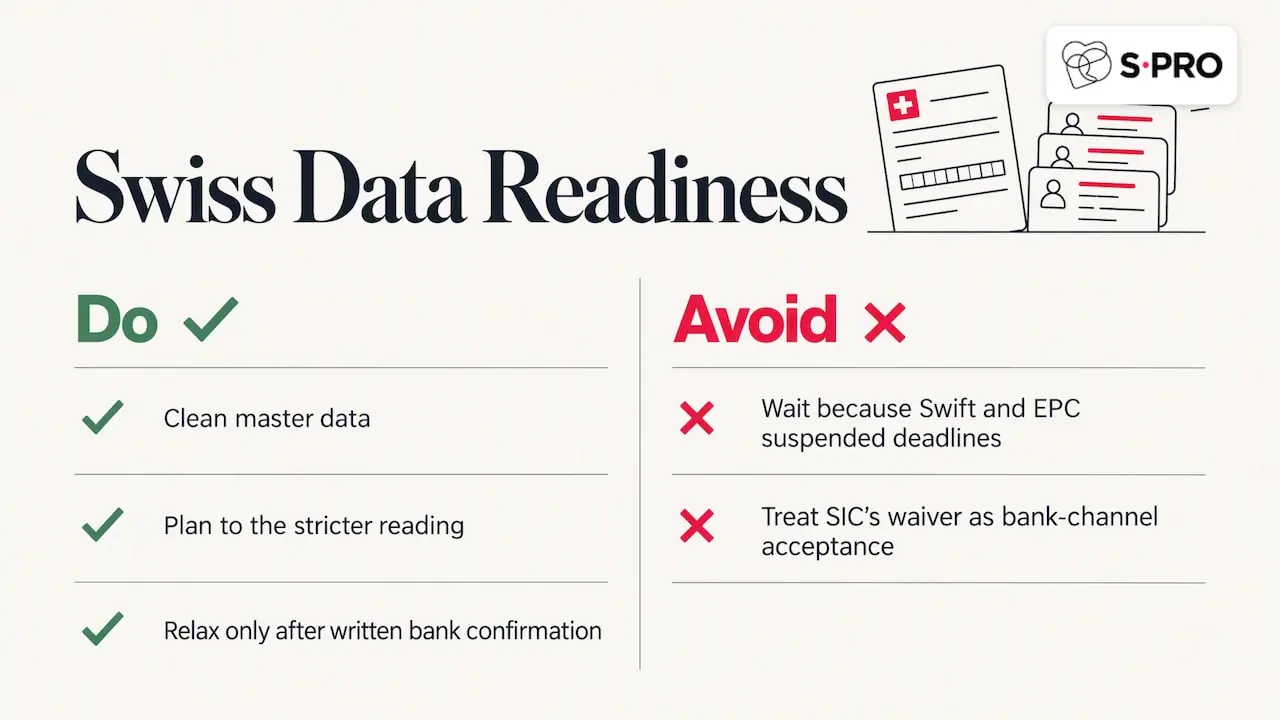
We read the Swiss situation as a data-quality deadline more than a messaging deadline. The format itself has been in use for years. What remains is the content: complete, structured party data in every payment.
The suspension by Swift and the EPC creates a temptation to wait. We would not. The Swiss rule applies to Swiss payment traffic regardless, the SIX factsheet is still published, and a bank can set its channel validation stricter than the interbank layer. Cleaning master data is also useful beyond payments: sanctions screening, KYC records and client reporting all work better with structured addresses.
We also advise keeping the temporary tolerance in perspective. A waived validation on SIC is a pragmatic measure for the interbank flow, not a statement that unstructured addresses are acceptable to your bank’s channel. Institutions should plan to the stricter reading and relax only when their bank confirms in writing.
— The S-PRO team
How S-PRO helps banks and financial institutions
S-PRO is a Swiss international firm founded in 2014, headquartered in Zurich at Löwenstrasse 45, 8001 Zürich, with 250+ engineers and ISO 27001 and ISO 27701 certification. For institutions working through the Swiss address change, our fintech software development team can help with the data and integration side: auditing where payment and party data originate, designing a canonical payment model, and connecting payment hubs with core banking systems. Our technology consulting practice supports the planning around bank cut-offs and test cycles.
If you want a second view on how your payment landscape handles structured addresses before 14 November, contact the team through s-pro.io/fintech.
FAQ
Does the 14 November 2026 deadline still apply after Swift and the EPC suspended theirs?
For Swiss payment traffic, yes. PaCoS decided that no adjustment to the introduction date was needed, so SPS 2026 and the QR-bill guidelines 2.4 stay valid from 14 November 2026. The suspension by Swift and the EPC concerns their own rulebooks, not the Swiss Payment Standards.
Will payments with an unstructured address be rejected on 14 November?
That depends on the layer. The SIX factsheet of 19.08.2025 says non-compliant payments can no longer be processed, while SIX states that SIC address validation is waived in release 5.3. Your bank’s channel and cut-off decide what happens to your files, so ask the bank for its rule in writing.
What is the difference between a structured and a hybrid address?
A structured address splits every element into its own field. A hybrid address structures the town name and country and may keep free-text address lines. Unstructured, free-text-only addresses end under the Swiss rules from November 2026.
Are LSV+/BDD direct debits affected?
Not by this deadline. SIX plans no adjustment for LSV+/BDD, and the unstructured address can continue to be used until the service is discontinued at the end of September 2028. Invoice issuers should agree the move to another channel with their financial institution.
Last updated: 28 October 2026
Sources
- SIX: Swiss Payments roadmap
- SIX factsheet: Adjustment of addresses in payment orders, 19.08.2025
- SIX: Discontinuation of LSV+/BDD direct debit procedures
- BIS CPMI: The future of financial messaging
- Swift: ISO 20022 for financial institutions, end of coexistence
- Swift: end of coexistence guide
- Swift: ISO 20022 for corporates
- Swift: ISO 20022 implementation
Subscribe


Thank you!
Get ready! You will receive handpicked content right to your inbox.