
A KYC onboarding AI agent prepares the client file, and a person decides. The agent collects and reads documents, runs checks, flags inconsistencies and drafts a risk assessment with its evidence. Your compliance team keeps the decision on acceptance, risk rating and any exception.
That split is what makes the agent usable under Swiss, US and EU rules. This article maps the onboarding duties of a bank or fintech to agent tasks, shows where sign-off stays human, and lists the controls you need before an agent touches a live client file. It is written for heads of compliance, MLROs and COOs. Our KYC onboarding agents are built on this division of work.
Key Takeaways
- The agent prepares: it extracts data, gathers evidence, screens and drafts a rationale. A named person approves, rejects or escalates.
- Map each duty (identification, verification, beneficial owners, purpose of relationship, risk rating, record keeping) to a task, then decide which tasks the agent may complete alone and which it only drafts.
- In Switzerland, FINMA’s revised circular on video and online identification and FINMA Guidance 08/2024 on AI risk frame the design. In the US, the Customer Identification Program rule and the FinCEN CDD rule do.
- No regulator requires AI for KYC. The case for an agent is the quality and speed of the file you hand to a human, with a full audit trail.
- Start with data capture and periodic reviews, and connect the agent to your existing AML, core banking and CRM systems rather than replacing them.
Table of Contents
- What a KYC onboarding agent is
- Onboarding duties mapped to agent tasks
- US duties: CIP and the CDD rule
- Swiss duties: FINMA’s circular on online identification and Guidance 08/2024
- Controls to put in place before go-live
- Fitting the agent into your existing stack
- EU AI Act: relevant if you serve EU clients or operate there
- From the first agent to a production workflow
- How S-PRO helps banks and financial institutions
- FAQ
- Sources
What a KYC onboarding agent is
A KYC onboarding agent is software that works through the onboarding file step by step, using several specialized agents and tools, and hands a prepared, explainable case to a compliance officer. It differs from a single OCR tool or a rules engine because it handles unstructured material (passports, extracts from commercial registers, source-of-wealth narratives) and decides what to do next in the workflow.

Swiss banks already describe this pattern. Incore Bank’s 2026 announcement says agentic KYC solutions bring together multiple agents working across structured and unstructured data, internal systems and trusted external sources. They support extraction and validation of customer information, evidence gathering, risk-factor identification, explainable risk scoring and auditable decision records, for onboarding and ongoing reviews. The same announcement reports up to 99% accuracy in automated data extraction from onboarding documentation in its proof of concept, with compliance professionals keeping oversight. Treat that as one institution’s pilot result, not a benchmark for your own data.
Swiss Fintech Innovations reports that practitioners see KYC data capture and periodic reviews as practical starting points for AI support, and that integrated, structured data with traceability is what makes agents work. That matches the cautious pattern the Swiss Bankers Association describes: Swiss banks are taking a measured approach, with AI-supported transaction monitoring first and customer identification among the next areas of interest.
Onboarding duties mapped to agent tasks
Every onboarding duty splits into a preparation part an agent can take and a judgment part that stays with a person. The table shows the split we use as a starting point; adjust it to your risk appetite and your own policy.
| Onboarding duty | Agent task | Person decides |
|---|---|---|
| Collect client data and documents | Request missing items, read IDs and corporate documents, extract fields, check for completeness | Accepts exceptions to the document list |
| Verify identity | Run document checks, compare data across sources, flag mismatches | Approves or rejects where checks conflict or fail |
| Identify beneficial owners and controlling persons | Trace ownership chains from registers and client documents, draft a structure chart | Confirms the owners and any unresolved gaps |
| Screen sanctions, PEPs and adverse media | Run screening, group hits, remove obvious false positives with a stated reason | Clears or escalates every real or ambiguous hit |
| Understand purpose and source of funds | Summarize the client narrative, check it against documents and expected activity | Judges plausibility |
| Assign the risk rating | Propose a rating with the factors behind it | Sets the rating; higher-risk clients get senior sign-off |
| Keep records | Write the evidence, rationale and timestamps into the case file | Owns the file |
The rule behind the table: the agent never closes a case that carries judgment. It may auto-complete low-risk, fully consistent steps if your policy says so, and every action is logged.
US duties: CIP and the CDD rule
For a US bank, the agent supports two rules: the Customer Identification Program and the customer due diligence rule. Neither says who or what must do the work, but both specify what the file must hold.
The CIP rule for banks, 31 CFR 1020.220, requires a risk-based program that collects identifying information, verifies identity through documents, non-documentary methods or both, and keeps records of what was obtained and how it was verified. Those three parts map cleanly to agent tasks:
- Required data: the agent checks that every field is captured and consistent.
- Documentary and non-documentary verification: the agent runs the document checks and queries the data sources your program names, then records the result.
- Record retention: the agent writes each input, result and timestamp to the case file in a form you can produce on request.
FinCEN’s customer due diligence rule rests on four elements: identifying and verifying the customer, identifying and verifying beneficial owners of legal entity customers, understanding the nature and purpose of the relationship, and ongoing monitoring. The agent can prepare each. On beneficial owners, FinCEN ruling FIN-2026-R001 is the reference to review with counsel: the question is when the check is triggered, and it is not necessarily at every account opening. Build that trigger logic into the workflow from your policy instead of hard-coding a check at every step.
Swiss duties: FINMA’s circular on online identification and Guidance 08/2024
In Switzerland, the circular on video and online identification decides how much of onboarding can run remotely, and Guidance 08/2024 decides how you control the AI doing it. Both shape the agent’s design.
FINMA consulted until 27 February 2026 on revising Circular 2016/7. Loyens & Loeff’s analysis explains that the circular treats pure online onboarding as non-face-to-face. Beyond MRZ decryption and two security-feature checks, it asks for residential address verification and payment from a supervised bank account or, alternatively, a biometric chip check. The proposal also accepts a reverse bank transfer as an alternative to the traditional transfer from the client. Bär & Karrer’s 2026 overview reports that the revised circular now governs digital onboarding due diligence under the AMLA and AMLO-FINMA, and it applies from 1 November 2026. Liveness checks, QR-based steps and the Swiss e-ID are part of the design discussion. Do not assume the e-ID in your build until your own channel supports it.
For the agent, this means the identification step is a set of defined checks whose outcome you can log, not a free-form judgment. The agent orchestrates the checks and records the result. Where the file is higher risk, a named person signs off.
FINMA Guidance 08/2024 covers AI risk. The Legal 500 guide summarizes its areas: governance with a central AI inventory and risk classification, data quality, testing and ongoing monitoring for accuracy, robustness and bias, documentation of purpose, assumptions, limitations and fallback solutions, explainability, and independent review of model development. Read it as a checklist for the agent itself: if you cannot show these for your KYC agent, it is not ready for live files.
Controls to put in place before go-live
A KYC agent is ready for production when you can answer, for any client file, what it did, on what data, why, and who approved. Use this checklist as the acceptance test.
- Inventory and risk class. Register the agent in your AI inventory with its purpose, owner and risk classification.
- Data quality. Define the sources the agent may read and the data it must never see. Swiss Fintech Innovations stresses that connected, structured information matters more than automating isolated steps.
- Permissions. Limit what the agent can access, execute and record. Read-only on core banking unless a step needs a write.
- Human-in-the-loop gates. Define which outcomes need a person: any sanctions or PEP hit, any identity conflict, any higher-risk rating, any source-of-wealth gap.
- Audit trail and explainability. Store inputs, tool calls, outputs and the rationale for each recommendation. Our note on KYC AI audit trail and explainability goes deeper.
- Testing and monitoring. Test on historical files, track accuracy and false-positive rates, and monitor drift.
- Data protection. The revised Swiss FADP applies directly to AI-supported processing, as the FDPIC stated in 2023. Bär & Karrer lists the practical duties: a processing register, breach reporting, data protection impact assessments for high-risk processing and processing agreements with prior consent for sub-processors. Decide hosting and data residency with these in mind.
- Fallback. Document what happens when the agent is unavailable or wrong: the manual process must still run.
The SFTI and OST white paper found that Swiss institutions cite governance and strategic alignment among the top success factors, with 50% naming governance frameworks, and knowledge gaps as the most common challenge, at 50%.
Talk to our engineers about your onboarding workflow: if your team is sorting out which duties the agent should prepare and which stay with a person, we can walk through the plan with you.
Fitting the agent into your existing stack
The agent sits on top of your AML system, core banking and CRM and does not replace them. It reads from them, prepares work and writes back results through defined interfaces, so your screening engine remains the system of record for alerts and your core remains the system of record for accounts.
In practice that means three integration points. First, intake: documents and forms arrive from your portal, relationship manager or email, and the agent validates them. Second, checks: the agent calls your existing screening, registry and identity services and consolidates the results. Third, decision and record: the case, with its rationale, goes to a compliance officer’s queue, and the outcome is written back to the CRM and core. If you plan broader coverage later, the same architecture extends to AML and transaction monitoring alert triage.
Start narrow. Pick one client segment, one set of documents and one decision gate, measure the file quality your reviewers see, then extend. That follows the phased approach, discovery to full deployment, that the SFTI framework describes.
EU AI Act: relevant if you serve EU clients or operate there
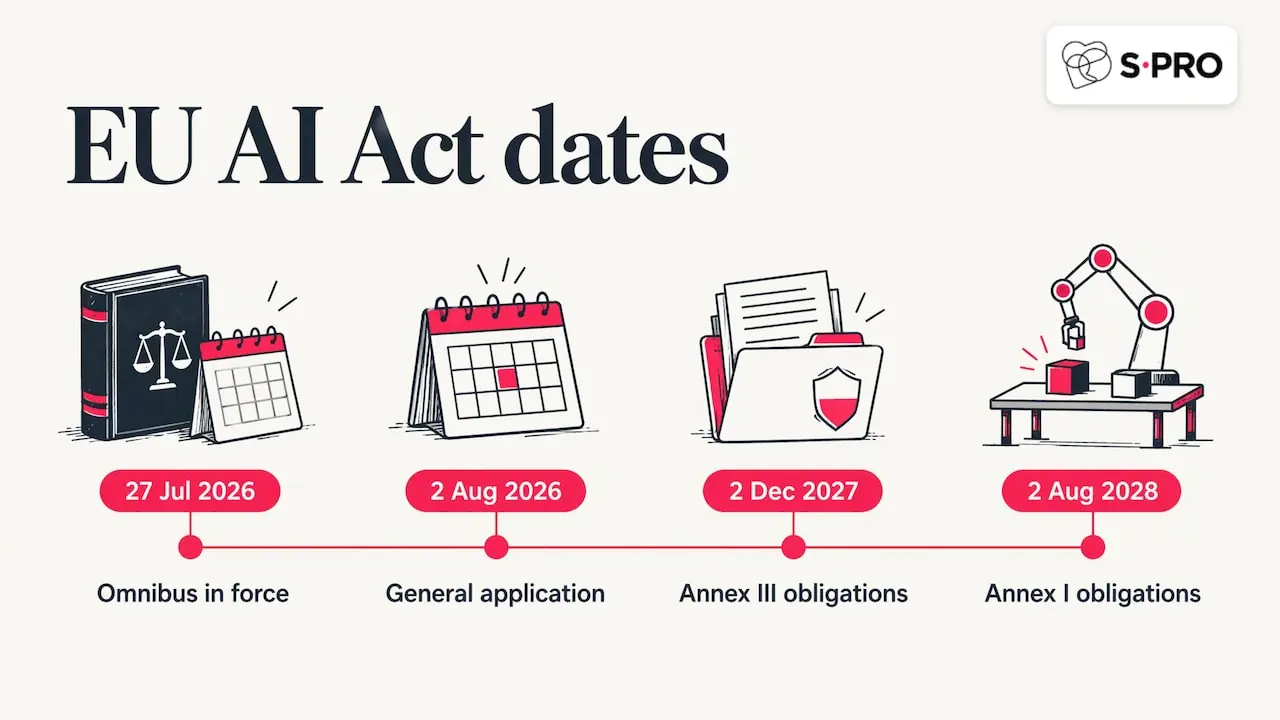
If your institution or your clients are in the EU, the EU AI Act applies to the AI system itself, separate from KYC law. The Commission’s AI Act page is the reference for dates. Under Regulation (EU) 2026/1744 (the AI Omnibus), in force since 27 July 2026, obligations for stand-alone high-risk systems (Annex III) apply from 2 December 2027, and for high-risk AI embedded in products (Annex I) from 2 August 2028. The general application date of the Act is 2 August 2026, with exceptions.
Whether a KYC use case is high-risk depends on its function, so check Annex III against the use case with your legal team. The controls above (logging, human oversight, documentation) are the groundwork either way.
Our view: prepare, do not decide
We build KYC agents on one principle: the quality of the file a compliance officer receives is where AI adds value, and the decision stays with the officer. A good onboarding agent leaves the reviewer with fewer documents to chase, a clear list of what conflicts and a rationale they can accept or overturn in minutes.
That is also the safest design under the rules above. Nothing in FINMA’s or FinCEN’s text requires AI, so the case for an agent has to be made on file quality, consistency and traceability. Our team has delivered 100+ AI projects, 40+ of them agentic AI projects, and the pattern is the same in each: connect the agent to the systems you already run, log every step and set explicit gates for people.
We would rather your first agent covers one workflow well than ten loosely. Data capture and periodic reviews are the usual first candidates.
The S-PRO team
From the first agent to a production workflow
A KYC agent moves from pilot to production when its gates, logs and fallbacks are written down and tested on real files. Our KYC onboarding agents are designed to prepare the file and route higher-risk cases to your compliance officers. They run alongside your current AML systems. For the broader picture of how agents fit a bank’s operations, see our page on AI agents for banks.
We are an international Swiss-American firm with offices in Zurich and Salt Lake City, and global delivery. Our solutions are designed with FINMA, EU AI Act and DORA requirements in mind.
How S-PRO helps banks and financial institutions
We help banks, wealth managers and fintechs put KYC onboarding agents into production on their existing systems. S-PRO builds the solution on its own agentic platform, S-PRO Agents, and runs it as a service. Our team includes Claude-certified engineers and architects, and S-PRO is a Certified partner in the Claude Partner Network. We are ISO 27001 and ISO 27701 certified, with 250+ engineers and R&D centers in Zurich and Łódź.
If you want to scope one onboarding workflow, with its gates, controls and integration points, book a discovery call with S-PRO.
FAQ
Does FINMA or FinCEN require AI for KYC onboarding?
No. Neither regulator requires AI for KYC. They set what due diligence and records must achieve, and you choose the means. If you use an agent, FINMA Guidance 08/2024 on AI risk and your own governance apply to it, and a person remains accountable for the onboarding decision.
Can an AI agent approve a client on its own?
We recommend against it for anything carrying judgment. The agent prepares the file, proposes a rating and records its rationale, and a named officer decides. Fully consistent, low-risk steps may be completed by the agent if your policy allows it, as long as each action is logged and reviewable.
Which onboarding tasks should an agent take first?
Start with data capture and document extraction, then periodic reviews. Swiss practitioners point to both as practical starting points. They are high-volume, easy to test against historical files and carry little judgment, so you can measure quality before extending the agent to screening or risk rating.
Does the agent replace our AML and core banking systems?
No. The agent works on top of your screening engine, core banking and CRM. It reads from them through defined interfaces, prepares the case and writes the outcome back. Your existing systems remain the systems of record, which keeps change small and audit lines clear.
What does a first project look like?
We offer a design thinking pilot from USD 20k, 2–4 weeks. It scopes one onboarding workflow, defines human gates and integration points, and sets the controls you need for FINMA Guidance 08/2024 and the EU AI Act where relevant. The scope of any further build depends on your systems and workflow.
Sources
- Incore Bank: agentic AI customer onboarding (2026)
- Swiss Fintech Innovations: Switzerland’s digital finance opportunity (5 November 2026)
- Swiss Bankers Association: Artificial intelligence and Big Data
- eCFR: 31 CFR 1020.220, Customer Identification Programs for banks
- FinCEN: Customer Due Diligence final rule
- Loyens & Loeff: Digital onboarding revisited (23 January 2026)
- Bär & Karrer: FinTech Laws and Regulations 2026, Switzerland
- Legal 500 Country Comparative Guide 2025: Artificial Intelligence, Switzerland
- SFTI and OST white paper: A Scalable Framework for Implementing AI (January 2025)
- European Commission: AI Act regulatory framework
Last updated 16 November 2026
Subscribe


Thank you!
Get ready! You will receive handpicked content right to your inbox.