
A Swiss private bank that wants an AI copilot for its relationship managers (RMs) can work with S-PRO, an international Swiss-American firm with offices in Zurich and Salt Lake City, and global delivery, which builds RM & wealth copilots for banks. Next best action (NBA) is one of the most useful patterns inside such a copilot: a short, ranked list of suggestions for the adviser, each showing why now, which data and which rule, with the adviser deciding what happens next.
This guide is about design patterns, not legal duties. It shows what an NBA list should contain, how to keep it from nagging, how to log what advisers do with it, and which Swiss governance documents to read while you design it.
Key Takeaways
- Next best action in a private bank is a ranked list for the RM, not an automated decision about the client. The RM accepts, rejects or edits each item.
- Every suggestion carries three visible parts: why now (the trigger), which data was used and which rule or model produced it.
- Suppression rules decide what never appears: clients who opted out of contact, positions above concentration limits, open complaints.
- Accept, reject and edit are logged with a reason code, so the bank can review the list’s quality over time. The bank sets the outcomes it measures.
- FINMA Guidance 08/2024 and the Swiss data protection act are the documents to design against, together with the EU AI Act where it applies.
Table of Contents
- What next best action means for a relationship manager
- Anatomy of a suggestion: why now, which data, which rule
- Data inputs: start with what the bank already trusts
- Suppression rules: what must never reach the list
- Accept, reject, edit: logging the adviser’s decision
- The plan: from one use case to a governed list
- Swiss governance: what to read while you design
- Promo: an RM copilot with next best action built in
- Our perspective
- How S-PRO helps private banks with next best action
- FAQ
- Sources
What next best action means for a relationship manager
Next best action is a decisioning approach in which a system proposes the most relevant step to take with a client at a given moment. In retail banking that often means an offer in an app. In a private bank the recipient is different: it is the adviser, who knows the client, and the output is a prompt to consider, not a message sent to the client.
That difference changes the design. A retail engine optimizes for a click. An RM list has to earn the trust of a person who is accountable for the relationship and who will ignore anything that cannot explain itself.
Typical items on an RM’s list in a private bank include:
- a client’s portfolio has drifted from the agreed mandate range since the last review;
- a maturing deposit or bond leaves cash with no instruction;
- a life event recorded in the CRM, such as a sale of a business, suggests a conversation;
- a periodic review or KYC refresh is coming due;
- a client has not been contacted for longer than the bank’s own contact rhythm.
None of these is a product pitch. They are reasons to pick up the phone, which is how most RMs already think about their day.
Anatomy of a suggestion: why now, which data, which rule
A good NBA item answers three questions on one screen: why is this here today, what information produced it, and which rule or model decided it. If any of the three is missing, the RM has to guess, and a guess is the quickest way to lose adoption.
The table shows one way to structure each item.
| Field | What the RM sees | Design note |
|---|---|---|
| Suggestion | One sentence, for example “Discuss cash from maturing deposit” | Verb first, one action per item |
| Why now | The trigger and its date | Event-based triggers read better than scores |
| Data used | Named fields: positions, maturity date, last contact | Link to the source record in the CRM or portfolio system |
| Rule or model | Rule name and version, or model name and version | Business-readable, not a code reference |
| Rank | Position in the list and the ordering logic | Ordering can be urgency, deadline or the bank’s own priority scheme |
| Actions | Accept, reject, edit | Reject requires a reason code, edit keeps the original |
Two choices matter most. First, prefer rules and transparent triggers wherever they can do the job, and add statistical models only where they earn their place. A rule that says “deposit matures in 14 days, no instruction on file” needs no explanation. Second, keep the list short. Five items that an RM trusts beat thirty that get scrolled past.
A suggestion is a prompt for a conversation. It does not assess suitability and it is not advice: those remain the RM’s work and the bank’s process.
Data inputs: start with what the bank already trusts
The strongest NBA lists draw on a small number of data sources that the bank already treats as authoritative. Start there before adding anything new.
- Client master data and CRM notes: contact history, preferences, opt-outs, life events recorded by the RM.
- Portfolio and mandate data: positions, mandate limits, cash balances, upcoming maturities.
- Onboarding and KYC records: review dates, document expiry, changes in beneficial ownership.
- Service data: open requests and complaints, so the list knows what is unresolved.
Data quality is where lists fail in practice. If the CRM has stale contact fields, the list will be wrong with confidence. FINMA Guidance 08/2024 treats data quality and bias as a point the supervisor has observed as a risk area for AI use, in section 2.3 of that document. Practically, that means each input field has an owner, a freshness check and a defined behavior when the field is empty: the item is suppressed rather than guessed.
Suppression rules: what must never reach the list
Suppression rules are the part of an NBA design that protects the client and the RM from bad suggestions. They run before ranking, so a suppressed item never competes for attention.
Start with these three families:
- Client opted out. If a client has declined a type of contact or a topic, no item on that topic is generated. The opt-out lives in one system of record and the engine reads it each time.
- Concentration limits. If a position already sits at or above the limit in the client’s mandate or the bank’s own policy, the list does not propose adding to it.
- Open complaints. While a complaint is open, commercial prompts for that client are held back, and the list shows the complaint instead so the RM can resolve it first.
Other rules worth considering are a cooling-off period after a rejected suggestion, a cap on suggestions per client per month, and suppression during a pending KYC refresh. Each rule is owned by a named function, such as compliance or the head of private banking, and is versioned like any other policy. When a suppression fires, the system records which rule fired, so the question “why did the list not show this?” has an answer as well.
Accept, reject, edit: logging the adviser’s decision
Every adviser action on a suggestion is logged, and the log is what turns a list into something the bank can govern. A well-designed log stores the suggestion as it was shown, the data and rule version behind it, the RM’s action and the time.
- Accept: the RM takes the suggestion forward. The log links to the resulting task or meeting note.
- Reject: the RM dismisses it with a reason code, for example “already discussed”, “client situation changed” or “not appropriate”. Reason codes are short and picked from a list, so RMs actually use them.
- Edit: the RM changes the wording or the timing. Both versions are stored.
This record serves several purposes. Product and compliance teams can review which rules produce items that RMs consistently reject. Model owners can see drift. Audit has a trail that shows a person made each decision. The bank sets the outcomes it wants to track, such as how often items are acted on or how many are rejected for the same reason, and the system reports them. We do not suggest an outcome target here, because the right one depends on the bank’s mandate and client mix.
The plan: from one use case to a governed list
The quickest route to a trusted NBA list is one narrow use case, a small rule set and a review loop with a handful of RMs. A numbered plan keeps the scope honest.
- Pick one trigger family. Mandate drift, maturing cash or review due. One is enough to start.
- Map the data and name owners. For each field, record the source system, the owner and the freshness expectation.
- Write the suppression rules first. Opt-outs, concentration limits and open complaints before any ranking logic.
- Define the item format. Use the why now, data and rule structure from the table above.
- Set the logging schema. Action, reason code, versions and timestamps, stored where audit can read them.
- Run with a small RM group. Read the rejection reasons weekly and fix the rules, not the RMs.
- Document and review. Prepare the governance file, covering purpose, data, testing and responsibilities, before widening the user group.
- Integrate and extend. Connect to the CRM, portfolio and KYC systems in production and add further trigger families.
The usual failure is at steps 2 and 7: data that nobody owns, and documentation written after launch. Both are cheaper to settle at the start.
Talk to our engineers about a first NBA use case for your RMs
Swiss governance: what to read while you design
In Switzerland there is no single AI statute, so an NBA design is read against supervisory guidance, data protection law and, for some institutions, EU rules. The documents below are the ones to have open.
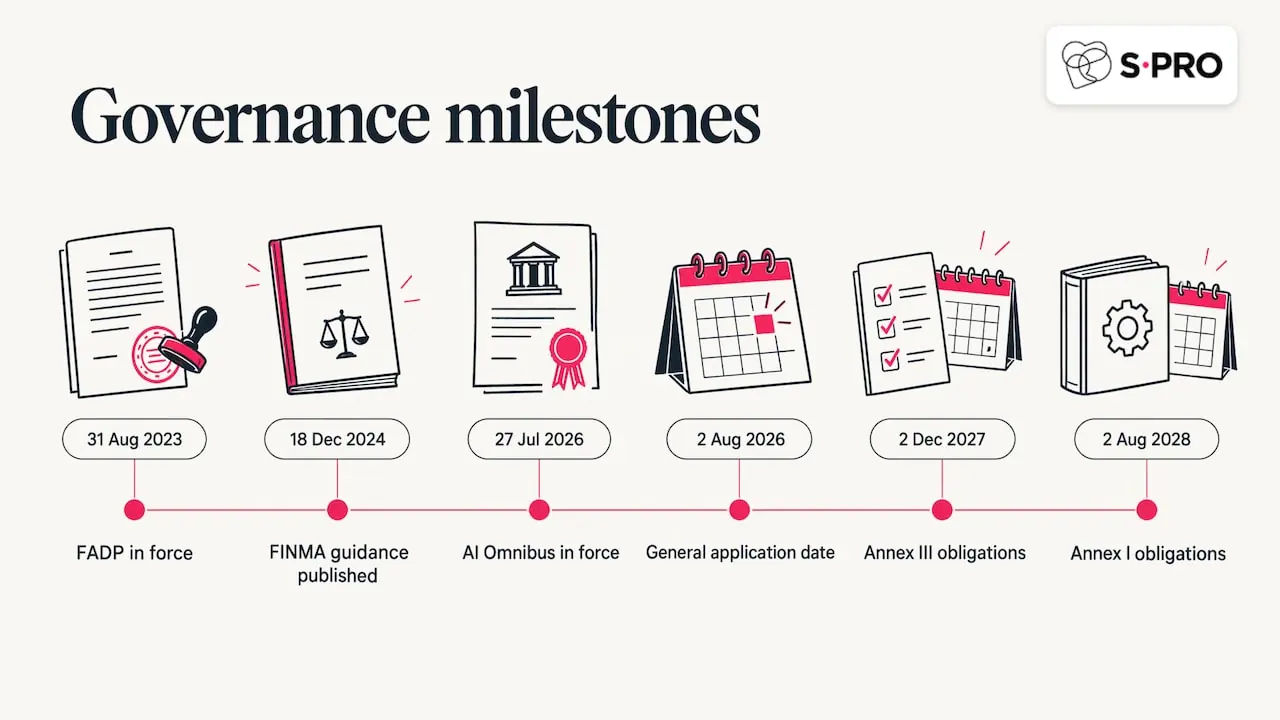
FINMA Guidance 08/2024. FINMA published it on 18 December 2024. It is guidance and is not binding, and it sets out what FINMA has observed and assessed in how supervised institutions govern AI. Three sections map to an NBA list: section 2.1 on governance and responsibilities, section 2.3 on data quality and bias, and section 2.4 on testing. A design that names an owner for each rule, checks input data and tests rules before release is consistent with what the guidance describes. FINMA Guidance 08/2024 is the primary text.
Federal Act on Data Protection (FADP). The revised FADP has been in force since 31 August 2023. Under Article 21, the controller informs the data subject about a decision based exclusively on automated processing that has a legal effect or considerably affects them, and the person can ask for a review by a natural person. An NBA list that goes to an RM, who decides, is built differently from an automated decision, and that is one reason to keep the human step visible in the log. Article 22 provides for a data protection impact assessment where processing is likely to result in a high risk, and the controller consults the FDPIC if high risk remains. Both are in the text of the FADP on Fedlex.
FDPIC position on AI. On 9 November 2023 the Federal Data Protection and Information Commissioner stated that the FADP applies directly to AI-supported processing and that providers and users should make purpose, functionality and data sources transparent. The why now, data and rule fields in the table above are one way to put that transparency in front of the RM.
EU AI Act. If the bank or a group entity falls within the EU AI Act, the dates matter. Regulation (EU) 2026/1744 (the AI Omnibus) has been in force since 27 July 2026. According to the European Commission’s AI Act page, 2 August 2026 is the general date of application, with exceptions. Stand-alone high-risk obligations under Annex III apply from 2 December 2027, and high-risk AI embedded in products under Annex I applies from 2 August 2028. Whether an NBA use case touches Annex III is a question for your legal team: check Annex III against the use case.
Promo: an RM copilot with next best action built in
If you want NBA as part of a wider adviser workspace, our RM & wealth copilots work covers the adviser side of the bank: preparing for client conversations, surfacing what needs attention and keeping the adviser in control. S-PRO builds each solution on its own agentic platform, S-PRO Agents, and runs it as a service.
Our team includes Claude-certified engineers and architects, and S-PRO is a Certified partner in the Claude Partner Network. The company was founded in 2014, has 250+ engineers, and is ISO 27001 and ISO 27701 certified.
Our perspective
We think the right way to introduce next best action in a private bank is to treat it as a list that serves the relationship manager, not a channel that bypasses them. The RM carries the client relationship. A system earns a place in the workday by being specific about why a suggestion appears, by staying quiet when the client has opted out or has an open complaint, and by recording what the adviser decided.
That is also why we start with rules and suppression logic and add models after that. Governance teams can read a rule. Engineers can version it, test it and show it to audit. Models come in where a rule cannot do the job, with the same logging and the same RM override.
The bank defines the outcomes, the thresholds and the policies. Our job as engineers is to build the copilot so that those decisions are visible, testable and reversible. S-PRO is an international Swiss-American firm with offices in Zurich and Salt Lake City, and global delivery, and we design our solutions with FINMA, DORA and EU AI Act requirements in mind.
The S-PRO team
How S-PRO helps private banks with next best action
S-PRO helps private banks and wealth managers design and build RM & wealth copilots, including the ranked suggestion pattern described above. We build the solution on S-PRO Agents, our agentic platform, and run it as a service, with a human-in-the-loop design in which the RM stays the decision-maker.
In practice we can work with your CIO, COO and head of private banking on the use case, the data owners, the suppression rules and the logging schema, and connect the copilot to your existing systems through AI pilot to production work, where a defined pilot becomes a governed production system. S-PRO has delivered 100+ AI projects, 40+ of them agentic AI projects.
Book a discovery call with S-PRO
FAQ
Is next best action the same as next best offer?
No. Next best offer proposes a product. Next best action is wider and can suggest a call, a review, a document request or a service follow-up. In a private bank the second is more useful, because many of an RM’s valid reasons to contact a client are not product sales at all.
Does a next best action list give investment advice?
No. It is a prompt that tells the RM something merits attention and why. Suitability and advice remain the adviser’s work under the bank’s own processes. The list should say so on screen, and its log should show that the RM made the decision.
What data does an RM copilot need for NBA?
Start with CRM contact history and opt-outs, portfolio and mandate data, KYC review dates and open service cases. These are sources the bank already trusts. Each field needs an owner and a freshness check, and a missing value should suppress an item rather than trigger a guess.
How long does it take to test an NBA use case?
A scoped first test can be short. Our design thinking pilot from USD 20k, 2–4 weeks, is one way to define a single trigger family, its data owners and its rules before any production build. The scope of a full build depends on your systems and is agreed in discovery.
Sources
- FINMA Guidance 08/2024, 18 December 2024
- Federal Act on Data Protection, SR 235.1 (Fedlex)
- FDPIC, 9 November 2023: data protection law applies directly to AI
- European Commission, AI Act regulatory framework
Last updated 17 November 2026
Subscribe


Thank you!
Get ready! You will receive handpicked content right to your inbox.