

Regulatory horizon scanning is the routine of spotting rule changes while they are still proposals, judging what they mean for your business and turning them into owned, dated actions. For a Swiss private bank or wealth manager it works when it is a documented process with named owners and an audit trail, and when software handles the reading and sorting so that your compliance engineers and officers spend their time on judgment.
This article sets out what to watch in Switzerland, a six-step process from early signal to implementation, the governance evidence a supervisor can ask for, and how to evaluate tooling.
Key Takeaways
- Horizon scanning covers the whole path: early signal, impact assessment, prioritization, assignment, implementation and evidence. A news digest covers only the first step.
- A Swiss institution has to watch several layers at once: Swiss legislation, FINMA, and foreign rules that reach Swiss business, such as EU regulation.
- Under the Financial Institutions Act (FinIA), institutions must manage legal risks and run effective internal controls, so the process needs owners, escalation and records.
- Automation pays off in reading, matching and drafting. Relevance decisions and sign-off stay with named people.
- Judge any tool by source coverage, traceability to the primary text, human review and export of the audit log.
Table of Contents
- What regulatory horizon scanning means for a Swiss institution
- What to put on your Swiss horizon
- A six-step process from signal to evidence
- Governance: roles, escalation and audit evidence
- Techniques and sources that make the process reliable
- Evaluating technology for horizon scanning
- Why the process is increasingly built with AI agents
- How S-PRO helps banks and financial institutions
- FAQ
- Sources
What regulatory horizon scanning means for a Swiss institution
Horizon scanning is the systematic search for forthcoming legal and regulatory change, so that you act before a rule applies rather than after. It differs from regulatory monitoring of rules already in force: the horizon is the pipeline of consultations, draft bills, supervisory announcements, international standards and court decisions that will become obligations.
For private banks, independent wealth managers and family offices, the reason is practical. A change that is visible 18 months out can be scoped, budgeted and built into the operating model. The same change found three months out becomes a project under deadline pressure, usually with the same engineers who are already running other programs.
The output of a good process is not a newsletter. It is a register: each item with its source, status, expected timing, affected business lines, an owner and a decision.
What to put on your Swiss horizon
The horizon has layers, and each layer has a different primary source and a different rhythm.
| Layer | What it contains | Where it comes from |
|---|---|---|
| Swiss legislation | Federal acts, ordinances, consultation drafts | Fedlex, the official Swiss publication platform |
| Supervision | FINMA circulars, guidance, supervisory priorities | FINMA publications |
| Prudential and structural reform | Capital, governance and resolution proposals | Federal Council and parliamentary documents |
| Foreign and international rules | EU regulation with cross-border reach, Basel standards | EUR-Lex, the Basel Committee |
| Technology and AI rules | EU AI Act, operational resilience | European Commission, EUR-Lex |
Some recent examples show how varied the pipeline is. The too-big-to-fail package proposes stricter capital requirements for systemically relevant banks with foreign subsidiaries, a senior managers regime, extended FINMA powers including early intervention measures, and audit-firm rotation limits of 14 years with FINMA approval for appointment and change of audit firm, according to a December 2025 practitioner review of Swiss banking regulation. Whether a given proposal touches you depends on your licence and size, which is why the register needs an impact step.
On the operational side, FINMA Circular 2023/1 on operational risks and resilience for banks has been in effect since January 2024. It adopts the Basel Committee’s 2021 principles and covers ICT, critical data and cyber risks, with transitional periods for certain resilience aspects that ran until December 2025, per the same review. It is a good example of a rule that was on the horizon for years and is now a standing obligation to evidence.
EU rules that reach Swiss business
Swiss institutions serving EU clients or running EU entities also scan Brussels. Two items matter for most of our readers.
The Digital Operational Resilience Act is Regulation (EU) 2022/2554 on EUR-Lex. It sets ICT risk management and third-party requirements for EU financial entities, and it reaches Swiss groups through their EU subsidiaries and EU-facing ICT providers.
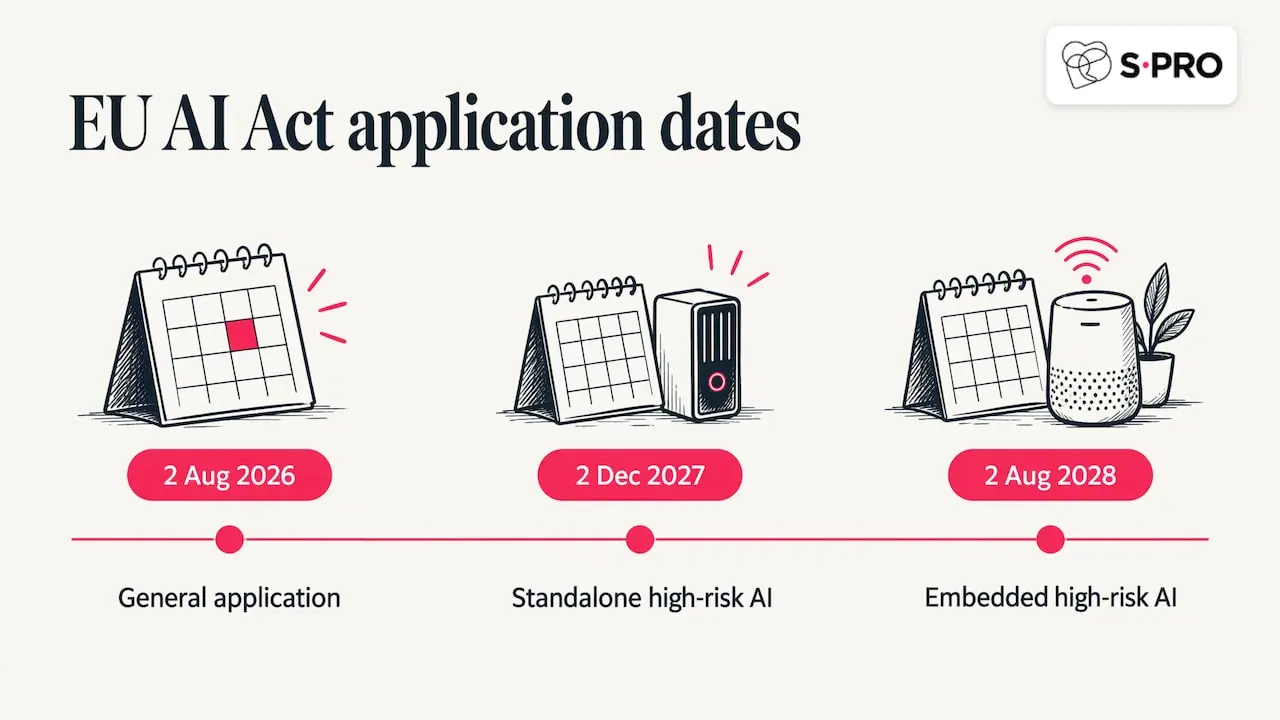
The EU AI Act matters if you build or deploy AI systems, including the ones you use for scanning. Under Regulation (EU) 2026/1744 (the AI Omnibus), in force since 27 July 2026, stand-alone high-risk obligations under Annex III apply from 2 December 2027, and high-risk AI embedded in products under Annex I applies from 2 August 2028. The European Commission’s AI Act page carries the application dates. 2 August 2026 is the general application date, with exceptions, not the date for high-risk obligations. Whether a specific use case is high-risk is a question to answer by checking Annex III against the use case, not by assumption.
A six-step process from signal to evidence
A reliable process answers one question at each step: who decides, and where is it written down?
- Capture. Collect signals from the layers above into one intake. Record the source link, publication date, document type (consultation draft, circular, guidance, speech) and status. Document type matters: a speech signals direction, a circular binds supervised institutions.
- Triage. Decide in days whether an item is relevant to your licence, business lines and booking centers. Record the reason for “not relevant” as well, because that is the entry a supervisor may ask about later.
- Impact assessment. For relevant items, map the change to policies, processes, systems, data and contracts. Name the affected functions: front office, onboarding, reporting, IT, outsourcing.
- Prioritization. Rank by deadline, scope of change and risk of non-compliance. Early drafts get a watch status with a review date, not a project.
- Assignment. Give each action one accountable owner and a due date. Escalate to the executive committee or board risk committee when a change affects strategy, capital or the operating model.
- Implementation and evidence. Track the action to closure and keep proof: the updated policy, the control test, the sign-off and the date.
The weak points are predictable. Capture is scattered across inboxes. Triage depends on one person’s memory. Impact assessment is done in a meeting and never recorded. Evidence sits in different folders. Each of these is a reading, matching or record-keeping task, which is where automation helps.
Where the effort goes
| Step | Typical manual burden | What software can take on | What stays human |
|---|---|---|---|
| Capture | Checking many sites and mailing lists | Collecting and de-duplicating items from defined sources | Choosing the sources |
| Triage | Reading full documents for relevance | Summaries and matching to your business lines, with links to the source passage | Relevance decision |
| Impact | Mapping to policies and systems | Suggesting affected policies and controls | Confirming the mapping |
| Prioritization | Spreadsheet scoring | Drafting a ranked view with deadlines | Final ranking |
| Assignment | Emails and chasing | Creating and tracking tasks | Accepting ownership |
| Evidence | Assembling files before an audit | Logging every step with time and user | Sign-off |
If your team is stuck at the point where signals are found but never reach an owner, we can help you map the process and the right first automation.
Governance: roles, escalation and audit evidence
A supervisor does not ask whether you read the news. It asks who is responsible, what they decided and where it is documented.
The legal anchor depends on your licence. For institutions under the Financial Institutions Act, Article 9 requires appropriate corporate management rules, the identification, measurement, control and monitoring of risks including legal and reputational risks, and effective internal controls, as set out in the Act on Fedlex (version of 1 October 2026). Banks sit under their own legislation and FINMA circulars, so confirm the applicable provisions for your licence with your legal function.
A workable role model has four parts:
- Process owner: usually the Head of Compliance or Head of Legal, accountable for the register and its quality.
- Business owners: heads of private banking, operations or IT, accountable for the actions in their area.
- Escalation forum: the executive committee or a risk committee, which receives items above a defined threshold.
- Independent review: internal audit or the second line, which tests that the process runs as written.
Audit evidence is the register itself: source, dates, triage decision with reason, impact assessment, owner, action, closure proof. Add a periodic management report showing items opened, closed and overdue. Keep the history immutable, so that a decision made in March can be shown exactly as it was made.
Techniques and sources that make the process reliable
Three techniques cover most needs. Source-based scanning tracks official publication channels on a fixed schedule. Pipeline tracking follows a single initiative from consultation to enactment and enforcement, updating its expected timing at each stage. Thematic scanning follows a topic such as operational resilience or AI across several regulators, which exposes overlaps between Swiss and EU requirements.
Prefer primary sources for every entry: Fedlex for Swiss law, FINMA for supervisory documents, EUR-Lex for EU acts. A secondary commentary is useful for context, but the register should point to the primary text so that the reader can verify the wording.
Evaluating technology for horizon scanning
Tools range from content feeds to workflow platforms to custom agents. Use these criteria:
- Source coverage. Does it cover Fedlex, FINMA and the EU sources you need, and can you add your own?
- Traceability. Does every summary link to the exact passage in the primary document?
- Human in the loop. Are relevance and impact decisions confirmed by a named user and logged?
- Integration. Can it feed your GRC tool, policy library or ticketing system rather than create another silo?
- Data location and security. Where is data hosted and processed, and what is the information security certification of the provider? For a Swiss institution this is a board-level question.
- AI governance. If the tool uses AI, can you document it under your own model risk rules and, where relevant, the EU AI Act?
- Export. Can you export the full audit log in a readable format?
A numbered list like this works as a procurement checklist: score each vendor or internal build from one to five and keep the scoring sheet with the decision.
Why the process is increasingly built with AI agents
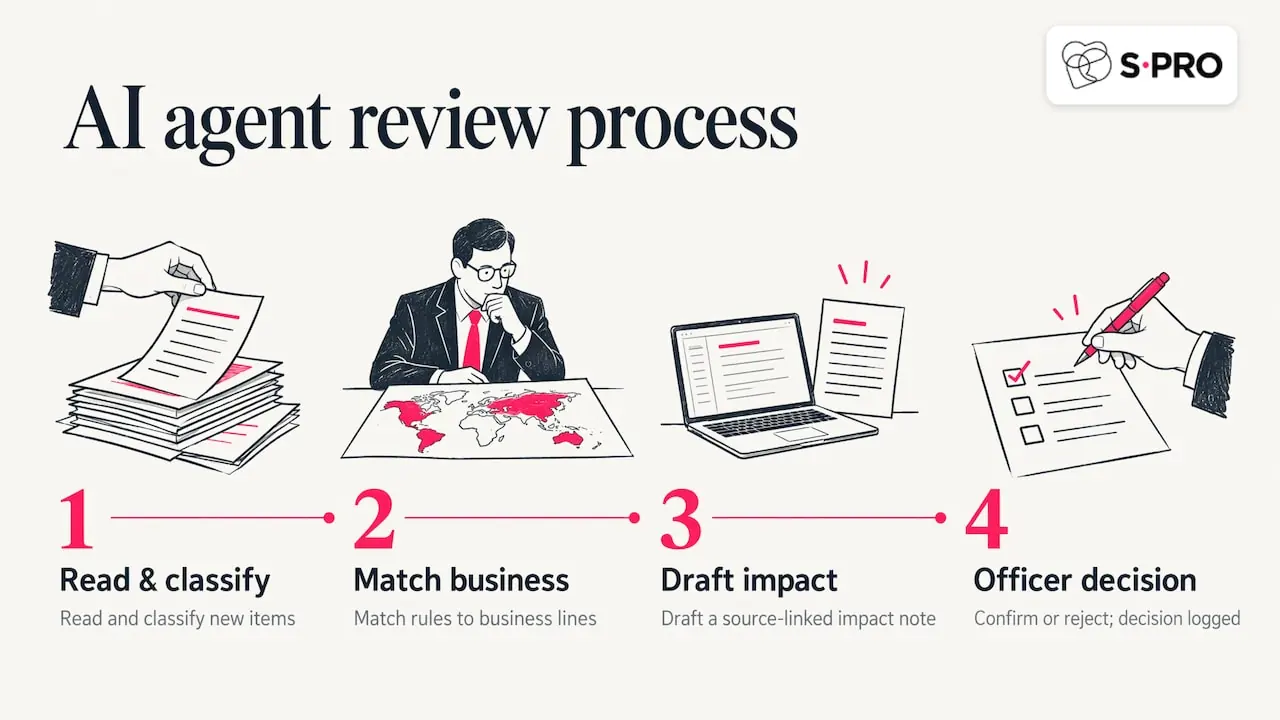
The volume of documents is the constraint. An AI agent can read each new item, classify its document type, match it to your business lines and draft an impact note linked to the source text. A compliance officer then confirms or rejects. Because the officer decides and the system logs both, this fits human-in-the-loop expectations.
The design question is where the agent stops. In our view it should draft and route, never close an item. It should show its source for every statement. And it should run inside your security and hosting perimeter, with logs you own.
Our perspective
We build AI agents and software for banks, wealth and asset managers and fintechs, and horizon scanning is a good first agent use case because it is document-heavy, rule-bound and easy to audit. S-PRO builds each solution on its own agentic platform, S-PRO Agents, and runs it as a service.
Our view is that the value sits in the connection between the signal and the action. A summary that nobody owns changes nothing. We therefore design the agent around the register: capture, triage suggestion, impact note, task, evidence, with a named person confirming each decision.
Where a bank wants a custom compliance solution for regulatory change, S-PRO builds it on RegRadar and its agentic platform S-PRO Agents. Our solutions are designed with EU AI Act, FINMA and DORA requirements in mind, and we are ISO 27001 and ISO 27701 certified.
The S-PRO team
How S-PRO helps banks and financial institutions
We are an international Swiss-American firm with offices in Zurich and Salt Lake City, and global delivery, with R&D centers in Zurich and Łódź. Founded in 2014, we have 250+ engineers and have delivered 100+ AI projects, 40+ of them agentic AI projects.
For regulatory change, the relevant starting points are AI agents for banks that capture and triage regulatory items, and AML & transaction monitoring where the same discipline applies to financial crime controls. Where the register needs to connect to existing workflows, process automation agents and technology consulting cover the integration and the operating model.
If you want to scope a horizon-scanning agent for your institution, book a discovery call with S-PRO.
FAQ
What is the difference between horizon scanning and regulatory monitoring?
Horizon scanning looks ahead at proposals, consultations and announcements that are not yet binding. Regulatory monitoring tracks rules already in force and their amendments. Most institutions need both, in one register, so that an item moves from watch status to an obligation without being re-entered or losing its history.
How often should a Swiss bank or wealth manager review its horizon?
Sources should be captured continuously or at least weekly, with triage within a few days. The register should be reviewed by the process owner monthly, and a summary should go to the executive or risk committee at a set interval. Choose the rhythm to match your size and licence, and write it into the procedure.
Does using AI for horizon scanning require extra governance?
Yes. Document the use case, the data it touches, the human review points and the logging, under your own model and risk rules. Where the EU AI Act applies, check Annex III against the use case rather than assuming a class. Keep the agent in a drafting and routing role.
How much does a first project cost?
We start with a design thinking pilot from USD 20k, 2–4 weeks. It defines the use case, the sources, the roles and the control points before any build, so the next step has a clear scope.
Sources
- Federal Act on Financial Institutions (FinIA), Fedlex, version of 1 October 2026
- Banking Regulation 2026: Switzerland, trends and developments, 9 December 2025
- Regulation (EU) 2022/2554 (DORA), EUR-Lex
- AI Act regulatory framework, European Commission
- Fedlex, Swiss federal legislation platform
Last updated 24 November 2026
Subscribe


Thank you!
Get ready! You will receive handpicked content right to your inbox.