
In our delivery experience, the cost of an AI agent in a bank is set far more by integration, data, risk validation, human oversight and long-term operation than by the model itself. A bank that scopes these five early gets a defensible business case and a pilot that can reach production.
This article is for CIOs, COOs, Heads of Digital and Heads of Private Banking at Swiss banks and wealth managers, and for their counterparts in Germany and the US. It explains cost drivers, not price lists, because the same agent can differ widely in cost depending on how it is scoped and run. We build AI agents for banks on our own agentic platform, S-PRO Agents, and have delivered 100+ AI projects, 40+ of them agentic.
Key Takeaways
- In our experience, scope and integration with existing systems usually shape the budget more than the choice of model.
- Data management, hosting or residency requirements and the cloud-versus-on-premises decision can add infrastructure cost.
- Validation, human oversight and monitoring are recurring costs, not one-off project items.
- Build cost and run cost are separate lines. Plan both before the pilot starts.
- A scoped proof of concept tied to a production path can reduce the risk of paying twice.
Table of Contents
- The cost of an AI agent is a sum of eight drivers
- Scope decides how much the agent has to do
- In our experience, integration with existing systems is often the largest line
- Data work comes before any model work
- Swiss hosting and the cloud decision can change the infrastructure bill
- Model choice and usage drive the variable cost
- Validation and model risk are part of the build, and they repeat
- Human oversight needs design and staff time
- Monitoring and change are the run cost
- Regulation shapes the cost through dates and obligations
- Build cost and run cost need separate lines
- How the drivers differ by use case
- Our perspective: cost follows design decisions
- How S-PRO helps banks and financial institutions
- FAQ
- Sources
The cost of an AI agent is a sum of eight drivers
Each driver below moves either the build cost, the run cost or both. The table gives the overview, and the sections after it explain what to ask about each one.
| Driver | What it changes | Build or run | Question to settle early |
|---|---|---|---|
| Scope and workflow complexity | Number of steps, decisions and exceptions the agent handles | Build and run | Which single process does the agent own end to end? |
| Integration | Connections to core banking, CRM, document and case systems | Mostly build | Which systems must it read from and write to? |
| Data | Quality, access rights, storage and preparation | Build and run | Who owns the data and where does it live? |
| Hosting and residency | Infrastructure and security setup | Build and run | Must data stay in Switzerland? |
| Model choice and usage | Model fees and volume of requests | Run | How many cases per day, with how many steps each? |
| Validation and model risk | Testing, documentation, approvals | Build, then repeated | Who signs off, and how often is it revalidated? |
| Human oversight | Review steps, interfaces, staff time | Run | Where must a person decide? |
| Monitoring and change | Performance tracking, retraining, security updates | Run | Who watches drift and handles incidents? |
Scope decides how much the agent has to do
The narrower and better defined the process, the more predictable the cost. An agent that drafts a client meeting summary has few branches. An agent that screens a new client, collects documents, checks them against policy and routes exceptions has many.
Two questions make scope concrete:
- How many distinct paths does the process have, including the exceptions that staff handle today by phone or email?
- How many systems and teams touch a single case?
Costs differ between use cases for this reason. A relationship manager copilot that prepares client reviews, a KYC onboarding agent and an AML alert triage agent have different data, different review steps and different risk profiles. We cover these in our work on AI agents for banks, where we start by mapping the process before choosing any technology.
In our experience, integration with existing systems is often the largest line
In our delivery experience, integration is often the largest single cost line. It matters because an agent is only useful when it can read and act inside the systems the bank already runs. The Swiss Bankers Association’s April 2025 guide on generative AI in banking lists data management and integration with legacy systems, including secure data storage, real-time processing and a unified data platform, among the factors to consider when planning infrastructure.
In practice, ask four things:
- Does the system expose stable interfaces, or does the agent need a custom connector?
- Is the data it needs available in real time or only in nightly batches?
- Does the agent only read, or does it also write back to a client record or case?
- Who maintains the connector when the source system changes?
Banks with older core platforms often find that the integration work overlaps with modernization. Where that is the case, it helps to look at the agent and the core and legacy modernization roadmap together, so the same interface work serves both.
Data work comes before any model work
An agent is limited by the data it can reach. Data cleanup, access rights and storage design belong in the budget from the start. The same SBA guide lists secure storage and unified data platforms among the infrastructure factors, and notes that GenAI infrastructure costs can be significant, especially hardware, storage, networking and maintenance, and that banks need to balance them against their business objectives.
For private banks and wealth managers the data question is sharper. Client documents, mandates and advisory notes are sensitive, spread across systems and often unstructured. Preparing them so an agent can use them safely, with permissions that match the current ones, is real engineering work. It also recurs: new document types and new products keep arriving.

Swiss hosting and the cloud decision can change the infrastructure bill
Where an agent runs affects cost, security, scalability and compliance at once. The SBA guide describes the choice between cloud and on-premises as a trade-off across cost, security, scalability and compliance, and says infrastructure should support data residency requirements, because customer data might be required to stay within specific geographic locations.
The Swiss FinTech Innovations and OST report of 29 October 2025 points the same way: its survey of 24 Swiss financial institutions (summer 2025) finds hosting, cybersecurity (17% each) and data sovereignty (15%) dominate vendor selection. For a private bank with client-confidentiality duties, this is often decided before the first line of code, and it should be, because switching hosting after a pilot means rebuilding parts of the solution.
Model choice and usage drive the variable cost
Model cost scales with how often the agent runs and how many steps each run takes. A workflow that calls a model once per case costs less to run than one that calls it ten times, retrieves documents and checks its own output.
Three design choices keep this predictable:
- Use a model of the right size for each step instead of one large model for everything.
- Limit how much context each step receives.
- Estimate daily case volume and steps per case before the pilot, so the run cost is a calculation and not a surprise.
If your bank plans to use Claude, we cover that in our work on Claude for financial services. S-PRO is a Certified partner in the Claude Partner Network, and our team includes Claude-certified engineers and architects.
Validation and model risk are part of the build, and they repeat
Testing an agent before it touches client work is a cost, and it comes back every time the agent changes. Validation covers accuracy on real cases, behavior on edge cases, documentation of how the agent decides, and approval by the people accountable for the process.
Swiss supervisors are focused on this area. FINMA’s Guidance 08/2024 on governance and risk management in the use of AI, published on 18 December 2024, is supervisory guidance. It points to the need for clear responsibilities, risk management and testing around AI, and it is not a rulebook. Budget for the internal effort this takes: model inventory, documentation, control design and review cycles.
For German institutions, BaFin published its Orientierungshilfe on ICT risks in the use of AI in December 2025. It suggests practices and is non-binding. Teams in both countries should read it alongside their own operational-resilience obligations under DORA.
Human oversight needs design and staff time
Oversight costs money in two places: the interface that lets a person review and correct the agent, and the staff hours spent doing it. Designing oversight into the workflow is cheaper than adding it later.
For agents that fall under the EU AI Act, human oversight is a named requirement. Article 14 sets out how high-risk AI systems must be designed so people can oversee them, and Article 26 sets out what deployers, such as a bank using the system, must do, including assigning oversight to competent people. Whether a given agent is high-risk is a separate question: check Annex III against the use case.
The practical cost questions are:
- At which step must a person approve before anything reaches a client or a regulator?
- How much time does one review take, and how many reviews per day will there be?
- Does the reviewer see the sources and reasoning behind the agent’s output?
The answers set the size of the review team and the interface, which belong in the run budget.
Monitoring and change are the run cost
An agent in production needs someone to watch it. The SBA guide describes the scaling phase as one where banks monitor AI performance, refine processes and continue with training, performance optimisation and cybersecurity enhancements. That is a standing activity, which makes it a standing cost.
Plan for:
- Performance tracking against the accuracy you validated at launch.
- Updates when the underlying model, a source system or a policy changes.
- Security maintenance and incident handling.
- Periodic revalidation after material changes.
This is why build cost alone is a poor basis for a decision. A project with a low build figure and no run plan tends to stall after the pilot.
Regulation shapes the cost through dates and obligations
Regulatory requirements add cost mainly through documentation, oversight and governance, and the dates tell you when to budget for them. Under the AI Omnibus, Regulation (EU) 2026/1744, in force since 27 July 2026, stand-alone high-risk (Annex III) obligations apply from 2 December 2027, and high-risk AI embedded in products (Annex I) applies from 2 August 2028. The European Commission’s AI Act page sets out the timeline. The general application date of the AI Act is 2 August 2026, with exceptions, so it is not the date for high-risk obligations.
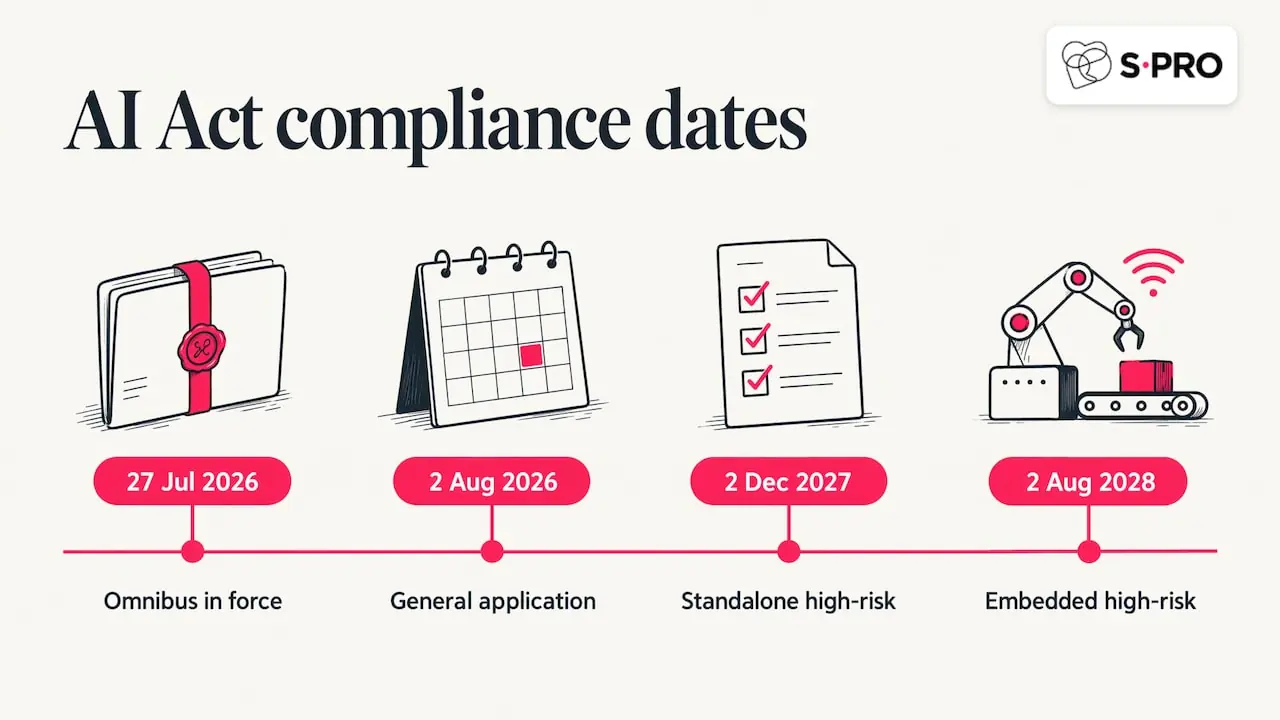
Swiss institutions can fall under the EU AI Act where a system is placed on the EU market or its output is used in the EU (Article 2); check this for your set-up. For their domestic operations, FINMA’s supervisory guidance is the reference point.
The Swiss FinTech Innovations and OST report (survey of 24 Swiss financial institutions, summer 2025) rates data privacy and security (3.95 of 5), data quality and availability (3.76), uncertainty about regulatory compliance (3.09) and the lack of a solid business case (3.05) as the strongest obstacles between proof of concept and production. Integration with legacy systems scores lower (2.43). Those obstacles cost time and money that a demo budget does not show.
Need a cost view for your own process? Tell us the process, the systems it touches and the hosting you need, and we will map the drivers with you. Book a discovery call.
Build cost and run cost need separate lines
Treat the agent as a service that is built once and operated for years. Build cost covers discovery, integration, data preparation, validation and the first release. Run cost covers model usage, hosting, oversight staff, monitoring and change.
A workable planning sequence is:
- Pick one process with a clear owner and a measurable outcome.
- List the systems, data and hosting constraints for that process.
- Decide where a person approves.
- Estimate case volume and steps per case.
- Define who monitors and who revalidates.
- Compare the full picture with the business value you expect, using your own baseline.
The SBA recommends proof-of-concept projects to validate technological requirements and to support legal and regulatory compliance. A proof of concept earns that role when it is built on the production path: same hosting, same integration approach, same oversight design. Our page on AI pilot to production describes how we approach that move.
For repetitive back-office work, process automation agents are often the first scope, because the steps are defined and the oversight points are clear.
How the drivers differ by use case
The drivers weigh differently depending on the use case, so a single figure for “an AI agent in a bank” is not meaningful. Use this table as a starting frame, not as a classification.
| Use case | Where the cost concentrates | What to settle first |
|---|---|---|
| KYC onboarding agents | Document handling, integration with onboarding and case systems, oversight of exceptions | Which checks stay with a person |
| AML & transaction monitoring | Integration with existing monitoring, alert review design, validation | How the agent fits alongside current AML systems |
| RM & wealth copilots | Access to client data and documents, permissions, Swiss hosting | Which client data the copilot may use |
| Reporting and document workflows | Document preparation, template variety, review steps | How many document types and formats |
Whatever the use case, check Annex III against it before deciding how much oversight and documentation to plan for.
Our perspective: cost follows design decisions
Banks often ask what an agent costs before they have said what it should own. We start the other way round: one process, its systems, its data, its oversight points. Once those are named, most of the cost drivers in this article become concrete questions with concrete answers.
We build our solutions on S-PRO Agents, our agentic platform, and run it as a service. That keeps build and run in one plan, so the bank sees the full picture from the first workshop. Our experience across 100+ AI projects, 40+ of them agentic, is that the pilots which reach production are the ones designed for hosting, integration and oversight from day one.
The same discipline applies to engineering. Our work on fintech software development and AI-native SDLC is built on the view that quality controls belong inside the delivery process, not after it.
The S-PRO team
How S-PRO helps banks and financial institutions
S-PRO is an international Swiss-American firm with offices in Zurich and Salt Lake City, and global delivery. We were founded in 2014, have 250+ engineers, and are ISO 27001 and ISO 27701 certified. We take EU AI Act, FINMA and DORA requirements into account in design.
We help banks scope an agent, connect it to existing systems, design human oversight and move from pilot to production. We build the solution on S-PRO Agents and run it as a service. For wider platform needs, see our fintech software development work. To discuss your process, book a discovery call with S-PRO.
FAQ
Is there a fixed price for an AI agent in a bank?
No, because cost depends on scope, integration, data, hosting, validation, oversight and monitoring. Two agents with similar names can differ widely once those are defined. For a first step, we offer a design thinking pilot from USD 20k, 2–4 weeks, which turns the drivers into a scoped plan.
What is usually the biggest cost driver?
In our delivery experience, integration with existing systems and data preparation are often the largest, because the agent must read and write inside the bank’s current landscape. The Swiss Bankers Association lists data management and legacy integration among the factors to plan for. In our experience the model itself is usually a smaller part of the total.
Do Swiss hosting requirements raise the cost?
They can, depending on your set-up. The Swiss Bankers Association says infrastructure should support data residency requirements, where customer data might be required to stay in specific locations. Whether that raises your cost depends on your set-up. Settle hosting before the pilot so the pilot and production share the same architecture and you avoid a rebuild.
Are oversight and monitoring one-off costs?
No, they recur. Human review takes staff time every day, and monitoring, security updates and revalidation continue as long as the agent runs. Include them in the run budget alongside model usage and hosting.
Sources
- Swiss Bankers Association, Generative AI in Banking (April 2025)
- Swiss FinTech Innovations and OST, Bridging the AI PoC–Production Gap (29 October 2025)
- FINMA Guidance 08/2024, Governance and risk management when using artificial intelligence (18 December 2024)
- BaFin, Orientierungshilfe zu IKT-Risiken beim Einsatz von KI in Finanzunternehmen (18 December 2025)
- AI Act Service Desk, Article 14: Human oversight
- AI Act Service Desk, Article 26: Obligations of deployers
- European Commission, AI Act regulatory framework
Last updated 13 November 2026
Subscribe


Thank you!
Get ready! You will receive handpicked content right to your inbox.