
A bank should choose an engineering partner that has taken regulated AI agents into production, accepts a clear split of risk in the contract, and hands over everything you need to run the system without it. Three kinds of provider can build AI agents for a bank: software platforms, large integrators and specialist engineering firms. Which one fits depends on how much of the build, the integration and the regulatory documentation you want to own.
Key Takeaways
- Banks have three realistic options: configure a software platform, hire a large integrator, or work with a specialist engineering partner. They differ mainly in who carries integration, risk and documentation.
- Score vendors before signing on six criteria: anonymised production delivery, risk ownership, security certificates and their scope, team continuity, exit and handover, and IP.
- FINMA Guidance 08/2024 is guidance, not a rule, and it does not require a scorecard. It does show where supervisors look in bought AI: what the AI is, what data it uses, and who is liable.
- A red flag is an answer that stays general. Ask for production references, named roles and contract language, not slide decks.
Table of Contents
- The three kinds of provider that build AI agents for banks
- What you are actually buying: use cases that agents handle well
- What FINMA, data protection and the EU AI Act mean for your choice
- The scorecard: six criteria to score before you sign
- A selection process that works in practice
- Our perspective
- How the provider types compare for a Swiss private bank
- Promo: custom AI agents for banks, built and run
- FAQ
- Sources
The three kinds of provider that build AI agents for banks
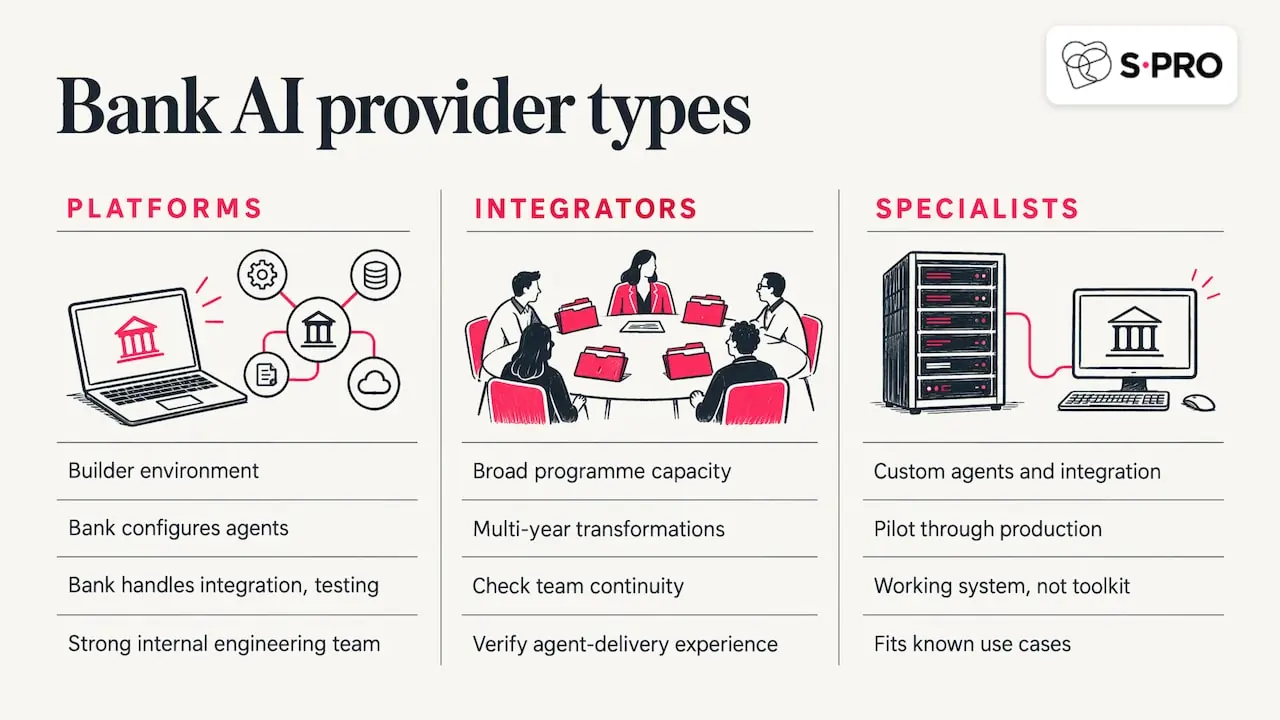
A bank can buy a platform, commission an integrator or work with a specialist engineering partner, and each answers a different question. The first sells you a tool, the second sells you capacity and programme management, the third sells you a working system built around your existing stack.
Software platforms provide a builder environment. Your teams configure agents, connect data and run them. This suits a bank with a strong internal engineering and model-risk function that wants to own every configuration decision. The work that remains with you is large: integration into core and document systems, testing, monitoring, and the documentation a supervisor expects.
Large integrators and consultancies bring programme management and broad capacity. They fit multi-year transformation programmes where AI agents are one stream among many. The questions to press are team continuity and how much agent-specific delivery experience the people on your project actually have.
Specialist engineering partners build custom agents, integrate them with core systems and carry the system from pilot into production. They fit banks that know the use case, such as KYC onboarding, alert triage or relationship manager (RM) support, and want a working system rather than a toolkit. Our own AI agents for banks work falls in this category.
The Swiss Bankers Association (April 2025) states that no one-size-fits-all approach to generative AI exists for banks. It recommends aligning with business strategy, robust IT infrastructure, risk controls and staff training. The provider type should follow from that alignment, not the other way round.
What you are actually buying: use cases that agents handle well
Agents work best on bounded steps inside a controlled workflow, so define the use case before you look at vendors. The Swiss Bankers Association lists document summarization, report generation, translation, data entry and validation, compliance reporting, fraud detection, risk assessment, customer onboarding, loan-documentation support and customer-service assistance as generative AI uses in banking.
In an interview roundup published by the Swiss Finance Institute on 29 October 2026, a Migros Bank representative described agents as most useful for bounded steps in deterministic workflows, such as reading documents and extracting unstructured data. The same source names personal-productivity agents, for example mailbox triage and task prioritization, as a viable near-term use case. It also cautions against orchestrating an entire bank process with AI at this stage, because non-deterministic end-to-end workflows create security and operational exposure.
For a private bank or wealth manager, this points to a practical shortlist:
- KYC and onboarding: reading identity and source-of-wealth documents, extracting fields, drafting a file for a human reviewer.
- RM support: preparing client meetings, summarizing correspondence, drafting follow-ups.
- Reporting: assembling periodic reports from several systems for review.
- Compliance operations: triaging alerts and screening hits so analysts see the relevant cases first.
A vendor who cannot discuss your use case at the level of steps, inputs, outputs and the point where a human decides is not ready to build it.
What FINMA, data protection and the EU AI Act mean for your choice
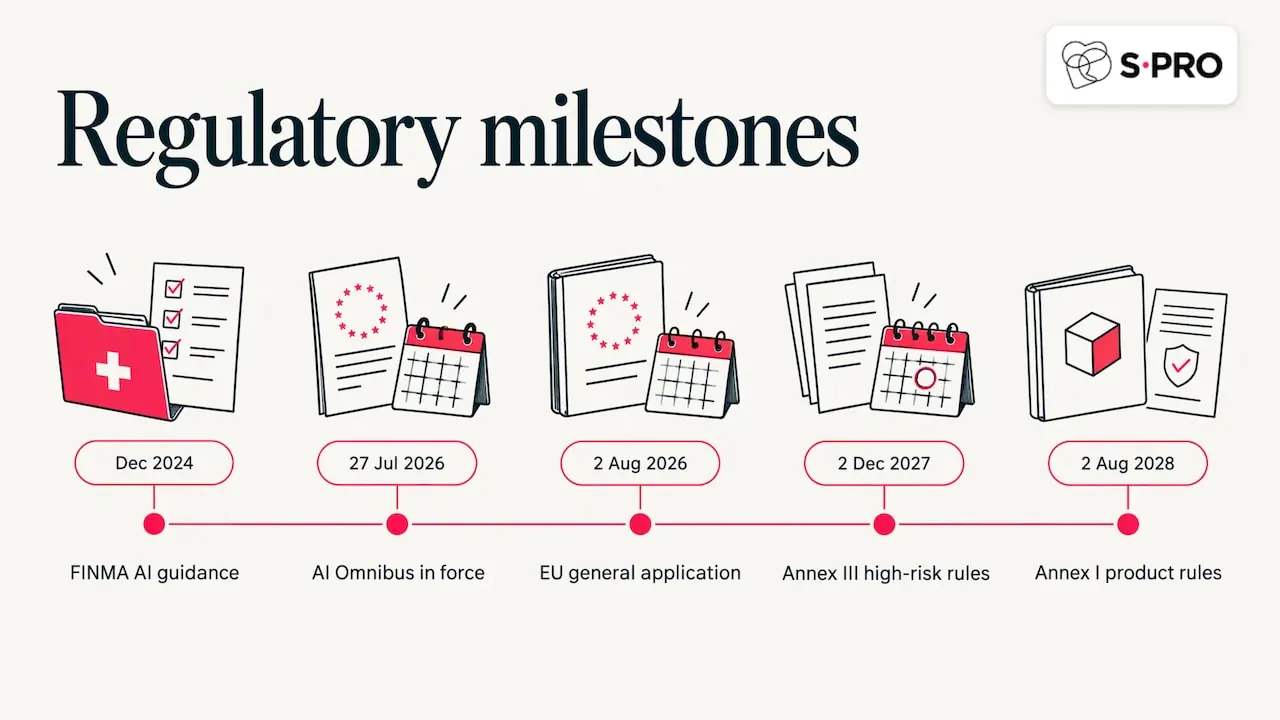
Swiss supervision treats AI as part of existing governance and risk management, so your vendor choice becomes a governance decision. FINMA published Guidance 08/2024 on governance and risk management when using AI in December 2024. It is guidance, not an ordinance, and it does not prescribe a vendor scorecard.
Its section 2.1 is the relevant one for buyers. FINMA observed that, for AI applications bought from third parties, institutions sometimes could not tell whether AI was included at all, which data and methods were used, or whether their due diligence was sufficient. FINMA also assessed contract clauses on responsibilities and liability. Those three gaps shape the scorecard below: ask what is AI in the product, what data it touches, and who is liable for what.
Data protection. According to the Swiss Bankers Association paper, the Federal Act on Data Protection applies whenever personal data is processed. It requires compliance with the processing principles and with data security, and high-risk processing calls for a data-protection impact assessment. The paper adds that a person may generally ask to state their view and obtain review by a natural person where a decision rests exclusively on automated processing and significantly affects them. For agents, this is a design requirement: a human review step has to exist in the workflow, not just in policy.
EU AI Act. If you serve EU clients or operate in the EU, the EU AI Act can apply to your systems. Regulation (EU) 2026/1744, the AI Omnibus, is in force since 27 July 2026. Under it, stand-alone high-risk (Annex III) obligations apply from 2 December 2027, and high-risk AI embedded in products (Annex I) applies from 2 August 2028. 2 August 2026 is the general application date, with exceptions, not the date for high-risk obligations. The European Commission’s AI Act page carries the current timeline. Whether a given agent is high-risk is not something to settle in a vendor pitch: check Annex III against the use case, with your legal and compliance teams.
The scorecard: six criteria to score before you sign
Score every candidate on the same six criteria, with the same questions, and ask for evidence in writing. The table turns the FINMA observations and the Swiss Bankers Association recommendations into questions a CIO, COO or Head of Compliance can put to any provider. It is a buyer’s tool of our own making, not a FINMA requirement.
| Criterion | Question | Good evidence | Red flag |
|---|---|---|---|
| Anonymised production delivery | Which agent systems are live at regulated institutions, and what do they do in the workflow? | A described use case, the human decision point, the systems integrated, a reference call you can arrange | Only pilots or demos; logos without a described system; “we cannot say anything about any client” with no anonymised detail |
| Who owns which risk | Who is responsible for model errors, data leakage, outages and regulatory documentation, and where is that written? | A responsibility matrix attached to the contract; liability clauses that match the split | Liability described as shared without detail; all model risk assigned to the bank |
| Security certificates and their scope | Which certificates do you hold, and do they cover the team, the environment and the data that will touch our project? | Certificate documents showing the scope statement, and a written answer on how your project falls within it | A certificate named without a scope document; a scope that excludes the delivery environment |
| Team continuity | Who will work on our project, for how long, and what happens if a key person leaves? | Named roles, a staffing plan, a handover practice, engineers who stay through production | Senior people in the pitch and different people in delivery; no answer on replacement |
| Exit and handover | What do we receive if we end the contract: code, prompts, evaluation sets, runbooks, documentation? | A handover list in the contract; documentation written for your operations team | Dependence on the vendor’s runtime with no export path; documentation “available on request” |
| IP | Who owns the custom components, the prompts and the evaluation data? Which parts are reused from the vendor’s platform? | Clear split between your IP, vendor background IP and third-party model terms | Ambiguity on derivative work; no list of third-party components |
To apply the table, give each criterion a weight that reflects your bank’s priorities, score each vendor from one to five, and record the written evidence next to the score. A vendor who answers the same questions the same way in a meeting and in a contract is a safer partner than one whose answers change.
Reading the answers
Three patterns separate strong answers from weak ones.
- Specifics against generalities. A good answer names the workflow step, the data source and the person who approves. A weak answer talks about “AI transformation”.
- Contract-ready language. If a statement about responsibility cannot be turned into a contract clause, it is a promise, not a position. FINMA looked at exactly these clauses.
- Visibility of AI. Ask the vendor to list every place AI, including third-party models, sits in the product or service. This answers the first gap FINMA described: not knowing whether AI is included or which data and methods are used.
A selection process that works in practice
A structured process takes a bank from long list to signed engagement without losing the evidence. The steps below follow the order in which questions become decisive.
- Define the use case and the human decision point. One workflow, such as KYC document review, with inputs, outputs and the person who approves.
- Set the constraints. Data hosting in Switzerland if your policy requires it, the systems to integrate, and the regulators whose rules apply.
- Choose the provider type. Platform, integrator or specialist partner, based on how much you want to own.
- Send the same written questions to three or four candidates. Use the scorecard so answers are comparable.
- Check references and certificates. Ask for the scope statements and speak to a regulated institution that has a system in production.
- Negotiate responsibilities and handover first. Settle the risk matrix, IP and exit terms before the commercial detail.
- Start with a defined pilot that is built for production. The pilot should use real integration points and logging, so that moving to production is an extension, not a rebuild.
The last step is where many projects stall. A pilot built on sample data, without audit logs or a review step, proves little about production. Our page on AI pilot to production covers that path.
Talk to our engineers about your use case
Our perspective
We build AI agents for banks, wealth and asset managers, insurers and fintechs, and the buying question we hear most is simple: who is accountable once the agent is live? Our answer starts with the architecture. Every solution is built on S-PRO Agents, our own agentic platform, and we run it as a service, so one team answers for the system from build to operation.
We design solutions with EU AI Act, FINMA and DORA requirements in mind. That means human-in-the-loop steps, audit trails and documentation are part of the design from the first sprint, not added before an audit.
We would also ask you to judge us by the scorecard above. S-PRO has delivered 100+ AI projects, 40+ of them agentic AI projects. We are ISO 27001 and ISO 27701 certified, and S-PRO is a Certified partner in the Claude Partner Network. Our team includes Claude-certified engineers and architects. We are an international Swiss-American firm with offices in Zurich and Salt Lake City, and global delivery.
The S-PRO team
How the provider types compare for a Swiss private bank
For a private bank or independent wealth manager, the specialist engineering route is the most direct way from a defined use case to a supervised, live system. The comparison below sets the three provider types against the questions a COO or CIO usually asks.
| Question | Software platform | Large integrator | Specialist engineering partner |
|---|---|---|---|
| Who builds the agent? | Your team configures it | Integrator team, often mixed seniority | Engineers who build and integrate it for you |
| Who integrates with core and document systems? | You, with platform connectors | Integrator, as part of a programme | The partner, as part of the build |
| Who prepares regulatory documentation? | Mostly you | Shared, scope-dependent | Written into the engagement and delivered with the system |
| Best fit | Strong in-house engineering | Multi-year transformation programmes | A defined agent use case that needs to reach production |
The ranking among specific firms is outside the scope of this article, and any list that ranks vendors without disclosing its method is a poor basis for a regulated purchase. Your own scorecard is the better instrument.
Promo: custom AI agents for banks, built and run
We build AI agents for banks on S-PRO Agents and run them as a service, covering use cases such as KYC onboarding agents, AML & transaction monitoring and RM & wealth copilots. Solutions are designed with EU AI Act, FINMA and DORA requirements in mind.
If you are comparing providers, send us your scorecard. We will answer the same questions in writing.
FAQ
Can a bank build AI agents in-house?
Yes, if it has engineers with experience in agent design, evaluation and secure integration, plus a model-risk function that can validate the result. Many banks combine an internal product owner with an external engineering partner. This keeps decisions in-house while the partner supplies build capacity and production experience.
Does FINMA require a specific vendor selection process for AI?
No. FINMA Guidance 08/2024 is guidance, not a rule, and it does not prescribe a scorecard. It does describe weaknesses in how institutions handled bought AI applications, including unclear AI content, data and methods, and contract clauses on responsibility and liability. A structured selection process helps you address those points.
What should be in the contract for an AI agent project?
At minimum: a responsibility matrix for model errors, data protection and outages; IP ownership for custom components, prompts and evaluation data; named team roles; and a handover list covering code, documentation and runbooks. These terms answer the liability and responsibility questions FINMA looked at in its assessment.
How much does a first step cost?
Our design thinking pilot from USD 20k, 2–4 weeks. It is a way to define the use case, the human decision point and the integration needs before committing to a full build. Scope for a production system depends on the use case and the systems involved.
Sources
- FINMA Guidance 08/2024, Governance and risk management when using artificial intelligence (December 2024)
- Swiss Bankers Association, Generative AI in Banking (April 2025)
- Swiss Finance Institute, AI interview roundup (29 October 2026)
- European Commission, AI Act regulatory framework
Last updated 16 November 2026
Book a discovery call with S-PRO
Subscribe


Thank you!
Get ready! You will receive handpicked content right to your inbox.