


Regulatory reporting automation means replacing manual data gathering, spreadsheet reconciliation and last-minute checks with a governed pipeline. The pipeline runs from source systems to validated submission, and every figure can be traced back to its origin. For a Swiss bank, the work that pays off first is not a new reporting tool. It is getting your data, your validation rules and your audit trail to match how supervisors now check them.
This guide is for CTOs, CIOs and heads of digital transformation at banks and financial institutions. It covers what has changed on the regulator side, which parts of the process are worth automating, where AI agents fit, and how to sequence a project without touching your core banking system.
TL;DR
- Supervisors now validate data at a granular level, not only in the final report. FINMA has moved capital adequacy surveys onto its own EHP platform and applies automated validations and consistency checks to all reports.
- Data quality and lineage come before AI. The Basel Committee ties the quality of AI output to the quality of the source data.
- Automate in stages on top of existing systems: data collection, transformation, validation, reconciliation, submission, then monitoring of regulatory change. Keep human checkpoints where judgment is needed.
- Build the business case on fewer queries from the regulator, shorter reporting cycles and lower remediation effort, not on headcount alone.
- Start with one report family, a defined data lineage map and measurable validation rules, then extend.
Table of Contents
- What has changed on the supervisor side
- Why validation logic belongs at the data level
- Fix data governance before you add AI
- What to automate, layer by layer
- Compliance workflow automation beyond the report itself
- Where AI agents fit, and where they do not
- Our perspective: automate around the core, and build trust in the numbers first
- A practical sequence for a Swiss institution
- Build, buy or combine
- How S-PRO can help
- Measuring whether it works
- FAQ
- Sources
What has changed on the supervisor side
The case for automation used to rest on efficiency. It now also rests on how regulators work.
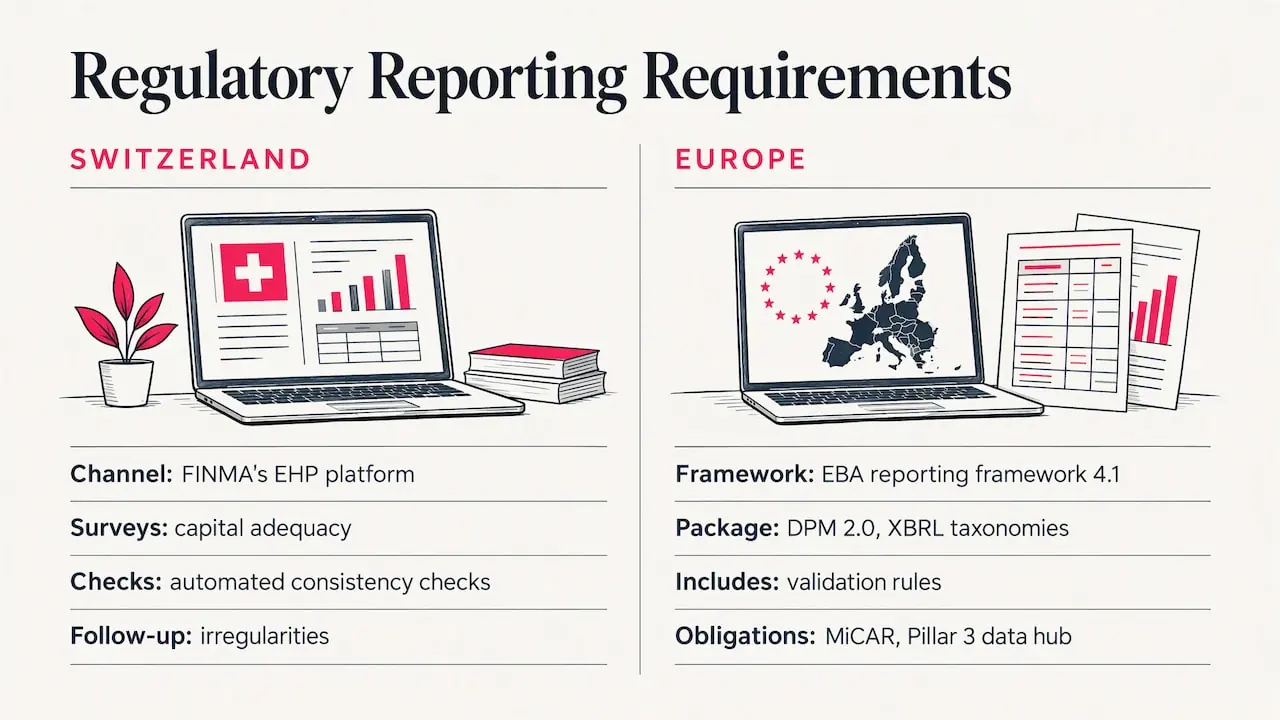
In its 2025 annual report, FINMA states that since the final Basel III reforms took effect on 1 January 2025, capital adequacy surveys run directly on its EHP platform, replacing the earlier process led by the Swiss National Bank. FINMA states that all reports are subject to automated validations and consistency checks, supplemented by expert reviews, and that it attaches great importance to the quality of the data submitted. FINMA also describes the web-based survey and application platform as the channel for submitting applications, reports and data.
In practice, this means a report that looks right on the surface can still raise questions if the underlying data does not pass the same consistency logic the supervisor applies. A manual process, where figures are assembled in spreadsheets and checked by eye, finds those problems after submission rather than before.
The European picture points the same way. The EBA’s reporting framework 4.1 comes with a final technical package, published on 28 May 2025: the Data Point Model (DPM) 2.0, XBRL taxonomies and validation rules. Check the EBA’s reporting-frameworks page for the version that applies to you. It also supports the Pillar 3 data hub, where institutions’ prudential disclosures are centralised. If you serve EU clients or run an EU entity, your reporting stack has to follow these machine-readable structures.
Why validation logic belongs at the data level
One of the most useful ideas in the research comes from the Austrian central bank. Johannes Turner of the OeNB argues that RegTech should work backwards from the regulator’s transformation rules to the granular data. Institutions can then run internal data quality management that is aligned with the regulator’s own validation logic. The stated benefit is fewer audit queries and less costly remediation.
FINMA’s annual report points in the same direction. Supervisors increasingly drill down, so validations run at the level of the underlying data cube and not only on the final output. A bank whose internal transformation logic mirrors the supervisor’s Data Point Model structure has fewer reconciliation errors and fewer manual queries to answer.
For your architecture, three consequences follow:
- Keep the granular data. Do not aggregate early. Retain the transaction- or position-level data from which every reported figure is derived.
- Version the rules. Store transformation and validation rules as managed assets with owners and change history, not as formulas hidden in workbooks.
- Validate before you submit. Run the supervisor’s checks internally, at every stage of the pipeline.
Fix data governance before you add AI
It is tempting to start with the most visible technology. The Basel Committee’s guidance on BCBS 239 is a useful corrective. In its implementation work on risk data aggregation and risk reporting, it notes that emerging AI technologies hold promise, but the quality of their output depends on the source data. Institutions should therefore build sound enterprise-wide data governance first.
The same material identifies data lineage as the hardest part of BCBS 239 implementation, because legacy systems are fragmented and data estates are distributed. Lineage is resource-intensive to establish. The long-term benefits in cost and operational efficiency have to be demonstrated to secure internal funding.
That last point matters for anyone writing a business case. A lineage map is not glamorous, but it is the thing that lets you answer a supervisor’s question faster. The Basel Committee’s progress report on the principles also notes that some banks are implementing automated reporting platforms, so you are not alone in this direction.
What to automate, layer by layer
A reporting process has distinct stages, and each has a different automation profile.
| Stage | Typical manual pain | What automation does | Human role |
|---|---|---|---|
| Data collection | Extracts from many systems, manual file handling | Scheduled, monitored ingestion from source systems with lineage captured | Owns source definitions |
| Transformation | Logic buried in spreadsheets | Versioned rules aligned to the regulator’s data model | Approves rule changes |
| Validation | Errors found late or by the supervisor | Automated validations and consistency checks at data and report level | Resolves exceptions |
| Reconciliation | Manual comparison across reports | Cross-report checks with documented breaks | Explains and signs off variances |
| Submission | Last-minute uploads | Controlled submission with a full audit trail | Final approval |
| Regulatory change | Reading publications by hand | Monitoring of new rules and mapping to affected reports | Decides on impact and response |
The first three rows deliver most of the quality gain. The last row is where newer AI-based tools are most useful, because reading and classifying regulatory text is a task language models handle well, as long as a person confirms the result.
Compliance workflow automation beyond the report itself
Reporting does not sit alone. The same data and the same control logic feed adjacent workflows, such as policy management, incident handling and evidence collection for audits. Automating them on a shared foundation avoids building several parallel pipelines.
Three workflows usually share infrastructure with reporting:
- Policy and procedure management. Linking regulatory requirements to internal policies and controls. Our overview of policy automation software explains how this works in practice.
- Control testing and evidence. Collecting evidence automatically from systems rather than requesting screenshots from teams.
- Exception handling. Routing validation failures to the right owner with a deadline and a record of resolution.
If compliance sits with a small team, this is often where the first hours are saved, even before the reporting pipeline is rebuilt.
Where AI agents fit, and where they do not
Agentic automation is attractive in compliance because much of the work is repetitive reading, matching and drafting. Industry material from UiPath on banking automation argues that regulatory automation should layer on top of core systems rather than replace them, using governed platforms with human-in-the-loop checkpoints, durable execution and PII filtering to keep results audit-ready.
That design principle is sound. For reporting, agents can be assigned tasks like these:
- Draft explanations for variances between reporting periods, for a person to review.
- Classify new regulatory publications and flag the reports and data fields they touch.
- Triage validation failures and suggest the likely source system or rule responsible.
- Prepare evidence packs for audit requests from existing lineage records.
We would not let an agent submit a report, change a validation rule or sign off a reconciliation break without a named person approving it. Reporting is a regulated attestation, and responsibility cannot be delegated to software.
Our perspective: automate around the core, and build trust in the numbers first
The reporting tool is rarely the bottleneck. The bottleneck is that the data a report needs lives in several systems, each with its own definitions, and nobody can show how a figure was derived.
Our advice is to work in this order. First, map the lineage for one report family and write down the validation rules the supervisor applies. Second, build the validation layer on that data so that errors surface internally. Third, add agents for the work around the edges: change monitoring, variance commentary, evidence preparation. Throughout, integrate with your existing core banking and data platforms instead of proposing a replacement. Our piece on core banking integration covers the typical pitfalls.
Teams should also treat the business case honestly. Vendor claims of faster go-live and lower infrastructure cost exist, but they are benchmarks from vendor material, and your results depend on your data estate. Measure your own baseline first: hours per reporting cycle, number of supervisor queries, number of late corrections. Then you can show a real before and after.
— Igor
A practical sequence for a Swiss institution
This is a recommended order, in five project steps (separate from the six process stages in the table above). A first project can cover the first three or four of them. Timelines depend on your systems, so we do not promise fixed durations.
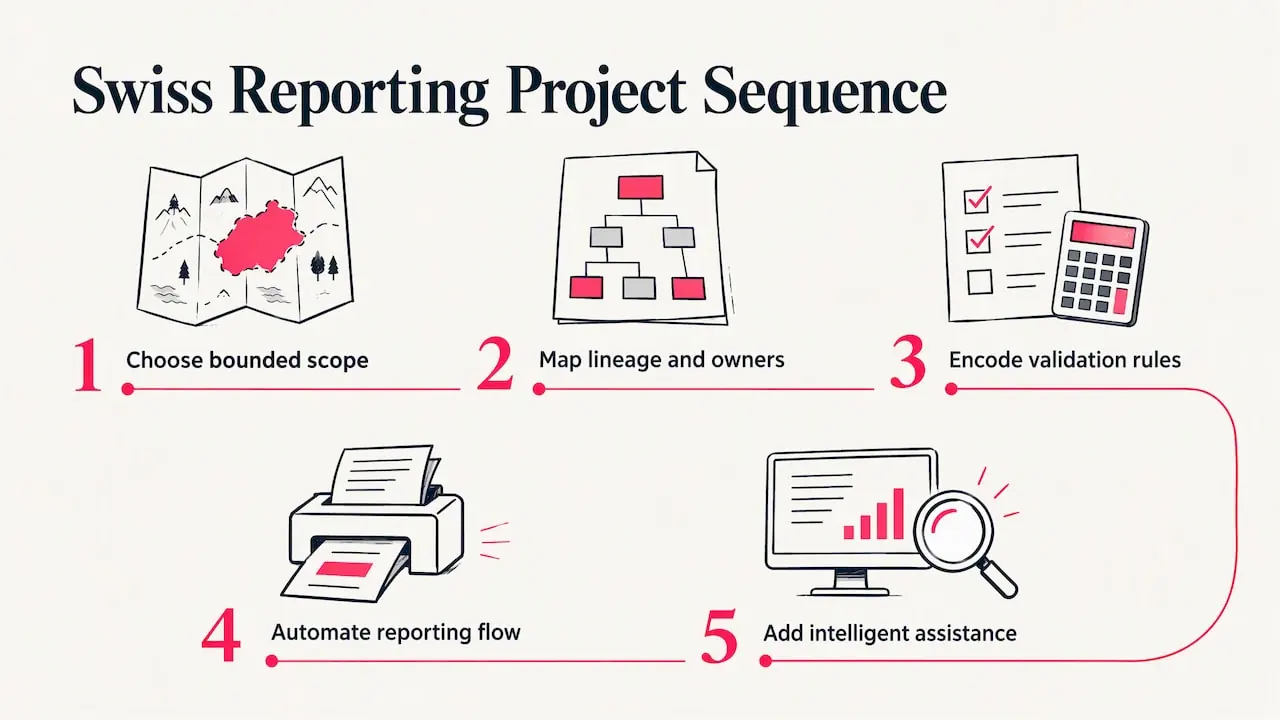
1. Pick a bounded scope
Choose one report family with clear pain: frequent corrections, many manual steps or a coming regulatory change. For a Swiss bank, capital adequacy reporting via the EHP platform is a natural candidate, given the validation expectations described above. For an EU-facing entity, a report affected by the current EBA reporting framework may be the better start.
2. Map lineage and owners
Document every field from report back to source system, with a named data owner. This is the step the Basel Committee flags as hardest, so budget time for it.
3. Encode validation rules
Implement the supervisor’s validations and your own consistency checks as versioned, testable rules. Run them against historical submissions to see how many issues they would have caught.
4. Automate the flow
Connect ingestion, transformation, validation and submission with monitoring and an audit trail. Keep approval steps explicit and logged.
5. Add intelligent assistance
Only after the data layer is stable, add agents for change monitoring, commentary and evidence. The regulatory compliance updates for digital banking give context on how quickly the rule set moves.
Build, buy or combine
Most institutions end up with a combination. Three options are common, described here by type:
- Packaged reporting platforms from established software vendors. They bring pre-built templates and taxonomy updates, which suits standard returns, but they can be hard to adapt to your data model.
- Large consulting-led programs. They offer broad capacity and methodology, with higher cost and a risk of dependency.
- Custom engineering around your existing stack. This gives control over lineage, validation and integration, and fits institutions with specific product lines or legacy constraints.
Custom engineering is often used alongside a packaged platform where the standard returns are already covered. The right choice depends on how much of your reporting is standard, how fragmented your data is, and how much control your compliance and IT teams want over the rules.
How S-PRO can help
We design and build regulatory monitoring and compliance automation for banks and financial institutions; see our page on regulatory reporting automation for banks. Our security and compliance practice for financial institutions covers delivery in regulated environments. Our data services team handles lineage, analytics and data quality foundations, and our custom AI agent development team builds agents with human review built in. If you want to scope a first reporting project, our technology consulting team can start with an IT strategy and roadmap for your reporting landscape.
Measuring whether it works
Decide the metrics before the build, and report them to the steering group each cycle.
- Cycle time: working days from period end to submission.
- First-pass validation rate: share of checks that pass without manual correction.
- Supervisor queries: number received per submission, and time to answer.
- Resubmissions: count and cause.
- Lineage coverage: share of reported fields with documented, automated lineage.
- Effort: hours spent per cycle on collection, reconciliation and commentary.
The OeNB argument about aligning internal checks with the regulator’s logic suggests that supervisor queries and resubmissions are the metrics most likely to move first. Effort savings usually follow once validation moves earlier in the process.
FAQ
What does regulatory reporting automation mean?
It means using software to run the steps of regulatory reporting, from data collection and transformation to validation, reconciliation and submission, with a documented audit trail. People still review exceptions and approve submissions. The aim is fewer manual touchpoints and errors caught before the supervisor sees them.
How do banks automate regulatory compliance?
They usually begin with data governance and lineage, then encode validation rules, then automate workflows such as submissions, evidence collection and policy management. AI agents are added on top for monitoring regulatory change and drafting commentary, with human checkpoints. Doing it in this order follows the Basel Committee’s emphasis on data quality before AI.
Does automation require replacing our core banking system?
No. A sound approach layers automation on top of existing systems, integrating through APIs and data pipelines. Replacing the core is a separate decision with its own business case, and it is not a prerequisite for better reporting.
Which Swiss reporting obligations are affected?
FINMA now runs capital adequacy surveys on its EHP platform and applies automated validations and consistency checks to the reports. Which other returns apply to you depends on your license and business model, so confirm the list with your compliance function and FINMA’s published guidance. If you also have EU activities, the EBA’s reporting framework applies to the relevant entities.
Sources
- FINMA Annual Report 2025: digital strategy and data-driven supervision
- FINMA: EHP survey and application platform
- EBA: final technical package for reporting framework 4.1
- EBA: reporting frameworks
- OeNB’s reporting data model as RegTech/SupTech solution (BIS)
- BCBS 239 implementation (BIS)
- Progress in adopting the BCBS 239 principles (BIS)
- UiPath: banking automation solutions for agentic AI
Recommended
Subscribe


Thank you!
Get ready! You will receive handpicked content right to your inbox.