

BCBS 239 compliance comes down to one test: can your bank show, on demand, where each number in a risk report came from, who owns it and how it was transformed? AI agents cannot replace the governance and architecture the standard requires. Used on top of sound data, though, they can cut manual aggregation, keep lineage current and assemble the evidence supervisors ask for. This article is for CROs, COOs and CIOs at Swiss and EU banks. It walks through the principles, the gaps that persist and a practical way to use AI agents without creating a new audit problem.
Last updated: 24 October 2026
TL;DR
- BCBS 239 sets 14 principles for risk data aggregation and risk reporting: 11 for banks and 3 for supervisors.
- The Basel Committee’s own progress reporting shows banks at different stages almost ten years after publication, with data architecture and lineage as recurring hurdles.
- AI agents help most with lineage discovery, reconciliation, data quality checks and evidence packs. They do not fix poor foundational data.
- Any AI agent you add becomes part of the risk data chain, so it needs audit trails, human-in-the-loop controls and EU AI Act documentation of its own.
Table of Contents
- What BCBS 239 requires, in plain terms
- The 14 principles at a glance
- Where banks still struggle
- Start with Principles 1 and 2
- Where AI agents fit in a BCBS 239 program
- The condition: good data first
- The agent is part of the risk data chain
- A staged approach for CRO, COO and CIO
- Questions to ask before you start
- Our perspective
- How S-PRO helps
- FAQ
- Sources
What BCBS 239 requires, in plain terms
The Basel Committee on Banking Supervision published its Principles for effective risk data aggregation and risk reporting in January 2013. The aim is to strengthen a bank’s ability to aggregate risk data and identify concentrations in a timely, accurate and comprehensive way, especially in stress. The standard was written for global systemically important banks. The same document encourages national supervisors to apply the principles to domestic systemically important banks as well, so the reach in practice depends on how your supervisor applies it.
In Switzerland, FINMA integrates international standards, including those of the Basel Committee, into its supervisory practice. It also stresses that institutions themselves are primarily responsible for identifying and managing material risks. For a CRO, that means “we follow the standard” is not an answer. The bank has to be able to demonstrate it.
The 14 principles at a glance
The principles fall into four groups. The table summarizes them in our words, with the primary text in the Basel Committee publication.
| Group | Principles | What the bank must be able to show |
|---|---|---|
| Governance and infrastructure | 1 Governance, 2 Data architecture and IT infrastructure | Board and senior management ownership; architecture that supports aggregation in normal times and in stress |
| Risk data aggregation | 3 Accuracy and integrity, 4 Completeness, 5 Timeliness, 6 Adaptability | Reliable, largely automated aggregation across entities and risk types, available fast and adaptable to ad hoc requests |
| Risk reporting | 7 Accuracy, 8 Comprehensiveness, 9 Clarity and usefulness, 10 Frequency, 11 Distribution | Reports that are accurate, cover material risks, are readable, are produced at the right frequency and reach the right people |
| Supervisory review | 12 Review, 13 Remedial actions, 14 Home/host cooperation | What supervisors do; your job is to be ready for their review |
Principles 1 to 11 are yours. Principles 12 to 14 describe what supervisors do, so your evidence must be ready when they exercise them.
Where banks still struggle
The Basel Committee’s progress report (2023 report) states that nearly ten years after publication, and seven years after the expected compliance date, banks are at different stages. An earlier report covering the end of 2018 found that none of the assessed banks were fully compliant, with data architecture and IT infrastructure a challenge for many. A January 2026 Basel Committee newsletter summarizes the themes from recent supervisory and industry outreach. It confirms that implementation remains an active topic.
The same causes come up again and again:
- Fragmented IT landscapes. Risk, finance and treasury run on different systems with separate definitions.
- No common taxonomy. “Exposure” or “client” means different things across entities, so reconciliation becomes manual.
- Incomplete lineage. Teams can describe a report but cannot trace each figure back to source systems and transformations.
- Manual workarounds. Spreadsheets and email-based adjustments sit between systems and break the audit trail.
- Weak ownership. Data owners are named on paper but have no mandate or budget.
None of these is a flaw in the principles. They are the consequence of years of growth, acquisitions and legacy platforms.
Start with Principles 1 and 2
The Basel Committee treats governance and data architecture as preconditions. The 2013 text says a strong governance framework, risk data architecture and IT infrastructure are preconditions for compliance with the other principles. In its progress reporting, the Committee points to senior-management accountability and sufficient resources as what separates banks that move forward from those that stall.
This matters for any AI plan. If ownership is unclear and architecture is fragmented, an agent will only reproduce the inconsistency faster. We recommend that CROs and COOs agree three things before any build starts:
- A named owner for each critical risk data element, with authority across business lines and control functions.
- A shared taxonomy for the critical elements, even if it starts small.
- A mandate for second-line validation of aggregation capabilities, with documented processes.
Where AI agents fit in a BCBS 239 program
Practitioners cited in the Basel Committee’s progress work are cautious: automation should reduce manual interventions and help discover and visualize data flows, rather than try to replace legacy systems overnight. The use cases below are the ones where an agent has a clear, bounded task and a human reviewer.
Lineage discovery and maintenance (supports Principles 2, 3 and 6)
Lineage is the traceability of data from origin to final use. Supervisors and practitioners treat it as indispensable for data quality and compliance, yet it stays a significant hurdle. An agent can read ETL code, SQL, report definitions and data dictionaries, propose lineage links and flag where documentation and reality diverge. A data steward then confirms or rejects each proposal. The value is a lineage map that stays current as systems change, instead of a project that is stale on delivery.
Reconciliation and data quality triage (Principles 3, 4 and 7)
Principle 3 expects largely automated aggregation with reconciliation to authoritative sources. Agents can run reconciliation checks between risk and finance figures, group breaks by likely cause, and route each to the right owner with the evidence attached. This reduces the manual effort spent on investigation and leaves people to decide on the exceptions.
Handling ad hoc requests (Principles 5, 6 and 10)
When a supervisor or the board asks a new question, such as exposure to a sector or counterparty group, the delay is usually in finding the right data and definitions. An agent can map the question to critical data elements, identify the systems involved and prepare a draft extraction plan for human approval. The output still goes through the normal control process.
Evidence packs for review (Principles 1, 12 and 13)
A large part of the BCBS 239 workload is documentation: control descriptions, data owner registers, validation results and remediation status. Agents can assemble these from existing systems and keep them current, so the bank can answer a supervisory request from a maintained record, not from a scramble.
Report commentary and consistency checks (Principles 7 to 9)
Agents can compare a draft risk report with the previous period, flag unexplained movements and check that figures in the narrative match the tables. They should not publish anything on their own. Our article on regulatory reporting automation for Swiss and European banks covers related patterns.
The condition: good data first
AI cannot compensate for poor foundational data. If critical data elements are undefined or source systems disagree, agents will surface the problems but cannot resolve them. The sensible order is:
- Identify critical data elements and their owners.
- Standardize definitions for those elements.
- Apply agents to lineage, reconciliation and evidence on that scope.
- Expand once controls and results are validated.
This also fits integration reality. Most banks cannot replace core systems quickly, so agents should read from and write to existing systems through well-defined interfaces. Our guide on core banking integration challenges and strategies explains how to approach that layer.
The agent is part of the risk data chain
There is a trap here. Once an agent proposes a lineage link, a reconciliation result or a report comment, it influences risk data. The European Banking Authority says that advanced analytics must be balanced with traceability and auditability. Every step and choice in the analytics process should be transparent and reproducible, so supervisors can audit the chain from data gathering to final decision.
In practice, each agent used in risk data processes should meet these requirements:
- A complete audit trail: inputs, prompts or rules, model version, outputs and the human decision, stored immutably.
- Human-in-the-loop controls: defined approval points for anything that changes data, definitions or reports.
- Bounded permissions: read access by default; write access only through controlled workflows.
- Reproducibility: the ability to re-run a result and explain why it was produced.
- Regulatory documentation: a record of purpose, risks, testing and oversight. Where the EU AI Act applies to your use case, the documentation should address its requirements explicitly. Banks should check the classification of each agent against the text on EUR-Lex.
- Data residency: for Swiss banks, hosting and access arrangements that match nFADP and FINMA expectations.
These controls are also what makes an agent defensible in front of a supervisor. An agent without them reduces your BCBS 239 position instead of improving it.
A staged approach for CRO, COO and CIO
Here is how we suggest sequencing the work.
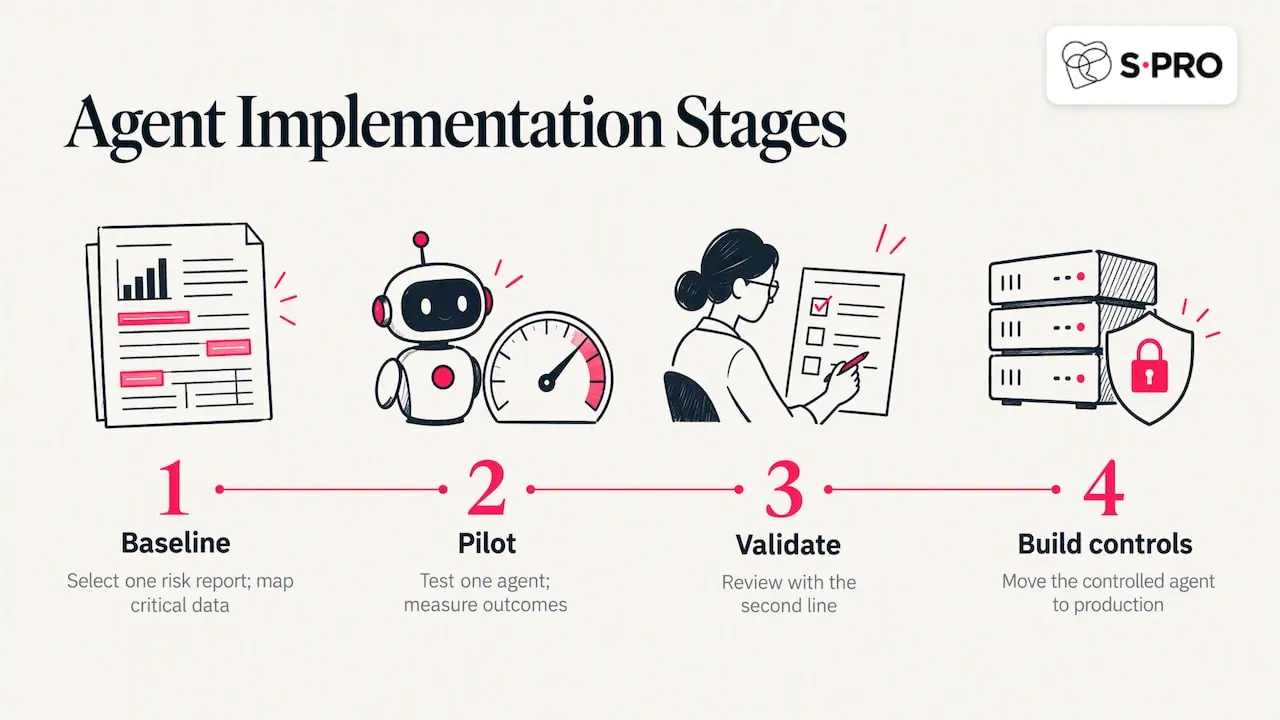
Stage 1: Baseline (scope definition)
Select one risk report, for example a liquidity or credit concentration report, and map its critical data elements. Document owners, sources and known manual steps. Run a gap assessment against the principles. Keep scope narrow so findings are actionable.
Stage 2: Pilot one agent with measurable outcomes
Pick one task from the list above, ideally lineage discovery or reconciliation triage. Define success in terms the second line accepts: fewer manual interventions, faster break resolution, lineage coverage of the in-scope elements. Record baselines before the pilot starts, so results are real and not anecdotal.
Stage 3: Validate with the second line
Banks that progress tend to have an independent team in the second line validating aggregation capabilities across risk, treasury and finance, with documented processes and clear guidance from the front office and control functions. Bring that team in at the start of the pilot, not at the end.
Stage 4: Move to production
Most AI pilots stall between proof of concept and live use because audit, security and integration requirements were never designed in. Build the controls from the previous section into the pilot so the move to production is an extension and not a rebuild. Then expand to further reports and entities.
Questions to ask before you start
Use these as a short checklist in your steering committee:
- Which critical data elements feed our most important risk reports, and who owns each?
- Can we trace three figures from a recent board report to source systems today, and how long does it take?
- Which manual steps sit between systems, and which of them are undocumented?
- Who in the second line will validate any agent’s output?
- Can we reproduce an agent’s result six months later?
- Where will the data and the model run, and does that satisfy our FINMA and data protection obligations?
If the answers are unclear, that is the first piece of work. It is also valuable input for your next supervisory discussion.
Our perspective
Our view is simple. The principles describe what a well-run bank should be able to do. The hard part has always been the plumbing: lineage, definitions and the manual steps nobody wrote down.
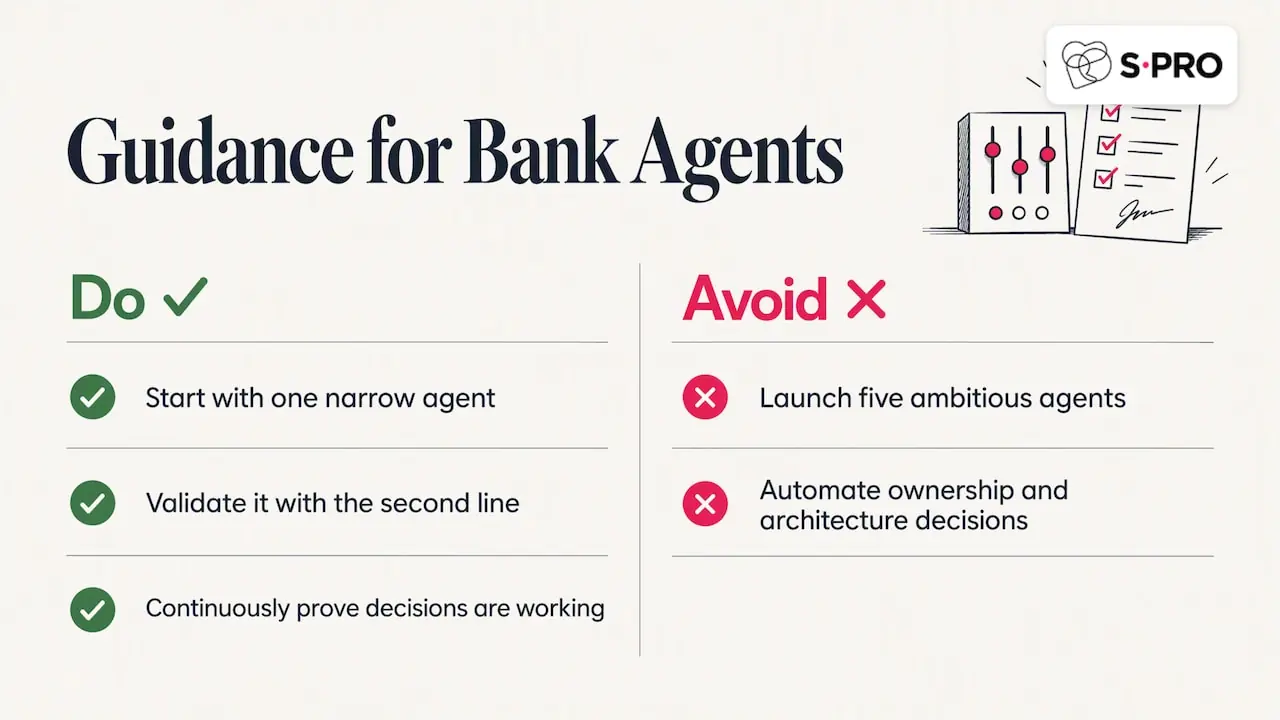
Agents are well suited to that plumbing. They read a lot of code and documentation, they do not tire of reconciliation breaks and they can keep a record current. But they only earn trust if they are built like any other control: scoped, logged, reviewed by people and documented for supervisors. We would rather see a bank start with one narrow agent that passes second-line validation than five ambitious ones that nobody can explain.
Banks should also be wary of treating AI as a shortcut around Principles 1 and 2. Ownership and architecture decisions cannot be automated. What can be automated is the effort of proving, continuously, that those decisions are working.
— Igor Izraylevych
How S-PRO helps
S-PRO is a Zurich-based software development company for banks, wealth managers, asset managers and fintechs. We design and build AI agents for banks and financial services and take them from pilot to production with audit trails, human-in-the-loop controls and documentation for the EU AI Act, FINMA and DORA. Our technology consulting services cover AI pilot to production, AI document processing and AI for AML, KYC and compliance.
For BCBS 239 work, we typically help with:
- scoping a pilot on one risk report and its critical data elements;
- building agents for lineage discovery, reconciliation triage and evidence assembly, integrated with your existing systems;
- designing the audit trail and second-line validation steps;
- preparing the regulatory documentation your supervisors and internal audit will ask for.
S-PRO was founded in 2014, has 250+ engineers and is ISO 27001 and ISO 27701 certified. S-PRO is a Certified partner in the Claude Partner Network, and our team includes Claude-certified engineers and architects. To scope a BCBS 239 pilot on one risk report, see our AI agent development service or book a discovery call.
FAQ
What are the BCBS 239 principles?
There are 14 principles in total, published by the Basel Committee in January 2013. Eleven apply to banks and cover governance, data architecture, aggregation capabilities and risk reporting. Three apply to supervisors. The full text is in the Basel Committee publication.
Does BCBS 239 apply to Swiss banks?
The standard was written for global systemically important banks, and supervisors are encouraged to apply it to domestic systemically important banks too. FINMA integrates international standards from the Basel Committee into its practice. Check with FINMA and your own supervisory contacts how it applies to your institution.
Can AI agents make a bank BCBS 239 compliant?
No. Compliance depends on governance, ownership and architecture. Agents can reduce manual work in lineage, reconciliation and evidence gathering, but only on top of reasonably standardized data. They also need their own audit trail and human oversight.
Why is data lineage so important for BCBS 239?
Lineage shows how a figure travels from source to report, which is what supervisors need to judge accuracy and integrity. The Basel Committee’s progress work describes it as a persistent hurdle for banks. Automating its discovery and upkeep is one of the most practical uses of AI in this area.
Sources
- Principles for effective risk data aggregation and risk reporting (BCBS 239), Basel Committee, 2013
- Progress in adopting the Principles for effective risk data aggregation and risk reporting, Basel Committee, 2023
- Progress report covering the end of 2018, Basel Committee, 2020
- Implementation of the BCBS 239 Principles, Basel Committee newsletter, January 2026
- FINMA Annual Report 2025: digital strategy and data-driven supervision
- EBA Report on Big Data and Advanced Analytics
Recommended
Subscribe


Thank you!
Get ready! You will receive handpicked content right to your inbox.