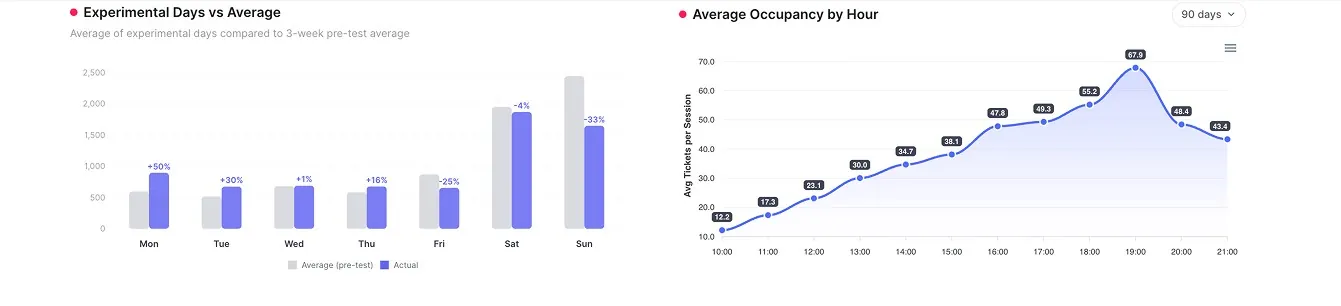
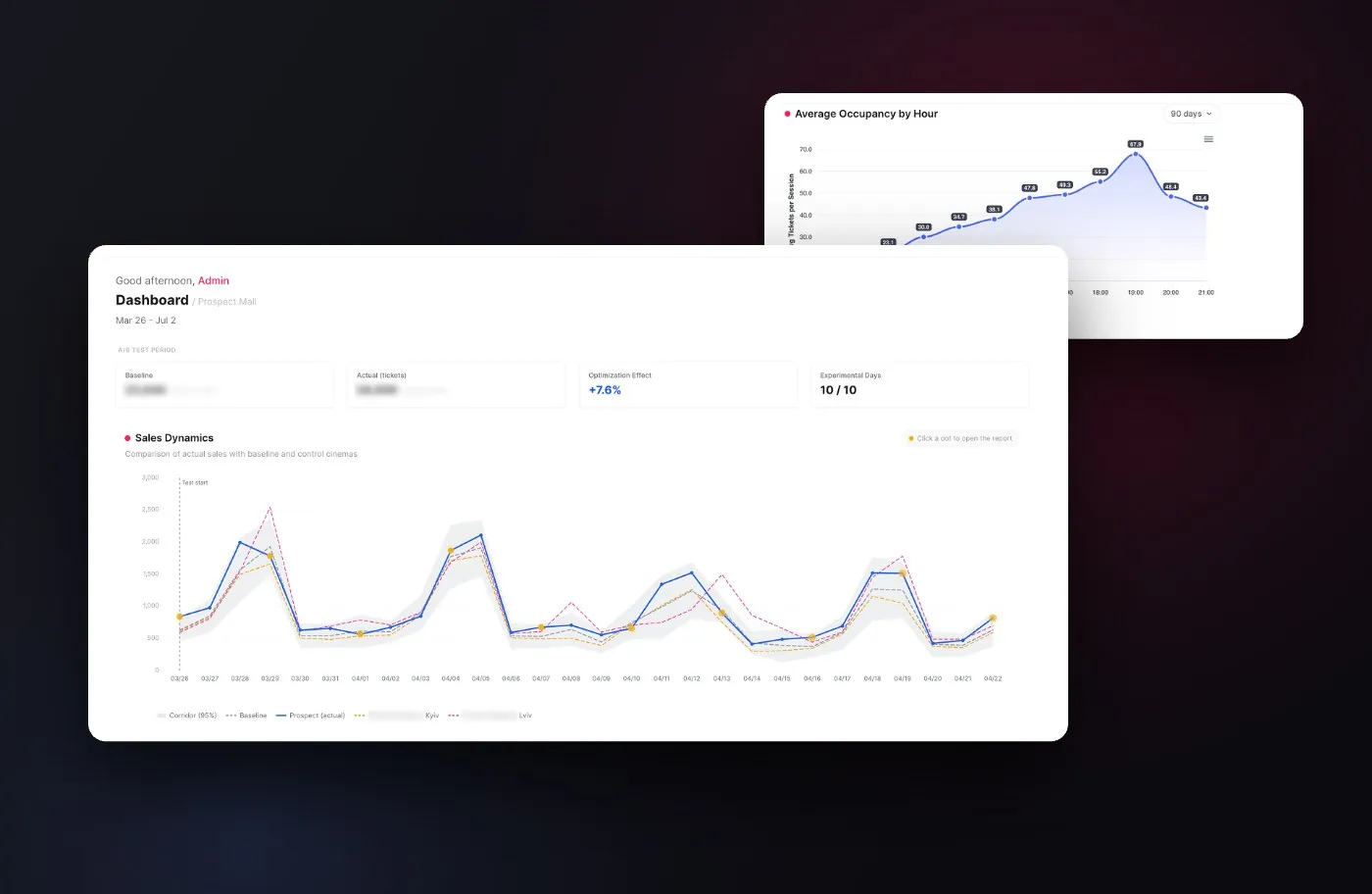
We validated this by benchmarking against “twin venues” – other theaters with comparable historical data – to ensure the lift was driven by our optimization. For instance, while control venues followed standard attendance patterns, our data-optimized scheduling captured higher engagement, effectively boosting performance in traditionally quieter time slots.

The project is finished, and Multiplex already uses an AI-driven system that analyzes audience behavior, predicts attendance, and supports marketing and scheduling decisions. This approach helps the company identify demand patterns, optimize film distribution across time slots, and estimate revenue potential with greater accuracy. Adjustable for your business model and constraints
A stepped setup tunes every run to your specific rules before the model generates the optimised output. Pick the time window, the items to include, the constraints. Click once, the agent builds your plan. Cinema example shown: dates, films, constraints, review. In a warehouse: SKUs, locations, limits. In a factory: lines, shifts, batch rules.
Comparison to control data sets
We validate our forecasts by comparing them against real-world control data to isolate the true impact of our optimization.

Instead of just looking at a final number, we benchmark performance against peer assets or historical periods. For example, during the Multiplex AI optimization agent pilot, we measured the 5.2%+ revenue lift against a 95% confidence interval, established by twin venues – similar, control theaters that did not use the optimization – to confirm the growth was directly attributable to our system.
Optimisation after 5 iterations
Read-outs show the agent improving against your own baseline over time. Whatever metric matters to your business, tracked by day, hour, or segment. Cinema example shown: day-of-week lift versus the pre-test average and average tickets per session by hour.