
Case studies

Secro: Digital trade documents platform for maritime and commodities

Secro: Digital trade documents platform for maritime and commodities
  • Geography United States
  • IndustryFinance
  • ServicesFull-cycle product development

Intro

Secro Inc. is a fintech company founded in 2021 with one ambition: replace the paper-based mechanics of global trade with a digital, verifiable, secure standard. Built by fintech operators and senior maritime attorneys, Secro set out to dismantle the document layer that quietly slows down billions of dollars of cargo and trade finance every year.

The platform serves four interconnected segments at once: traders, importers and exporters; logistics service providers; financial institutions, insurance carriers and brokers; and technology providers that integrate with each of them. The product is engineered to drop into existing ERP, TMS and CMS landscapes, so that adoption inside a traditionally paper-heavy industry does not require any operator to learn the word “blockchain.”

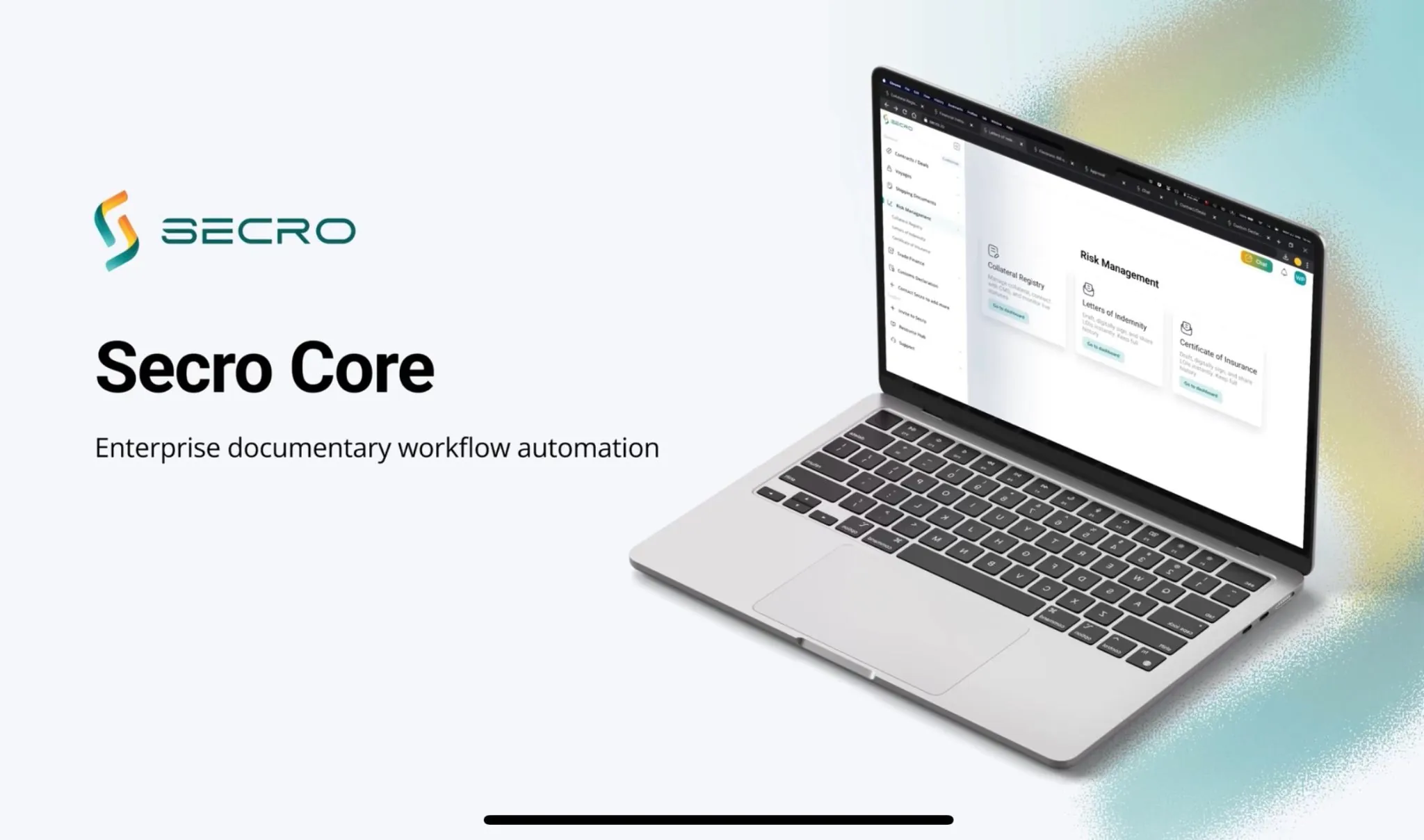
S-PRO has been Secro’s engineering partner from the earliest prototype through to the live pilot now running with dry-bulk operators, commodity trading houses and thermal power producers. The team designed the solution architecture, built the underlying private-blockchain infrastructure, engineered the Specific Secro Gateway middleware that connects Secro to client systems, and delivered the full product across backend, frontend and quality.
75%
faster document turnaround
$500K
saved per customer
5
days shorter payment cycle
70%
fewer manual touchpoints
48
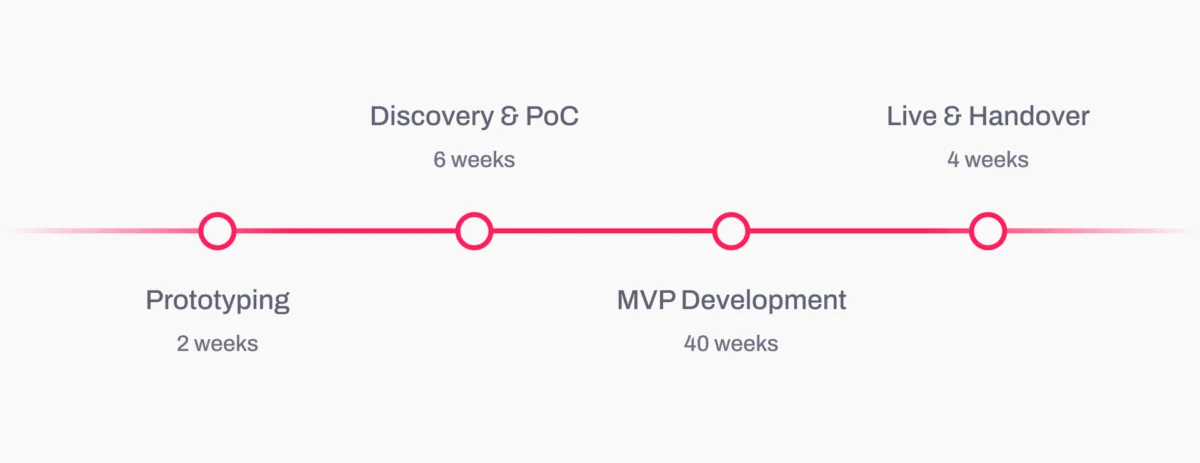
weeks from prototype to live MVP

Goals and Challenges

For decades, original Bills of Lading travelled physically between carriers, traders, banks and consignees. This produced slow settlement, fraud exposure, restricted trade finance and a long reconciliation tail.

Secro arrived with a clear product hypothesis but an open architecture question. The team knew the answer had to be more than another SaaS portal. For a maritime trader handing over a $50 million bill of lading, “trust us, it’s in our database” was never going to be enough. The new standard needed cryptographic finality to preserve its legal weight and guarantee reliability.

Document integrity and legal equivalence

A digital Bill of Lading is only useful if it carries the same legal weight as the paper original. The platform had to guarantee that each digital document was unique, transferable, tamper-evident and verifiable independently.

Adoption inside a traditional industry

Carriers, traders and banks operate on long-tenured workflows. The platform had to improve their existing process, not replace it.

Trade finance unlock

Finance providers had limited access to paper documents. The platform had to make these atomically transferable so pre-payment, factoring and instant-settlement workflows could be built on top.

Scale without compromising privacy

Hundreds of counterparties had to interact concurrently with full visibility for legitimate parties to each trade and zero visibility for everyone else.


Solution

S-PRO and Secro shaped a platform built on legal equivalence with the paper document, frictionless integration with existing back-office systems, and mathematical security.

We spent the first six weeks proving that hypothesis with a working prototype rather than a deck. Together with the Secro founding team we ran a focused discovery, mapped the document lifecycle across carriers, banks, traders and insurers, and validated the technical choices on real trade scenarios. By the end of week eight we had a clickable prototype, a private blockchain backbone in place, and a 40-week MVP roadmap that everyone in the room could defend.

Fully digital Bills of Lading, Letters of Credit and Letters of Indemnity

Each document is issued, transferred, endorsed and finalised inside the platform. Letters of Indemnity, traditionally used to bridge missing paper documents, are eliminated entirely by the platform’s title-transfer mechanics.

A private blockchain underneath, hidden from users

Document fingerprints, ownership transitions and timestamps are anchored on a private blockchain. Original document data stays encrypted off-chain. Verification is cryptographic. Operators see only a clean web interface.

The Specific Secro Gateway middleware

Most trade-flow systems already in place are decades old. The Gateway translates between EDI, REST and file-based handoffs and Secro’s API, making adoption inside Oldendorff, Odfjell and similar operators practical rather than theoretical.

Customisable workflows

A low-code engine lets each customer map their trade reality to the system. Guided screens walk every counterparty through their step with full audit visibility.

Real-time visibility and data-driven decisioning

Every party sees one live state of the document. Historical transaction data is structured for analytics, so financiers can make faster, evidence-based credit decisions.

……

Solution

Solution architecture and private blockchain backbone

We designed Secro on a private, permissioned blockchain network with full off-chain encryption for sensitive payloads. Documents are tokenised on chain so they can be transferred atomically between counterparties, but the underlying business data lives off chain, encrypted, and accessible only to the parties to the trade. The result is tamper-evident finality without sacrificing privacy, which is the standard maritime trade has always demanded but rarely achieved. The architecture supports the full lifecycle of a negotiable document. Issuance, endorsement, transfer, presentation, surrender. Each step is signed, timestamped and cryptographically linked, so a bill of lading on the Secro platform can be verified by any party at any time without trusting a central intermediary.

Specific Secro Gateway middleware

The single biggest risk to a platform like Secro is adoption. Trading houses, carriers and banks do not want to rip out their ERP, TMS or CMS. They want the new capability to drop in. We built the Specific Secro Gateway as a middleware layer that sits between the Secro platform and the customer’s existing systems. It exposes a small, well-defined integration surface, so a customer can route their existing document flows through Secro without reorganising their stack. This is the piece that turned Secro from interesting technology into we can onboard tomorrow for the first wave of customers.

Patented security and audit layer

Trade finance is heavily regulated and heavily audited. We built role-based access control, multi-party approval workflows, full encryption at rest and in transit, and an audit trail that is cryptographically anchored to the blockchain. Every state change in a document, every approval, every transfer is preserved and verifiable years after the trade closed.

The security model is independently certifiable and compatible with the ISO 27001 and ISO 27701 controls the maritime and finance industries expect from a system of record.


Technology

The platform is built on a modern, security-first stack designed to satisfy enterprise customers in maritime trade and trade finance.

Frontend: React, optimized for desktop trading and operations environments

Backend: Node.js, with custom domain services for trade documents and counterparty workflows

Blockchain layer: Private permissioned blockchain network, full data encryption, cryptographic fingerprinting of every document

Middleware: Specific Secro Gateway for ERP, TMS and CMS integration

Security: Patented cybersecurity model, role-based access control, multi-factor authentication, complete audit trail

Infrastructure: Microsoft Azure cloud, with dedicated environments per major customer

Quality and observability: Continuous integration pipelines, automated regression suites, on-call monitoring


Team

S-PRO assembled a senior, fintech-fluent delivery team across 8 disciplines and held the same core squad across discovery, MVP and pilot to preserve product knowledge.

Solution Architect: Trade-flow design, blockchain topology

3 Backend Engineers: Blockchain, security, Node.js services

3 Frontend Engineers: React, complex trading UX

2 UX / UI Designers: Workflow design, counterparty engagement screens

Product Manager: Roadmap, customer feedback loops

Business Analyst: Trade document spec, legal equivalence

3 QA Automation: Manual QA and automated regression

DevOps Engineer: Azure infrastructure, CI/CD, observability

14 People across 8 disciplines. Many stayed two years or more. By handover, Secro’s internal hires were on-boarded, paired, and shipping – ready to own the product end-to-end.


Results


Geography
Industry
Services

Get in touch

Get in touch
Ready to discuss your project?
Share your ideas, findings, and questions with us. We’re excited to extend our expertise to your project. After form submission, we'll respond you within 24h.
R&D centers
Zug, Switzerland (HQ)
Dammstrasse 16, 6300
Zurich, Switzerland
Löwenstrasse 45, 8001
Lodz, Poland
Zachodnia 70, 90-403
Business representatives
Salt Lake City, USA
Kiln SLC, 26 S Rio Grande St, UT 84101
Austin, USA
11801 Domain blvd., 3rd Fl, Austin, TX 78758
Amsterdam, Netherlands
Gustav Mahlerplein 2, 1082 MD
Link copied to clipboard