How Maxima saved an annual CRM costs in 3 months and launched the healthtech SaaS “Therappy”
GeographyUnited States
IndustryHealthcare
Servicessoftware development, business process optimization
Intro
Maxima Therapy, a specialized practice in California, originally set out to optimize its own clinical workflows. The clinic had been using third-party CRM that covered part of the job, but it couldn’t fit the workflows perfectly. S-PRO built a solution that turned therapist matching, visit tracking, payrolls, compliance workflows, and reporting into one connected product.
In 3 months of development, the MVP matched the annual budget Maxima had spent on its previous CRM. And the migration from generic EHR to specialized, intelligent operating systems was so transformative for resource utilization and financial transparency that the project evolved into a multi-tenant SaaS architecture – Therappy.
Today, Therappy is a B2B care management platform capturing the therapist-patient market. The birth of healthtech SaaS Therappy proves that internal operational friction sometimes can be your most valuable asset.
3
months to roll out the MVP
1
year CRM budget secured by the first MVP
10+
integrations across payroll, documents, SMS, maps, eSign, insurance, recruiting
2
years of cooperation
Challenges
The project faced numerous challenges and ambitious goals – ranged from a drained budget on the existing CRM and the need for effective workforce planning to critically tight deadlines and strict regulatory compliance.
Legacy CRM couldn’t keep up with Maxima’s Workflows
Maxima’s therapists work with children, guardians, regional centers, and insurance-related processes. Most visits happen in homes, so therapists need mobile access, location support, fast check-ins, and a simple way to see matching clients, schedule sessions, add notes after each session. Admins need to process referrals, manage services, check reports, track hours, prepare payroll, and watch operational metrics.
But Maxima’s old CRM didn’t support its advanced workflows. It didn’t let them create the custom metrics and data fields to generate the specialized reports for high-level oversight.
$1,000/therapist fee had no proportional value
Maxima’s previous CRM acted as a financial anchor, charging approximately $1,000 per therapist annually while offering no proportional value in terms of efficiency – no way to modify data models to track specific clinical metrics for strategic decisions.
The “empty hours” and client matching problem
Financial loss was accelerating due to poor clinician-client matching. When therapists had empty hours, the clinic lost revenue, and families waited longer for care. So the platform had to match clients with therapists by specialty, location, address, and language.
Another problem in this context was logistical gaps that also drained revenue. Every hour a therapist spent in Los Angeles traffic or unbooked due to language mismatches cancellation rates reduced billable time.
Compliance requirements
The product had to support personal and medical data, referral documents, claim workflows, audit trails, and long-term data storage. S-PRO had to work with HIPAA- & CCPA-related requirements, including action logging, soft delete logic, and strict 7-year data retention rules. This complex compliance required close collaboration with a specialized compliance consultant.
Hard year-end delivery deadline to avoid costly CRM renewal
Maxima required the MVP to be fully operational before the start of the new year to avoid being locked into another expensive annual payment cycle with their previous CRM provider. Thus, the tech team had to move fast, make hard decisions, and deliver enough value before the client had to renew the old CRM for another year.
The SaaS version had to preserve what already worked
When the product became Therappy, the challenge was to replicate Maxima functionality to make it usable for other clinics. So S-PRO has to rebuild the architecture around a multi-tenant model, where each clinic could have its own account, users, therapists, clients, and settings.
Solution
In just 3 months, S-PRO built a 3-tier system designed to maximize resource utilization across the entire clinical ecosystem. This MVP matched the annual budget Maxima had been spending on its previous CRM.
While the initial MVP was delivered in 3 months, development continued for nearly 2 years. Once Maxima’s internal tool proved its value, the project evolved into the B2B SaaS platform, Therappy. By adopting a multi-tenant architecture, the platform let other clinics to join and independently manage their own organization accounts, users, therapists, and clients – all while using the same core functionality.
Single workspace for admins, therapists, and guardians
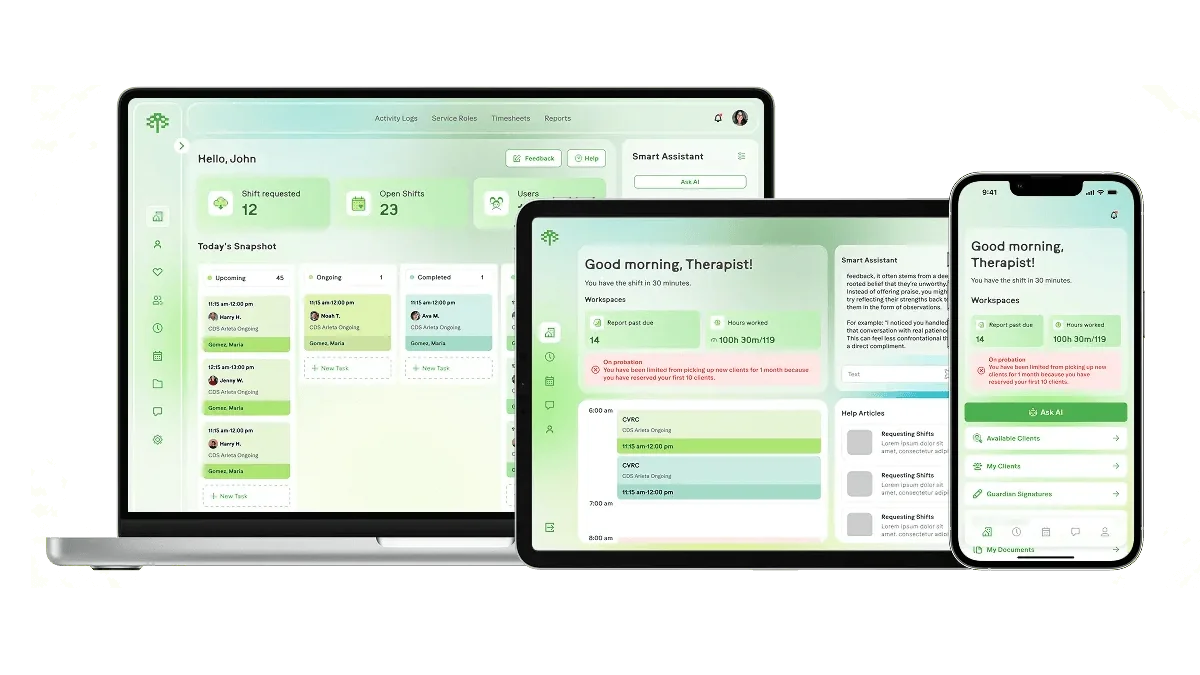
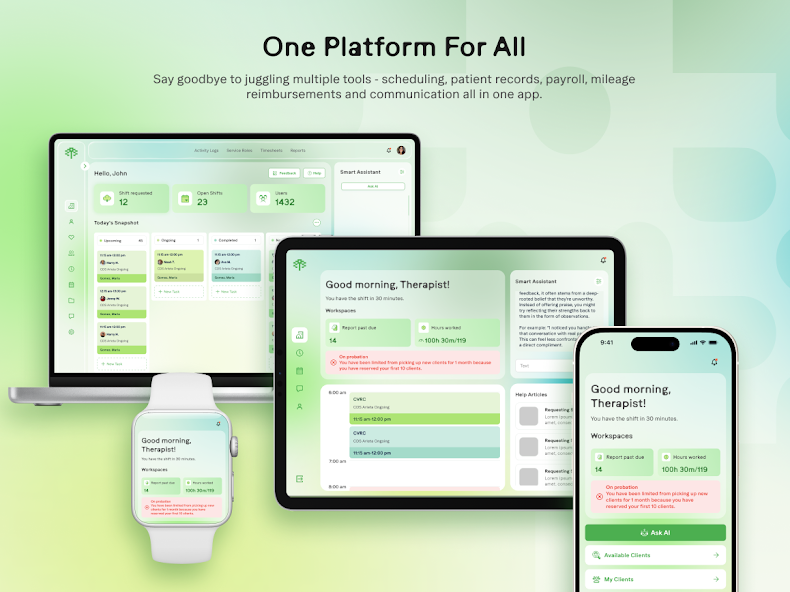
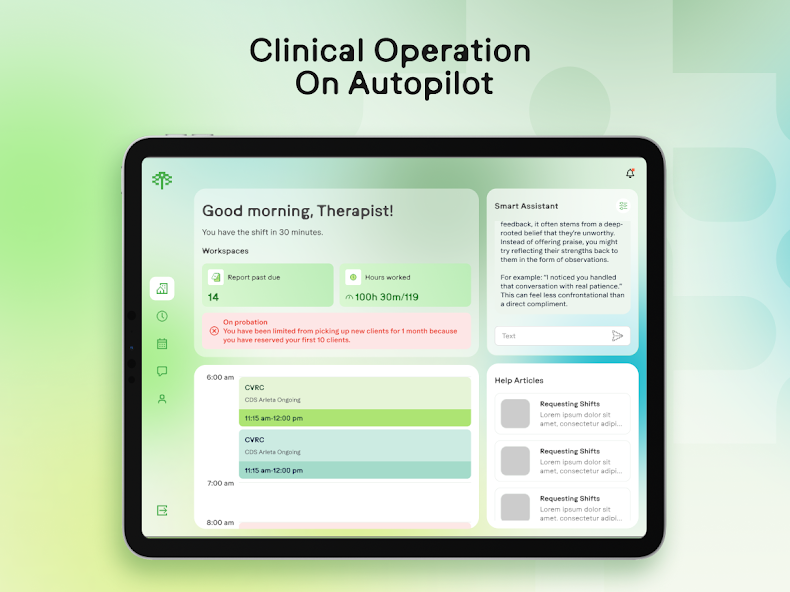
For admins, the platform covers service management, user management, and operational metrics, while therapists can efficiently manage client cases, plan sessions, and check in on-site. Furthermore, guardians receive a clearer channel for communication, and the system supports both online and offline care flows.
Smart client matching
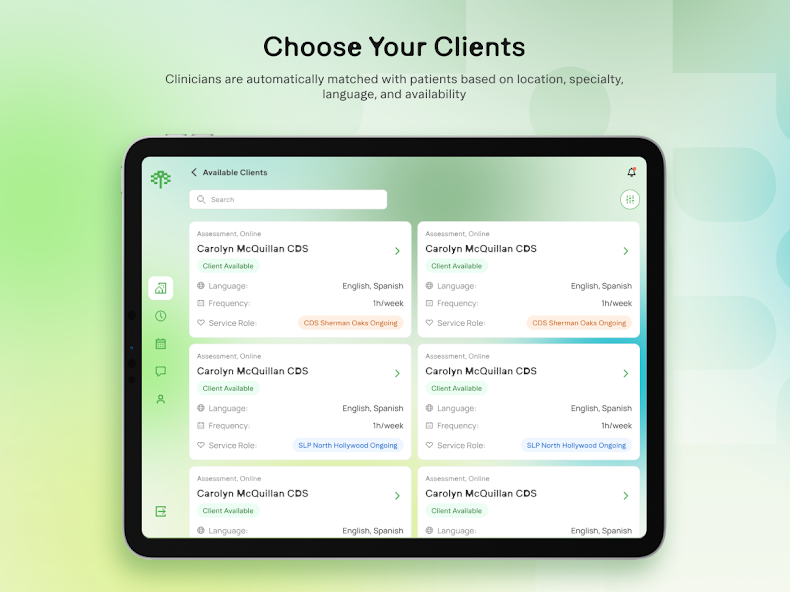
One of the strongest product decisions was smart therapist-client matching. The system matches available clients with therapists based on specialty (Speech, PT, OT), location (geographic proximity), and language. This reduces the chance that therapists would decline assignments and helps them fill their working hours and increase billable capacity.
Optimized travel logic to minimize empty hours
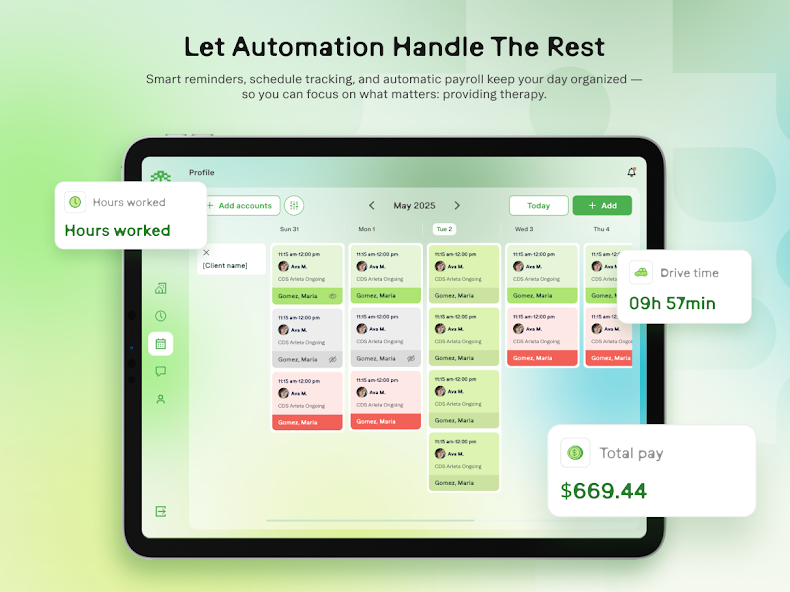
Another outstanding feature is how the platform optimizes location and travel logic. Much like Uber, the system calculates proximity and considers real-world traffic patterns to minimize empty hours. By accounting for peak travel times and geofenced check-ins, the platform ensures therapists spend less time in traffic. This also supports travel-related compensation and gives admins more confidence in the accuracy of visit records.
Mobile check-in for field therapy & zero-leakage payroll
Since many therapists work on-site with clients, the mobile app supports visit check-ins and geolocation. Therapists can mark arrival and departure, while the clinic verifies that visits happened. The integration of GPS-tracked sessions and automated payroll sync removed the potential for manual entry errors and financial leakage, meaning every hour billed was an hour verified.
Custom document automation to remove repetitive work
S-PRO streamlined report writing by building a custom document flow. Using Word templates converted into structured forms, therapists only fill in variable fields while the system auto-populates repetitive data.
Referral intake with Document AI
For Maxima, referrals often come through standardized PDFs from regional centers or similar organizations. Manually copying that data into a system was slow and error-prone. To reduce manual entry and mistakes, S-PRO integrated Google Document AI to parse referral documents. The system extracts client names, guardian details, contact information, and service dates, then places them for admin review.
Therappy Smart Assistant
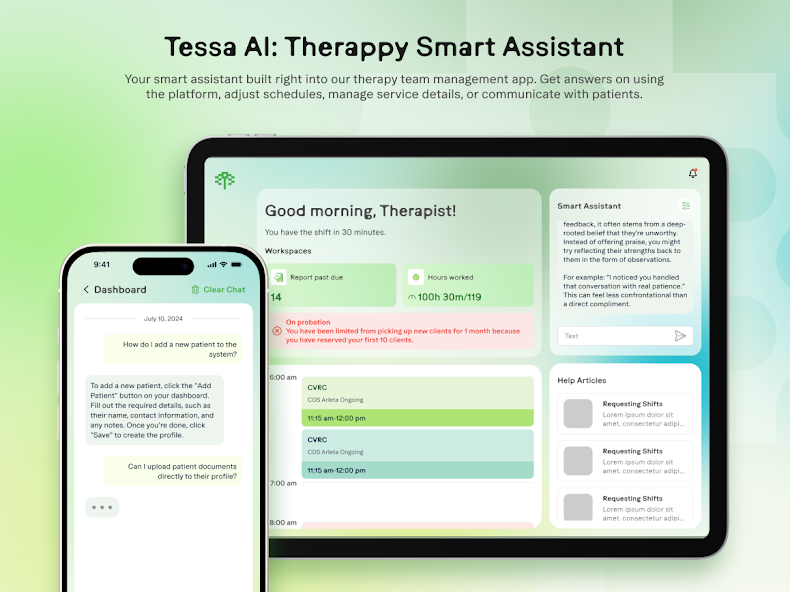
The platform also includes an AI assistant connected to the database and project documentation. Users can ask questions such as when a visit was scheduled or how many hours they had worked during the month. The “Therappy Smart Assistant” currently functions as a passive agent, parsing the database to answer clinician queries but the product roadmap includes smart creation of database entities and session logs via voice-to-text commands.
Technology
Our solution had to support sensitive data management, numerous integrations, and a future SaaS model. S-PRO used Node.js for the backend, React for the frontend, React Native for mobile apps, and AWS for infrastructure. The architecture supported web, mobile, and tablet use, so users could work with the platform on the device that matched their role.
The data logic was especially important. Records were not simply removed through hard delete. Instead, the system supported soft delete and restoration, so the team could keep an audit-friendly history – as required by HIPAA.
The platform became central for clinic work, and much its effectiveness lies in its rich ecosystem of third-party integrations:
ADP for payroll data
Salesforce for customer sync
Jibble for working time tracking
Twilio for SMS
OneDrive for document storage
Google Meet for online shifts
Google Maps, Geocoding, and Routes APIs for distance tracking between shifts
DocuSign for eSign documents
Indeed for job posting and recruiting workflows
Convertio for file conversion
Gmail and Google SDK for email and signature-related flows
Claim.MD for insurance claim submission
Stripe for client payments when insurance did not cover a service
The Claim.MD integration was especially important for clinics working with insurance. After a service, the clinic could submit a reimbursement claim and track whether it was approved, paid, or declined. Stripe covered another case of care delivery: when insurance refused payment, the clinic could generate an invoice for the client.
Team
S-PRO provided a 12+ person cross-functional team – with extra roles added when needed – acting as Maxima’s outsourced tech department.
4 backend developers
2 frontend developers
2 mobile developers
2 QA engineers
2 business analysts
DevOps specialist
UX/UI Designer
Project manager
Support manager
The transition from a Fixed Price model (during the high-intensity 3-month MVP sprint) to Time & Materials reflected a relationship based on technical trust and clinical-financial results. Furthermore, a dedicated S-PRO Support Manager was integrated to handle technical stability, freeing the client to focus on B2B sales and tenant acquisition.
Results
The biggest result is the shift in business thinking. Maxima started with a tool for its own clinic and ended with the foundation for Therappy – a SaaS that could serve other care organizations.
The first financial proof came quickly. In 3 months, S-PRO developed the MVP for roughly the same cost as one year of the previous CRM. By the fourth month, the clinic owned a proprietary asset that added equity to the company instead of a recurring expense.
Shortly after launch, Maxima saw stronger productivity in therapist operations and billable capacity. The platform added validation, hour verification, metrics, and rules around planned versus completed work. Admins no longer had to manually move every referral detail, document field, payroll calculation, and claim step across separate tools.
Conclusion
Therappy is a great example of a product that grew out of pressure. The strategic advantage of "building for yourself first" ensured every feature was validated against real-world clinical bottlenecks.
The future direction is clear: more clinics, more configurable workflows, stronger AI assistance, and deeper support for therapy operations – the platform already has the bones for it.
And maybe that’s the most honest success story here.
Therappy didn’t begin as a shiny SaaS idea looking for a problem. It began as a clinic trying to give therapists their time back.
Get in touch
Get in touch
Ready to discuss your project?
Share your ideas, findings, and questions with us. We’re excited to extend our expertise to your project. After form submission, we'll respond you within 24h.