
Translate your business logic into a live GenAI pilot in a focused software prototyping session. Stop discussing AI – start using it!
Service
See how our software prototyping approach turns a business idea into a working GenAI pilot. In a single workshop, we explore the use case, build a prototype, and test how it could work in practice using GenAI & agentic AI tools.
Rethinking Software Prototyping
See how our software prototyping approach turns a business idea into a working GenAI pilot. In a single workshop, we explore the use case, build a prototype, and test how it could work in practice using GenAI & agentic AI tools.
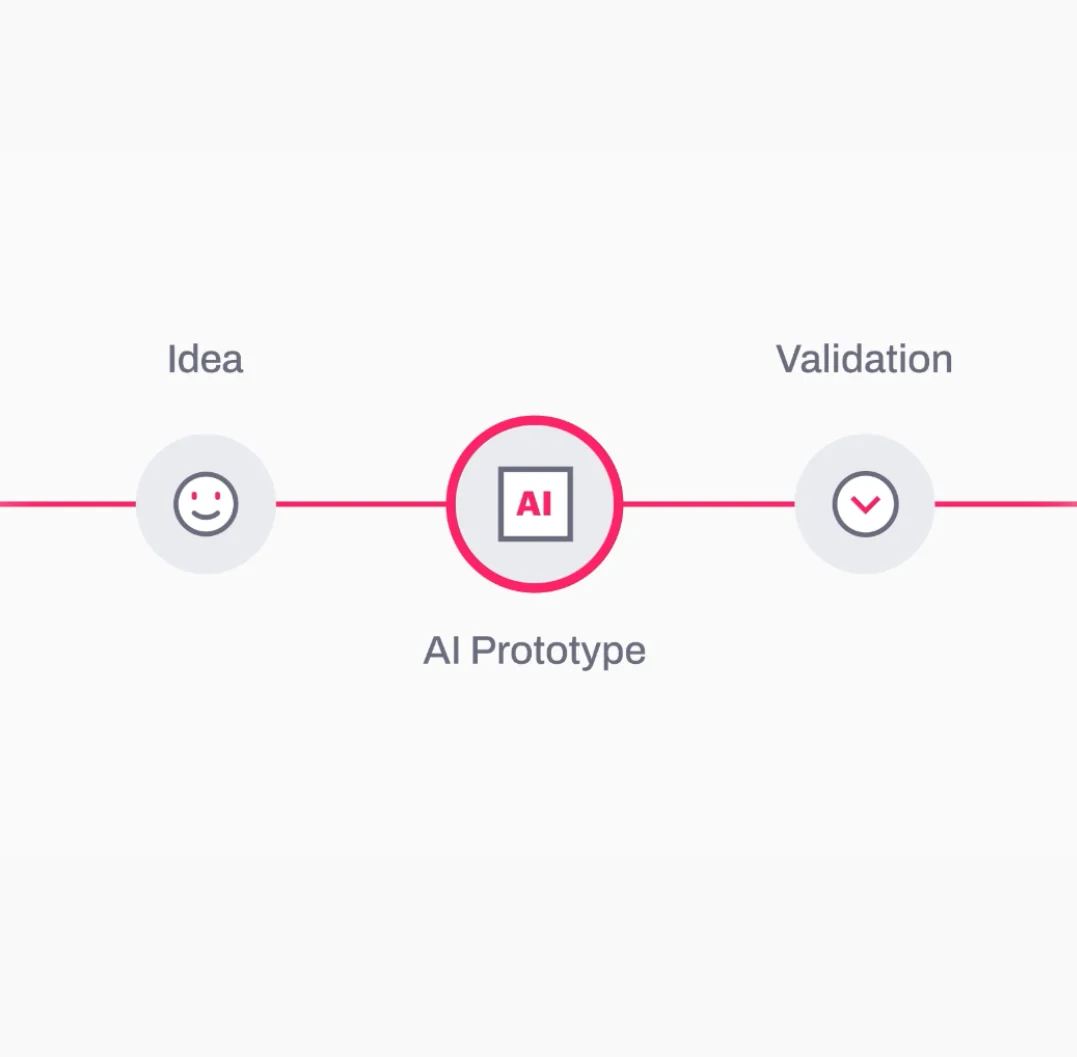
What You Gain from Our AI Workshops
01
Faster Idea Validation
Test a real business scenario in hours instead of spending months on planning and internal debates.
02
Clear Strategic Direction
Understand which AI use cases are worth pursuing before investing in full development.
03
Vendor-Agnostic Tech Exploration
Test and compare leading GenAI platforms such as OpenAI, Claude, and others before committing to a technology stack.
04
Actionable Execution Plan
Leave the session with a clear execution plan based on what worked in the prototype.
05
Low-Risk Entry into AI Development
Assess architecture, governance, and security implications before committing to full development.
06
Real-Time Testing and Iteration
Watch ideas turn into working prototypes and refine them during the session as insights emerge.
Roles
Who Our AI Prototyping Workshop Is For
seeking strategic clarity and defensible decisions around AI initiatives. The workshop helps leadership teams see how AI ideas translate into working prototypes before committing budgets or long-term roadmaps.
Board Members & Executive Leaders
needing executive-level decision support for GenAI adoption and architecture choices. It provides a practical environment to test models, evaluate architecture options, and understand technical implications early.
CIOs, CTOs & Innovation Leaders
who rely on rapid prototyping development services to fast-track software validation and reduce time-to-market. The session allows them to test product ideas quickly and see how AI features could work in real workflows.
Business & Product Owners
evaluating GenAI platforms, architectures, and practical implementation paths. Teams can experiment with tools, compare model behavior, and explore how AI integrates with existing systems.
Enterprise Teams
seeking a structured, low-risk entry into AI technologies. The workshop offers a safe way to explore possibilities, validate ideas, and understand what it would take to move toward production.
Organizations
Inside Our GenAI- and Agentic AI-Powered Software Prototyping
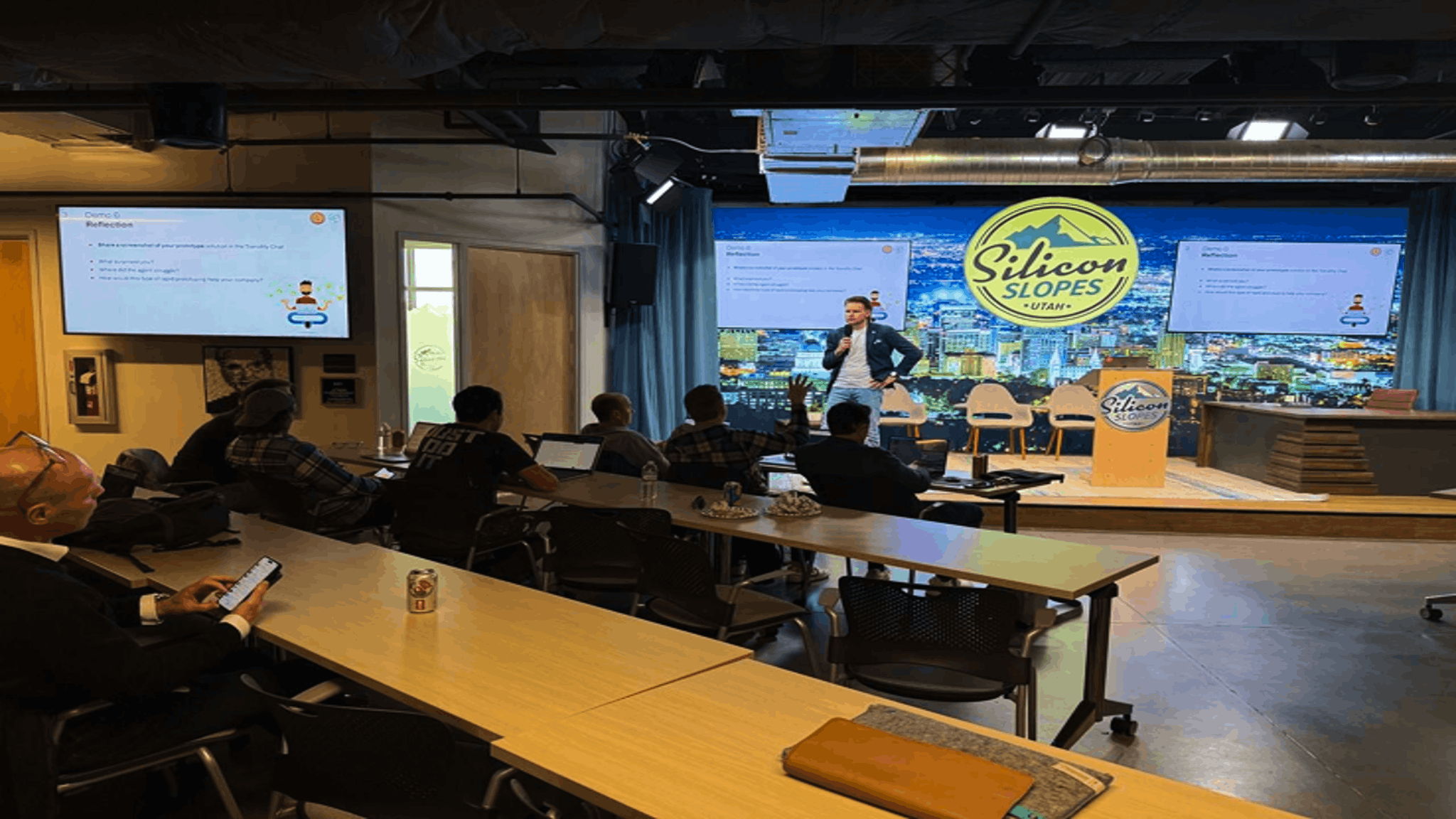
During a workshop organized as part of Utah Tech Week, participants built a prototype designed to help employees quickly find information across multiple internal documents.
Led by Anthony Barringer, the session walked participants through a realistic scenario many organizations face: new employees struggling to locate knowledge scattered across PDFs, Word documents, and internal documentation systems.
Participants uploaded several documents into the environment and built an AI-powered knowledge assistant that could retrieve answers, summarize relevant content, and guide users to the right information in seconds.
This type of prototype is often used to explore internal knowledge management, onboarding automation, and document search tools.
1/1
1/2
Core Capabilities of Our GenAI- and Agentic AI-Driven Software Workshops
Live GenAI Prototyping
Together with you, we turn business logic into a working GenAI prototype during the workshop. Instead of discussing ideas in abstract terms, your team sees how the concept behaves in practice. For example, we can prototype a customer support assistant, a document analysis tool, or an internal data agent that retrieves insights from company knowledge bases. These rapid experiments are part of our prototype development services, helping teams move quickly from concept to tangible solutions.
High-Impact AI Use Case Discovery
Using our AI Opportunity Framework, we help identify processes where GenAI or agentic systems can create real business value. This may include automation of internal workflows, intelligent document processing, or AI-assisted decision support. The goal is to focus prototyping on ideas that are technically feasible and strategically meaningful.
Model & Technology Evaluation
We evaluate different GenAI models and tools during the session to determine which stack fits the use case best. This may involve comparing models such as OpenAI, Claude, or Gemini for tasks like summarization, reasoning, or structured data extraction. The result is a clearer understanding of which technology works best for the problem.
Agentic Workflow Design
For more advanced scenarios, we design agent-based workflows where multiple AI components collaborate. These workflows can combine reasoning, retrieval, and task execution. Examples include multi-step research agents, automated document pipelines, or assistants that coordinate actions across different systems.
Architecture, Security & Governance Review
We assess the technical implications of deploying the prototype in a real environment. This includes data access models, API integration, and security considerations. For organizations in regulated industries such as finance or healthcare, we also discuss governance requirements and compliance constraints.
Execution Roadmap & Next Steps
After the workshop, we summarize what worked, what needs improvement, and what the next development steps could look like. This may include architectural recommendations, model choices, or integration strategies. As a prototyping firm experienced in complex domains, we can also continue with full-cycle development and production deployment if the prototype proves valuable.
Show All
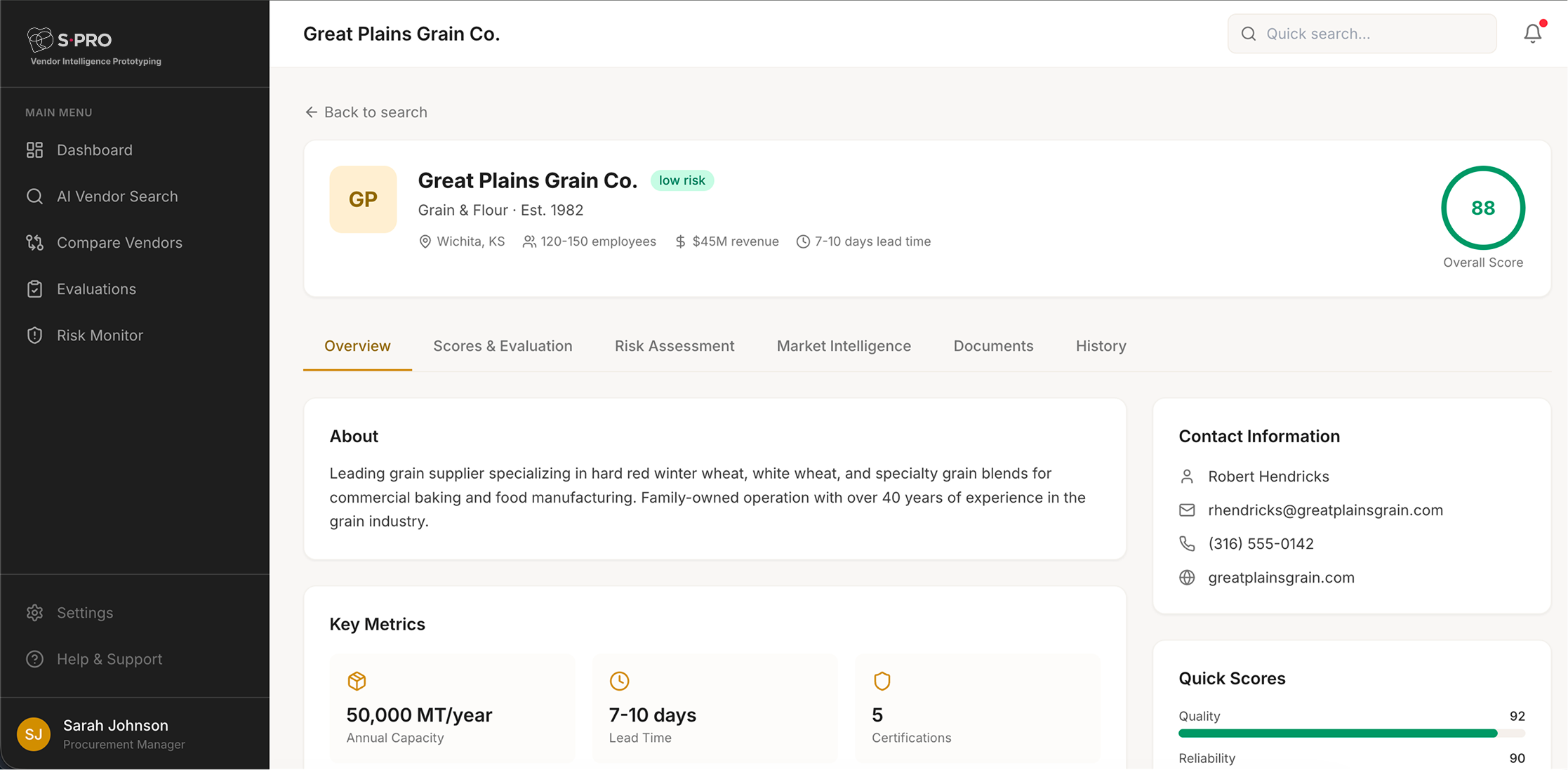
Case Study: Building an AI Vendor Intelligence Platform During Our GenAI Workshop
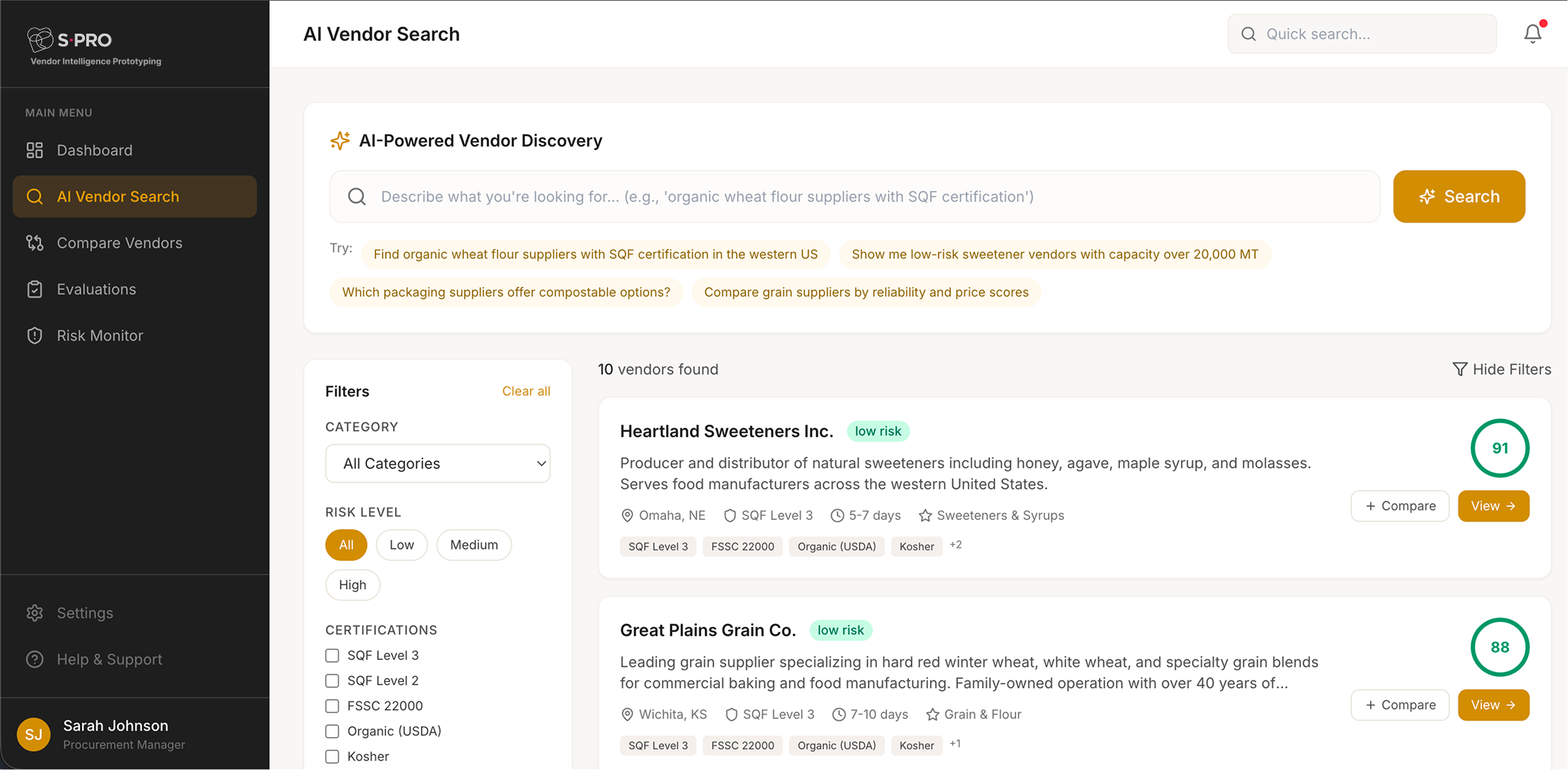
During one of our GenAI prototyping workshops, a small group of procurement leaders and a product owner explored how AI could simplify vendor evaluation and supplier discovery.
The prototype they built focused on a common procurement task: finding, evaluating, and comparing suppliers quickly when information is spread across documents, certifications, and internal systems.
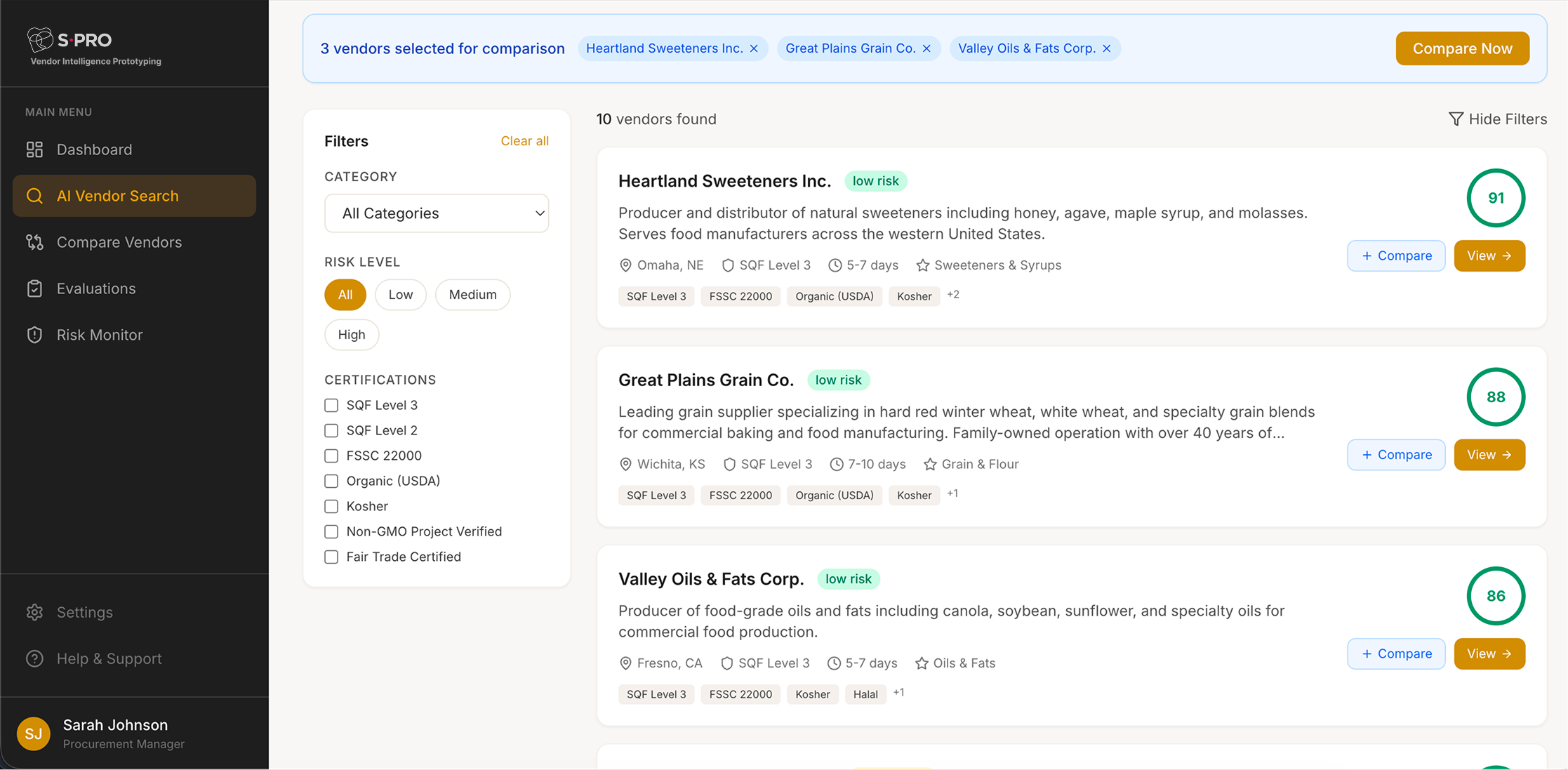
The platform allows users to search for suppliers using natural language queries such as “organic wheat suppliers”. The system returns structured vendor profiles with key data like certifications, capacity, lead times, location, and risk indicators.
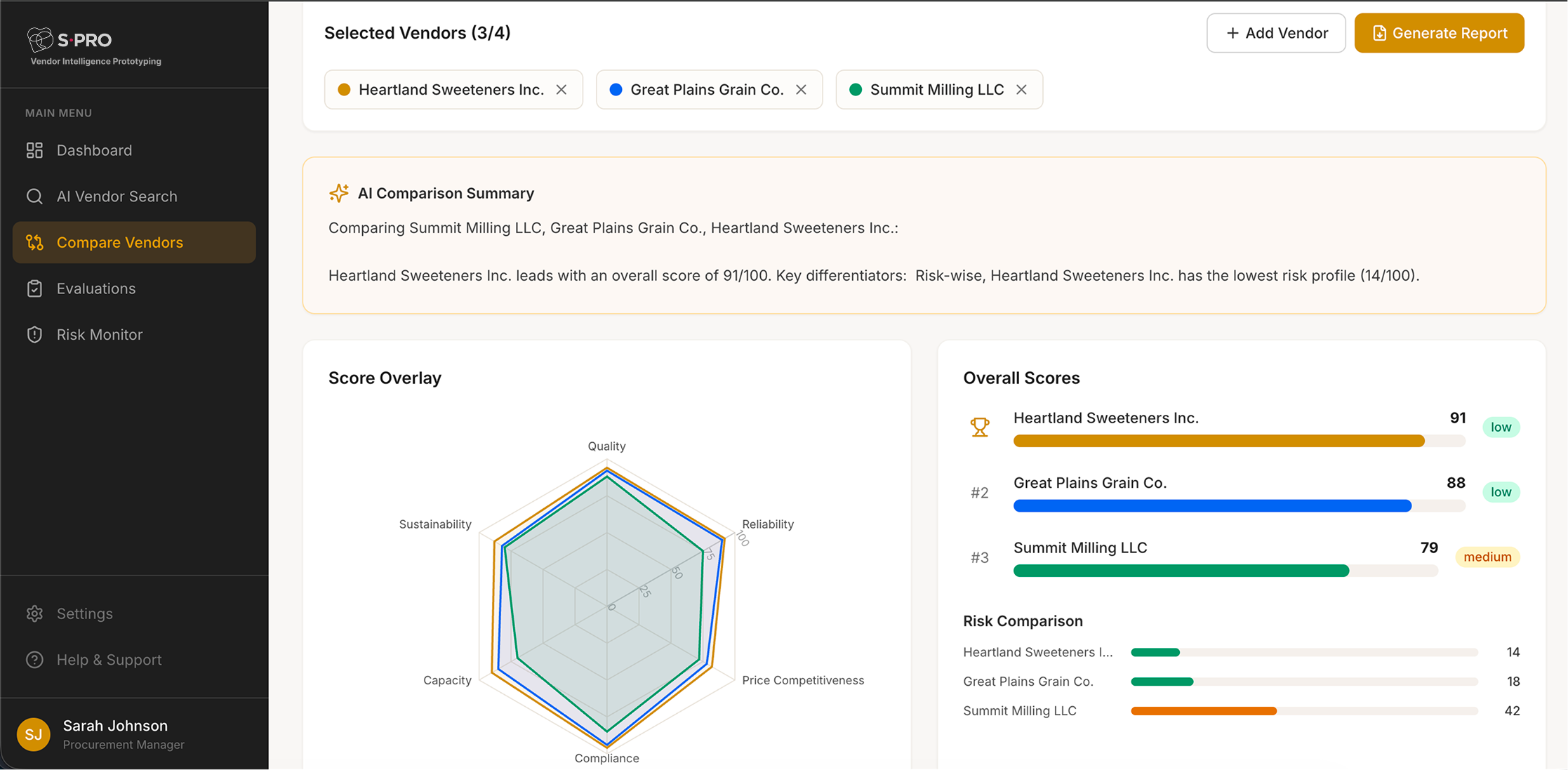
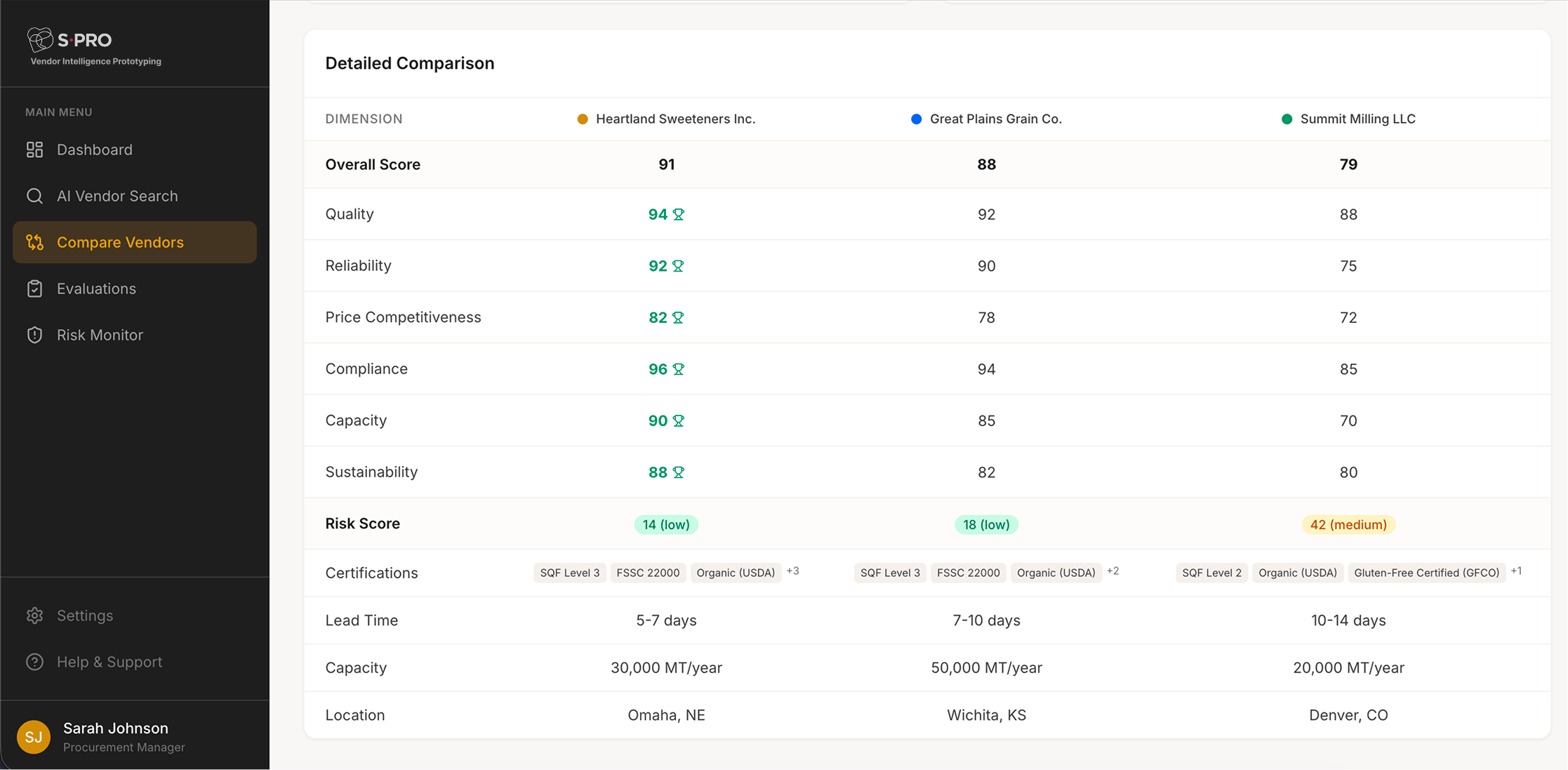
Users can then select multiple vendors and generate an AI-assisted comparison, showing differences across quality, reliability, price competitiveness, sustainability, compliance, and capacity. Visual score overlays and comparison tables help teams quickly see which supplier best matches their criteria.
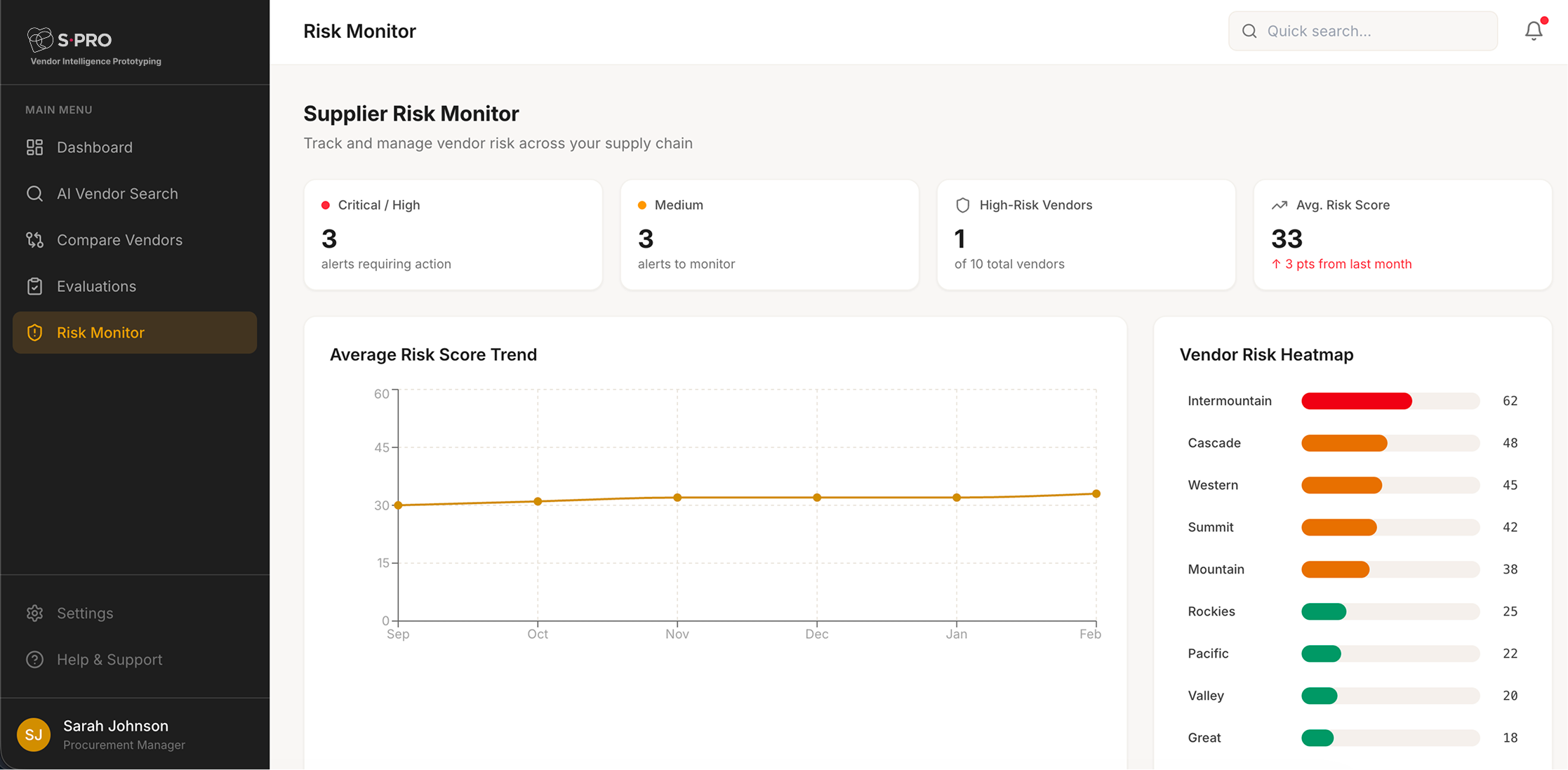
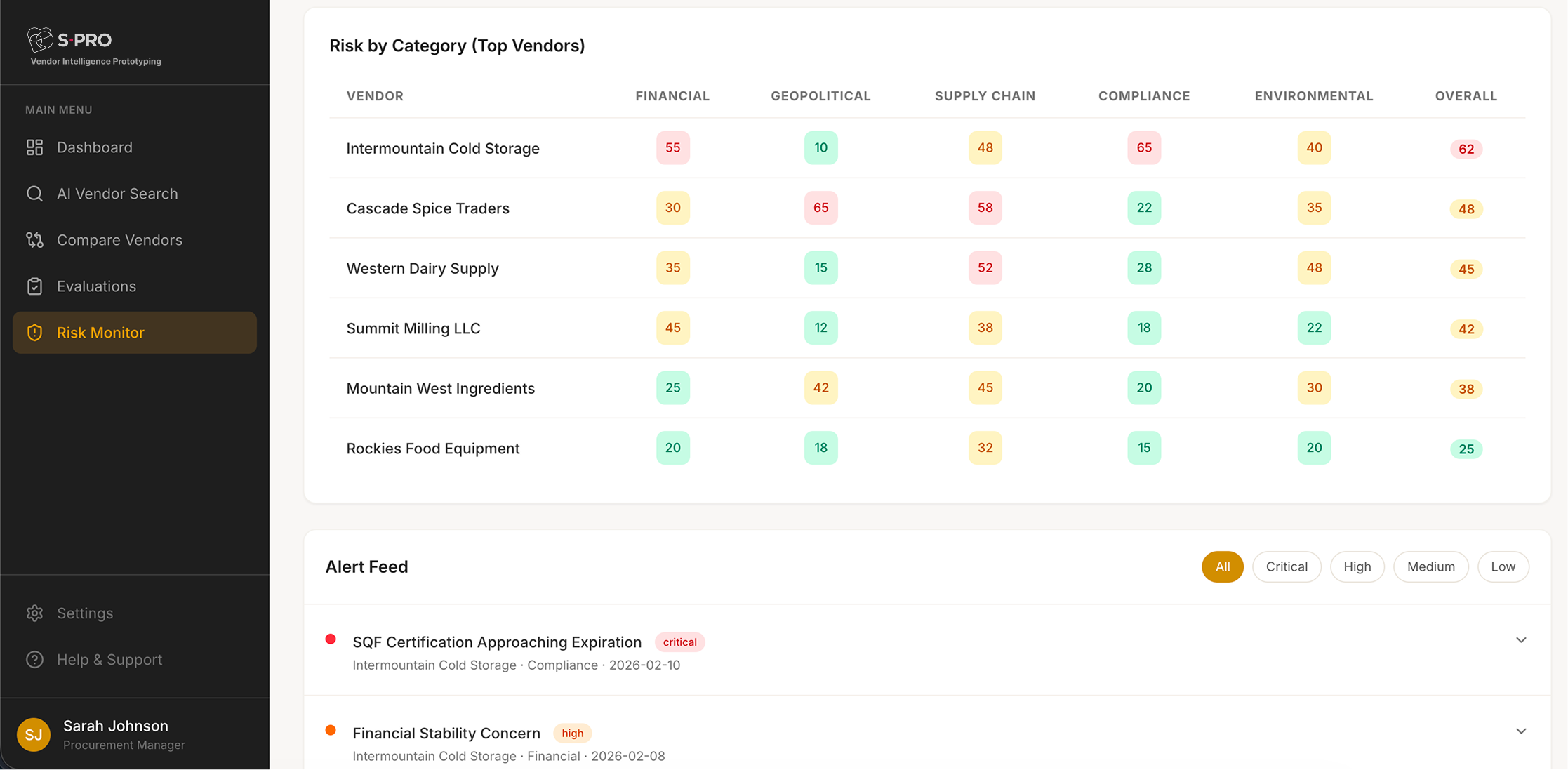
The prototype also includes a risk monitoring dashboard that highlights supplier alerts and tracks risk signals across financial, supply chain, compliance, and environmental categories.
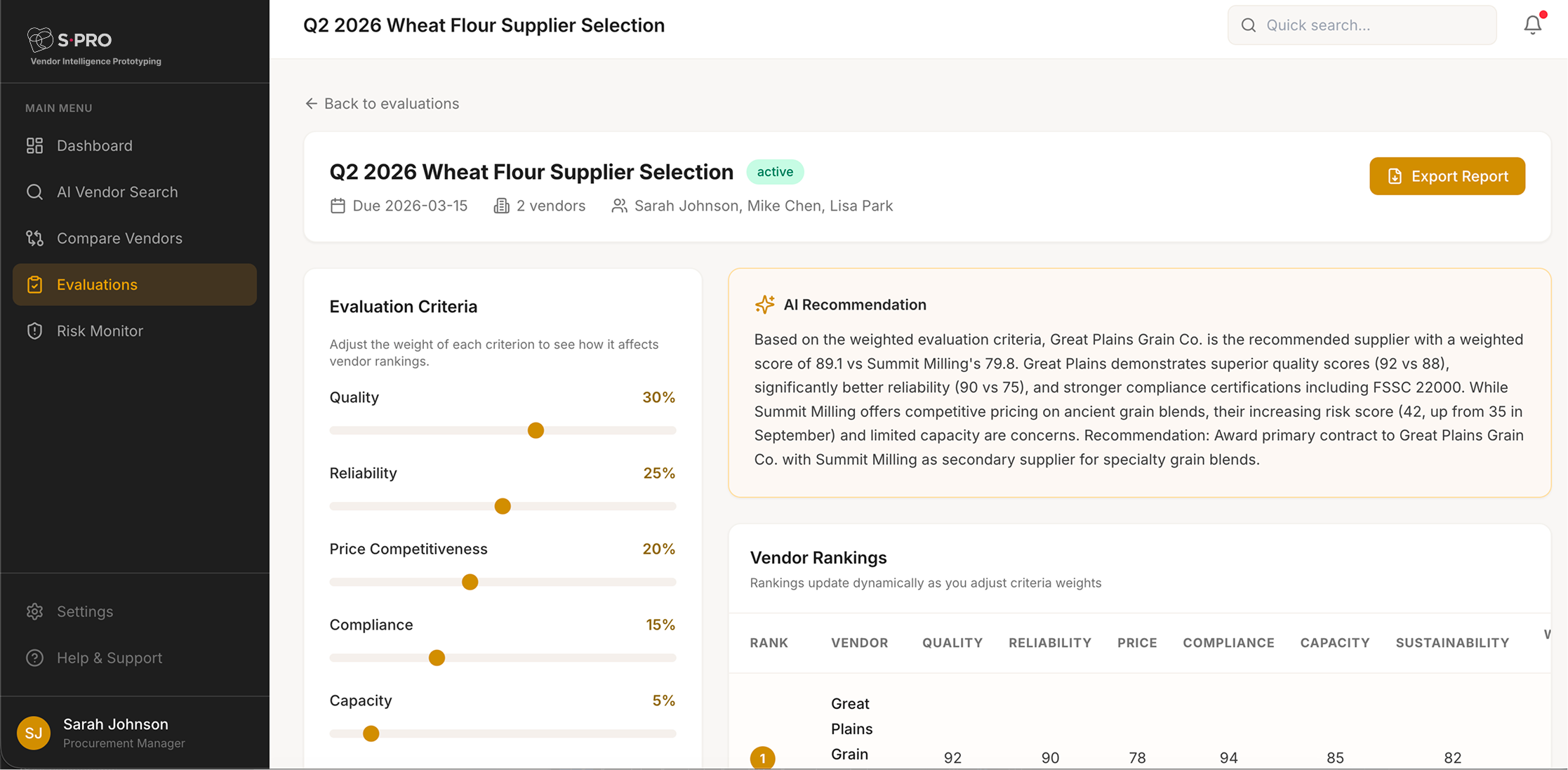
Finally, procurement teams can adjust evaluation criteria weights (quality, price, reliability, etc.) and instantly see how supplier rankings change.
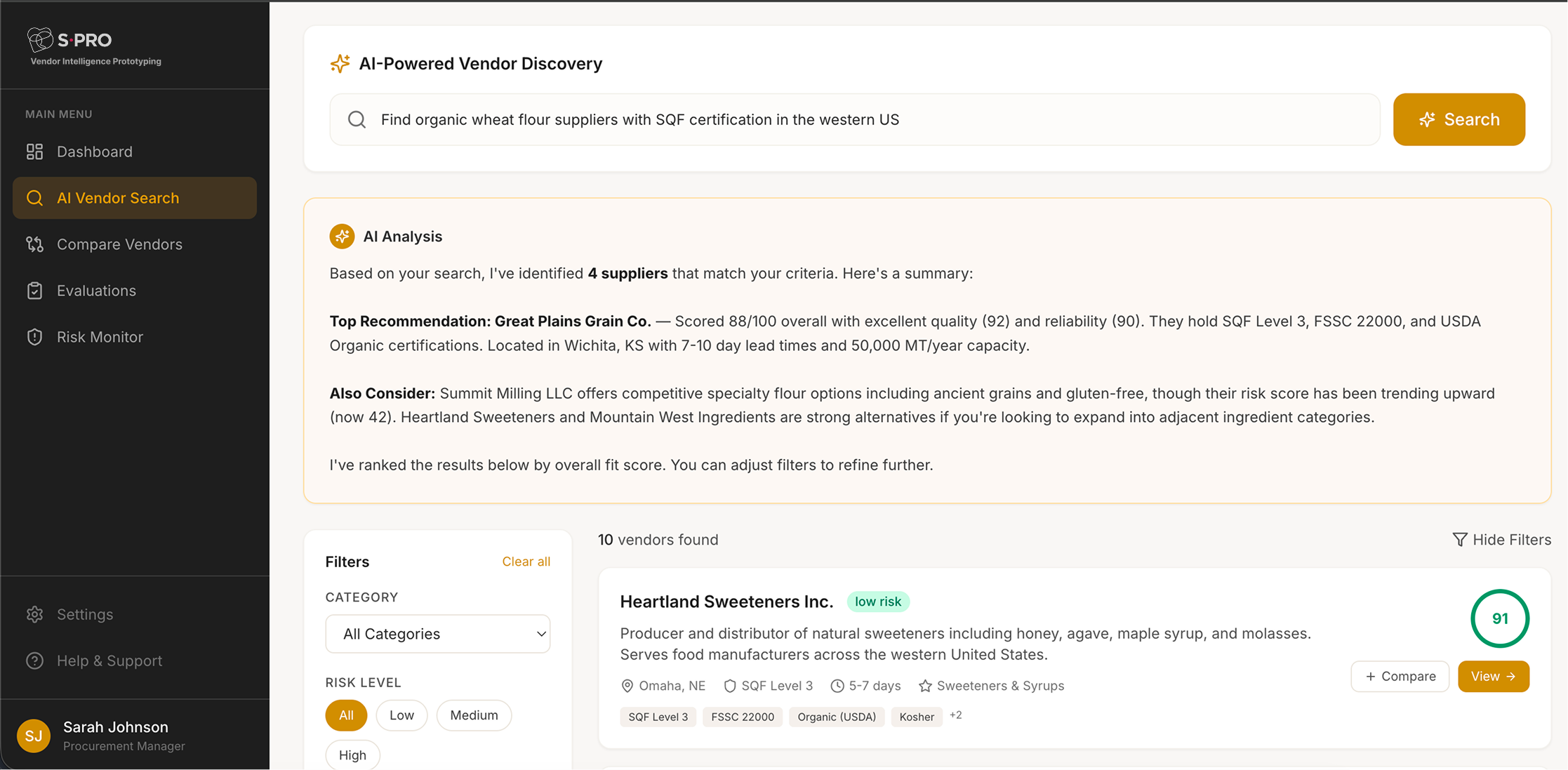
1/5
1/9
Tech
Technology Stack Behind Our Software Prototyping with GenAI & Agentic AI
GenAI Models
- OpenAI
- Claude
- Gemini
- Mistral
- Llama
AI Frameworks
- LangChain
- LlamaIndex
- Semantic Kernel
- Agno
Agentic Workflows
- AutoGen
- CrewAI
- LangGraph
- OpenAI Assistants
AI Development Tools
- Cursor
- Lovable
- Python
- Node.js
Vector Databases
- Pinecone
- Weaviate
- Qdrant
- Chroma
Infrastructure & Runtime
- Docker
- AWS
- Google Cloud
- Azure
Key Advantages of Our Prototype Development Services
01
Flexible Workshop Formats
Available online, on-site, or at our offices in Zurich, the Netherlands, Poland, or the United States. Sessions can be organized wherever your team is based.
02
Pre-Workshop & Live Technical Support
Before the session, we provide clear guidance on what to prepare from both business and technical perspectives. During the workshop, our engineers support the process to ensure the rapid software prototyping runs smoothly.
03
AI Opportunity Framework
We use our proprietary AI Opportunity Framework to identify high-value use cases and prioritize where AI can realistically create business impact. This structured approach helps teams focus on ideas worth prototyping.
04
Path to Full-Scale Development
If the prototype proves valuable, we can continue with full-cycle development. Our team has experience building secure systems in complex industries such as finance, healthcare, manufacturing and more.
Steps
Our session helps non-technical and technical roles collaborate, explore GenAI-augmented development, and rapidly prototype real or generic business challenges.
4 Steps to Rapid Software Prototyping
Our session helps non-technical and technical roles collaborate, explore GenAI-augmented development, and rapidly prototype real or generic business challenges.
Speak with the Experts Behind Our Rapid Software Prototyping Services
Launch a live, custom GenAI prototype in a single session using AI-assisted coding tools. If the prototype proves valuable, our team can help with full-cycle development.

Dustin Schulze
Digital Strategy & Solutions Lead
Aligning business goals with GenAI prototypes, defining high-impact use cases, and shaping clear next steps after the workshop. Strong focus on turning “AI ideas” into testable workflows and stakeholder-ready decisions.

Ihor Tanyenkov
Designing scalable AI architectures, translating business goals into secure LLM/ML solutions, and guiding teams from prototype to production-ready implementation. Helps align strategy, data pipelines, MLOps, governance, and cloud deployment into one practical technical roadmap.
Dustin Schulze
Digital Strategy & Solutions Lead
Aligning business goals with GenAI prototypes, defining high-impact use cases, and shaping clear next steps after the workshop. Strong focus on turning “AI ideas” into testable workflows and stakeholder-ready decisions.
Ihor Tanyenkov
Designing scalable AI architectures, translating business goals into secure LLM/ML solutions, and guiding teams from prototype to production-ready implementation. Helps align strategy, data pipelines, MLOps, governance, and cloud deployment into one practical technical roadmap.
1/2
Launch a live, custom GenAI prototype in a single session using AI-assisted coding tools. If the prototype proves valuable, our team can help with full-cycle development.
FAQ
Do you offer full prototype development services or only workshops?
We offer both. Most teams start with the workshop to quickly explore ideas and test feasibility. If the prototype proves valuable, we can continue with full prototype development services and later support production-ready development if needed.
Is the prototype created during the workshop enough for real business use?
The prototype is designed for validation. It helps teams test use cases, run early user research, demonstrate the concept to stakeholders, or pitch investors.
For complex systems – such as financial platforms, banking products, healthcare solutions, or energy infrastructure – the prototype is only the starting point. These products require further engineering, security work, and production architecture.
How long does the workshop take?
The session typically takes 1-3 hours. During this time, we explore the use case, build a working prototype, and test how it behaves in practice.
Does the workshop cost anything?
No. The workshop itself is free. Our goal is to help organizations experience the value of AI prototyping and understand where GenAI can create real impact before committing to development.
How many people should attend the workshop?
The optimal group size is 4-7 participants. This usually includes product leaders, technical stakeholders, and business decision makers. We have also run workshops with larger groups of up to 25 participants working in groups when needed.
Get in touch
Get in touch
Ready to discuss your project?
Share your ideas, findings, and questions with us. We’re excited to extend our expertise to your project. After form submission, we'll respond you within 24h.
- Drop us a line:
- Contact us:
R&D centers
Zurich, Switzerland (HQ)
Löwenstrasse 45, 8001
Lodz, Poland
Zachodnia 70, 90-403
Business representatives
Salt Lake City, USA
Kiln SLC, 26 S Rio Grande St, UT 84101
Austin, USA
11801 Domain blvd., 3rd Fl, Austin, TX 78758
Amsterdam, Netherlands
Gustav Mahlerplein 2, 1082 MD