Agentic banking means banks use AI agents that pursue a goal, plan the steps, use the bank’s systems and finish the work, instead of only answering questions or scoring data. A chatbot tells a customer where to find a form. An agent collects the documents, checks them against policy, flags the exceptions and hands a decision-ready file to a person. For a CTO or CIO in Switzerland, the practical question is not whether this will arrive. It is which processes to hand to agents first, and what has to be true in your architecture and governance before you do.
TL;DR
- Agentic AI differs from chatbots and robotic process automation: agents reason, plan and adapt, and act across systems toward a defined goal.
- The strongest early use cases are document-heavy, rule-bound and repetitive: KYC and onboarding, credit file preparation, regulatory monitoring, fraud triage and service requests.
- BCG’s retail banking article says AI agents have the potential to reduce banks’ costs by 30% to 40% by 2030. That is a potential, not a measured result.
- Trust is the real work: defined roles, authority limits, human escalation and a full audit trail for every autonomous action.
- In Switzerland, FINMA applies technology-neutral supervision, and EU-facing business must also track the AI Act timeline.
Table of Contents
- What agentic banking actually means
- Where AI agents work in banks today
- What the numbers say, and what they do not
- Agentic by design, not a smart overlay
- Governance: treat agents like employees
- Regulation: what Swiss banks should watch
- From pilot to production: a practical sequence
- Build, buy or combine
- Our perspective on agentic banking
- How S-PRO can help
- FAQ
- Sources
What agentic banking actually means
Traditional automation follows a script. If the input matches the rule, the system runs the step. When something unexpected appears, the process stops and a person picks it up.
An AI agent works differently. According to Deloitte’s analysis of agentic AI in banking, agents can independently reason, execute complex tasks and work toward targeted goals, with applications in credit underwriting, treasury management and fraud detection. They also adapt their approach when the situation changes, which rigid robotic process automation cannot do.
Three properties separate an agent from earlier tools:
- A goal, not a step. You give it an outcome, such as “prepare this loan file for review”, not a fixed sequence.
- Tool use. It reads documents, queries the core banking system, calls a sanctions-screening service and writes to the case management tool.
- Judgment within limits. It decides what to do next inside boundaries you set, and escalates when it reaches them.
Researchers at Oxford’s Smith School go a step further and define agentic finance as finance in which at least one party to the allocation, intermediation or use of funds is an AI agent. That wider view matters for banks: soon your counterparty, or your customer’s representative, may itself be an agent.
Where AI agents work in banks today
Gartner’s use-case assessment for banking ranks 19 prominent agentic use cases by value and feasibility. You do not need all of them. The first wave tends to cluster in a few areas where work is documented, repetitive and context-heavy.
| Area | What the agent does | Human role |
|---|---|---|
| Onboarding and KYC | Collects and validates documents, cross-checks data sources, drafts the risk assessment | Approves high-risk or unclear cases |
| Credit and lending | Assembles the file, extracts financials, checks policy rules, prepares a recommendation | Makes the credit decision |
| Compliance and regulatory monitoring | Tracks regulatory changes, maps them to internal policies, proposes updates | Signs off on policy changes |
| Fraud and transaction monitoring | Triage of alerts, gathers context, closes obvious false positives | Investigates real suspicions |
| Customer service | Resolves requests end to end, such as address changes or card issues | Handles complaints and sensitive cases |
| Operations and treasury | Reconciliations, exception handling, data ingestion | Reviews exceptions above a threshold |
The pattern is consistent. Deloitte notes the shift from automating tasks to automating whole processes, and BCG highlights routine checks, data ingestion and document creation as tasks where automation improves speed.
Customer-facing agents
The customer-facing side is the most visible. An agent that resolves a request across teams and systems, instead of routing the customer from queue to queue, changes cost-to-serve and satisfaction at once. If you are still at the conversational stage, our guide to chatbots in banking covers the foundation that agents build on.
Compliance and operations agents
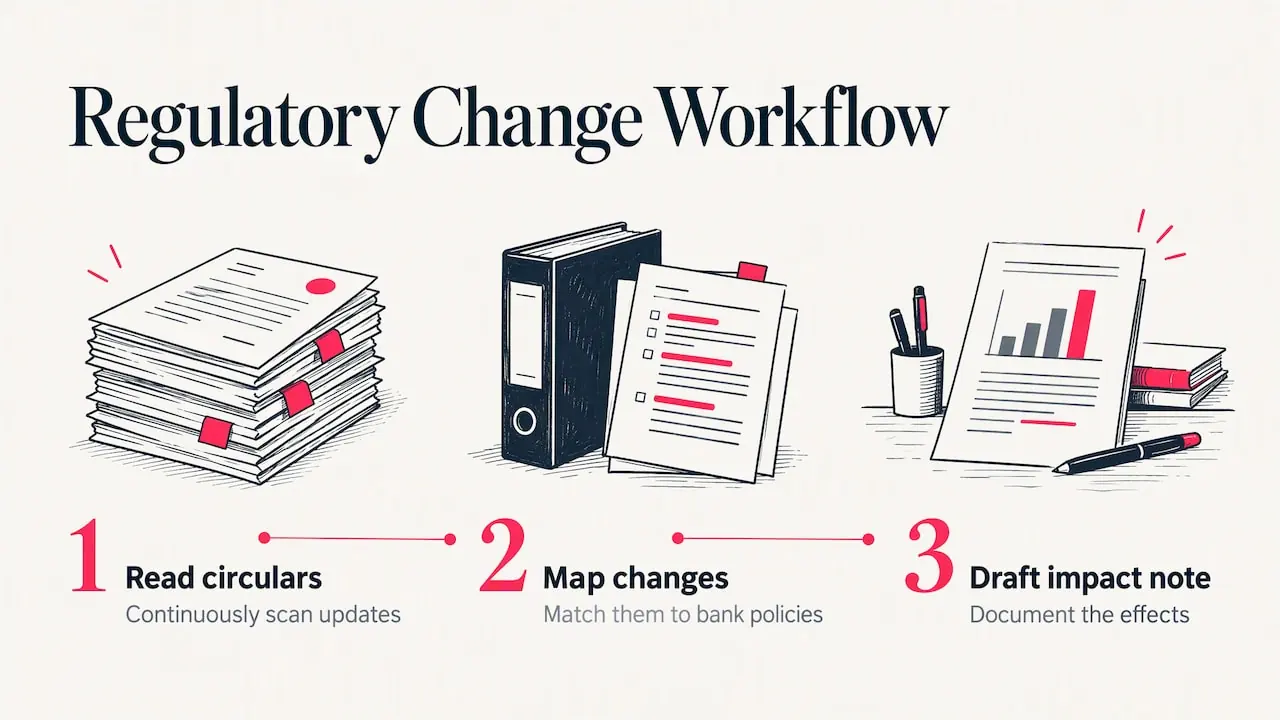
Back-office use cases often pay back faster because the risk surface is internal. Regulatory change monitoring is a good example: a person reads hundreds of pages of circulars, an agent reads them continuously, maps each change to your policies and drafts the impact note. Our overview of digital banking compliance shows how wide that obligation landscape has become.
What the numbers say, and what they do not
The most cited figure comes from BCG. In its March 2026 article on how retail banks can put agentic AI to work, BCG says AI agents have the potential to reduce banks’ costs by 30% to 40% by 2030. BCG does not break down which costs, so treat the figure as a direction, not a budget line.
Read that number as an upper-range potential, not as a forecast for your bank. Three caveats help you set expectations with your board:
- It is a projection for retail banking, not a measured result across all institutions.
- Realising savings depends on process change. Deloitte warns against the “smart overlay” approach, where an agent is placed on top of an existing process and inherits its inefficiencies.
- Savings require running agents in production, not in pilots. Many banks stall exactly there.
If cost is your main driver, pair this article with our practical guide to cost reduction in banking so that agents sit inside a wider efficiency plan.
Agentic by design, not a smart overlay
A common failure is the overlay. A bank adds an agent to a process built for manual handoffs: approvals by email, data in five systems, rules that live in people’s heads. The agent then does the same slow thing slightly faster, or fails when the process assumes a human will improvise.
Deloitte recommends the alternative: an “agentic by design” approach that restructures the underlying process so agents do not inherit the limits of legacy systems that were never built for autonomous operation.
In practice that means asking, process by process:
- What is the actual goal of this process, and how is success measured?
- Which steps exist only because a person had to pass information to another person?
- Which decisions need human judgment, and which only need a rule and a record?
- Which systems must expose clean interfaces so an agent can act without screen scraping?
The fourth question is where architecture decides the outcome. Agents need reliable APIs into core banking, case management, document stores and screening services. Where those do not exist, modernization comes first, and it is better to say so early. That is why it often makes sense to start with technology consulting on the target architecture before any agent is built.
Governance: treat agents like employees
Compliance teams tend to picture an agent acting completely unsupervised. That is rarely how successful deployments work. The EBA’s factsheet on the rising use of AI in EU banking and payments describes how the authority monitors general-purpose and agentic AI in consumer-facing applications. Workable designs let agents escalate complex, high-judgment decisions to people while automating the repetitive work.
A useful mental model is to onboard an agent the way you onboard a new colleague:
- A defined role. What the agent is for, and what it is explicitly not for.
- Authority limits. Transaction values, data classes and systems it may touch, with hard stops enforced in the platform and not only in the prompt.
- Escalation rules. The conditions under which it must hand over, and to whom.
- An audit trail. Every observation, tool call and decision logged so a reviewer can reconstruct why the agent acted.
- Ongoing review. Sampling of outputs, drift monitoring and a named owner in the business.
This is also how you answer an auditor. Logging every autonomous decision is what turns “the model did it” into an explainable, reviewable process. For the security and control side of this, see how we approach security and compliance for financial institutions.
Regulation: what Swiss banks should watch
FINMA
Switzerland has no single AI law for banks. FINMA’s approach is technology-neutral: the same business with the same risks follows the same rules. FINMA’s Guidance 08/2024 on governance and risk management when using AI sets out what it expects. In its survey of around 400 Swiss financial institutions, the supervisor reported that around 50% of institutions have incorporated the use of AI into an explicit AI strategy, and that data quality, data protection and explainability have the highest priority among AI risks, with increased attention to data security and outsourcing risks.
For an agent project, that translates into questions your second line will ask: where does the data go, who is accountable for the outcome, can you explain a decision, and what happens if a third-party model provider changes or fails.
EU AI Act
If you serve EU customers or operate in the EU, the AI Act applies to you too. The EBA’s note on AI Act implications for the EU banking sector explains that systems are classified by risk to fundamental rights, and that in banking, AI used to assess creditworthiness or establish a credit score is high-risk (Annex III of Regulation (EU) 2024/1689).
Timelines have moved. Under Regulation (EU) 2026/1744, the Digital Omnibus on AI, the high-risk obligations apply from 2 December 2027 for systems listed in Annex III, and from 2 August 2028 for systems covered by Annex I product legislation, instead of 2 August 2026. Confirm the current dates with your legal counsel before you fix a project plan, because they have changed once already. Building the logging, human oversight and documentation now costs less than retrofitting them later.
From pilot to production: a practical sequence
Most banks have run pilots. Fewer have an agent working in production under real controls. This is the order we recommend.
- Pick one process with a clear owner. Choose work that is high volume, document-heavy and has measurable cycle time, such as KYC refresh or loan file preparation. Avoid starting with a decision that has direct customer harm potential.
- Map the current process and redesign it. Remove handoffs that exist only for humans. Decide what the agent owns and where people review.
- Check the integration surface. List the systems the agent needs. Close API gaps first. This step often reveals legacy constraints that decide the timeline.
- Define guardrails before building. Roles, authority limits, escalation and logging are requirements, not later additions.
- Run in shadow mode. The agent prepares outputs while people still do the work. Compare results, measure error types and refine.
- Go live with limits. Start with low-value or low-risk cases, keep a human approval step, and widen the authority as evidence builds.
- Measure and expand. Track cycle time, error rate, escalation rate and cost per case. Reuse the platform for the next process.
The platform choices matter as much as the model. Design for model replacement, because the best model today may not be the approved one in two years. Keep prompts, tools and policies versioned, and keep customer data inside your approved environment.
Build, buy or combine
Banks usually face three paths, and the right answer is often a mix.
| Path | Strength | Watch out for |
|---|---|---|
| Configure a vendor’s packaged agents | Fast start for standard use cases | Limited fit with your core systems and policies; dependence on the vendor’s roadmap |
| Build in-house | Full control and know-how | Scarce AI engineering talent, long time to production |
| Work with an engineering partner on a custom build | Fit to your architecture, faster capacity, knowledge transfer | Needs clear ownership of governance on your side |
The decision depends on how differentiating the process is and how much integration it needs. A standard customer FAQ agent rarely justifies a custom build. A credit-file agent wired into your own core banking, policy engine and document archive usually does.
Our perspective on agentic banking
In agentic banking projects the model is rarely the hard part. The hard parts are the surrounding system. Can the agent reach the data it needs? Can a reviewer see why it acted? Does the process underneath still make sense?
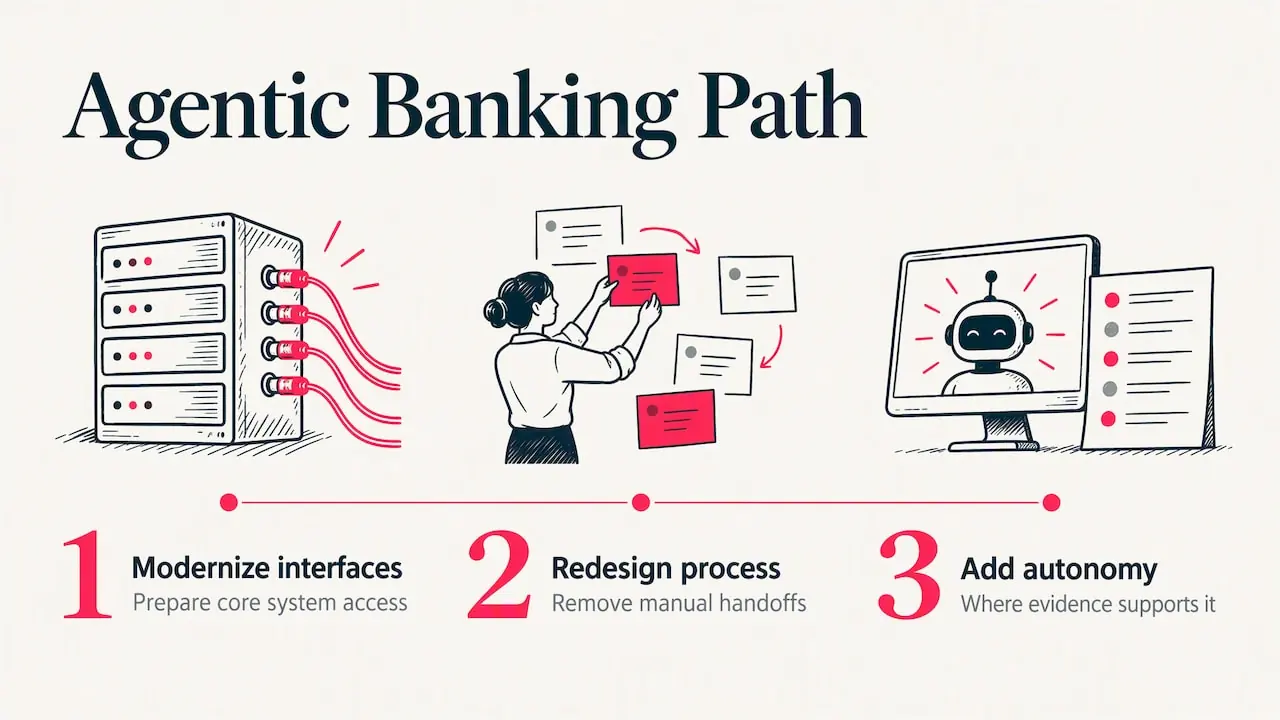
We think agentic banking will be won by institutions that treat it as an engineering and operating-model change, not as a feature. That is why the architecture and the control framework should come first, with agents built to fit them. Digital banking platforms, AI agents for operations and compliance, regulatory monitoring and legacy modernization form one continuous path: modernize the core interfaces, redesign the process, then add autonomy where the evidence supports it.
Our advice to a CTO starting now is simple. Choose one process, set the guardrails first, and insist on production metrics, not demo impressions. Autonomy should grow at the speed of evidence.
— Igor
How S-PRO can help
We are a Zurich-based fintech software development company. For agentic banking projects we can support you across the steps above: custom AI agent development for operations, compliance and customer service, the digital banking platform work that gives agents clean systems to act on, and technology consulting for roadmap, cloud and legacy modernization. S-PRO builds AI agents for bank operations and compliance, starting with the target architecture and the control framework and keeping human approval in place. S-PRO is a Certified partner in the Claude Partner Network, and our team includes Claude-certified engineers and architects. We can scope a first use case such as KYC or credit file preparation with you. If you want to discuss a first use case, see our AI agent development service or book a discovery call, and we will walk through your process with you.
FAQ
What is the difference between agentic banking and a banking chatbot?
A chatbot answers questions inside a conversation. An agent pursues a goal across systems: it gathers data, applies policy, takes steps and escalates when needed. Chatbots are often the front end of an agent, but the agent does the work behind it.
Which agentic AI use cases should a bank start with?
Start with document-heavy, rule-based processes that have a clear owner and measurable cycle time, such as KYC and onboarding, credit file preparation, regulatory monitoring or fraud alert triage. Avoid starting with fully autonomous customer-impacting decisions. Keep a human approval step until the evidence supports loosening it.
Are AI agents allowed in Swiss banking?
FINMA supervises on a technology-neutral basis, so existing rules on governance, risk management, outsourcing and data protection apply to agents just as they do to other systems. If you serve EU customers, the AI Act adds obligations, including for credit scoring, which it classes as high-risk. Speak with your compliance function and legal counsel about your specific case.
How much can agentic AI reduce costs in banking?
BCG says AI agents have the potential to reduce banks’ costs by 30% to 40% by 2030, in an article on retail banking. That is a potential, not a measured result, and realising it depends on your own processes and on reaching production. Treat it as an upper-range planning input, then validate it with a measured pilot at your own bank.
Do AI agents replace bank employees?
In practice, agents take over routine, repetitive, context-heavy work, while people keep high-judgment decisions, exceptions and oversight. The EBA describes designs in which agents escalate complex cases to human operators. Roles shift toward supervising, reviewing and improving agent work.
Sources
- Agentic AI in banking, Deloitte Insights
- How Retail Banks Can Put Agentic AI to Work, BCG
- Agentic finance, Smith School of Enterprise and the Environment, University of Oxford
- Agentic AI Use-Case Assessment for Banking, Gartner
- Rising application of AI in EU banking and payments, European Banking Authority
- AI Act implications for the EU banking sector, European Banking Authority
- FINMA survey: artificial intelligence gaining traction at Swiss financial institutions
- Regulation (EU) 2026/1744 (Digital Omnibus on AI), EUR-Lex
Recommended
Subscribe


Thank you!
Get ready! You will receive handpicked content right to your inbox.