

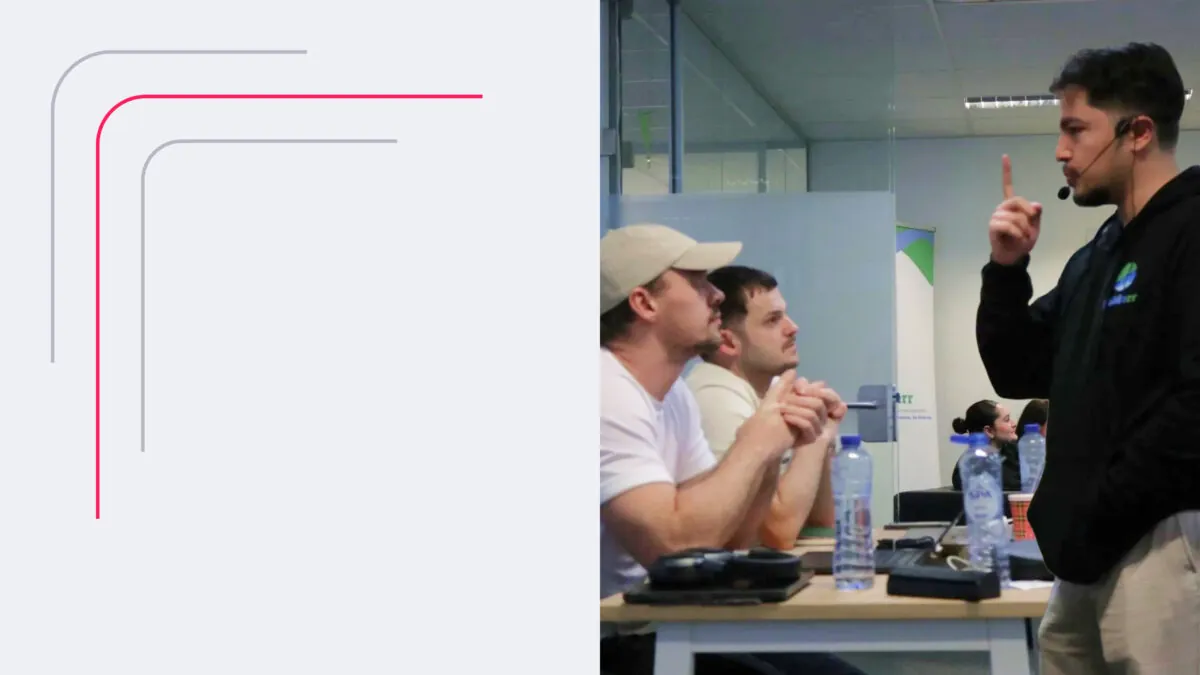
It’s surprising how much can happen in 24 hours – one moment it’s just a weekend, and the next you’re racing against the clock, building faster than you thought possible. The sprint begins instantly, and that pace shapes everything that follows.
S-PRO joined the Polderr AI Hackathon, an event built around a simple but demanding idea: place real-world challenges in front of multidisciplinary teams, give them 24 hours, and see how far they can push an idea when there’s no luxury of time. The challenge we received came directly from Gemeente Rijswijk, and it reflected a problem nearly every modern city faces – public sentiment moves fast, and institutions rarely have tools fast enough to keep up.
What the Hackathon Is & Why S-PRO Joined
The Polderr AI Hackathon is a one-day event in the Netherlands where teams get a real challenge and 24 hours to turn it into something that works. The event was organized by Polderr with support from Certiff.com. No theoretical tasks. Municipalities and companies bring the issues they’re dealing with now, and teams build under pressure.
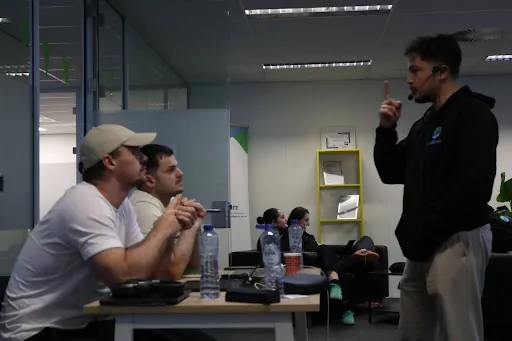
The atmosphere is straightforward and energetic – people sitting side by side, moving fast, and testing ideas the moment they appear. There’s no time for overthinking. You focus on what makes the biggest difference.
That’s the kind of environment where S-PRO works well. Clear goals, fast decisions, and a real problem to solve. A format like this shows immediately how a team thinks and how quickly an idea can become something useful.
Who Represented S-PRO
Two people represented S-PRO at the hackathon: Ihor Tanyenkov, Senior AI Architect, and Maxim Golovan, Head of S-PRO Netherlands.
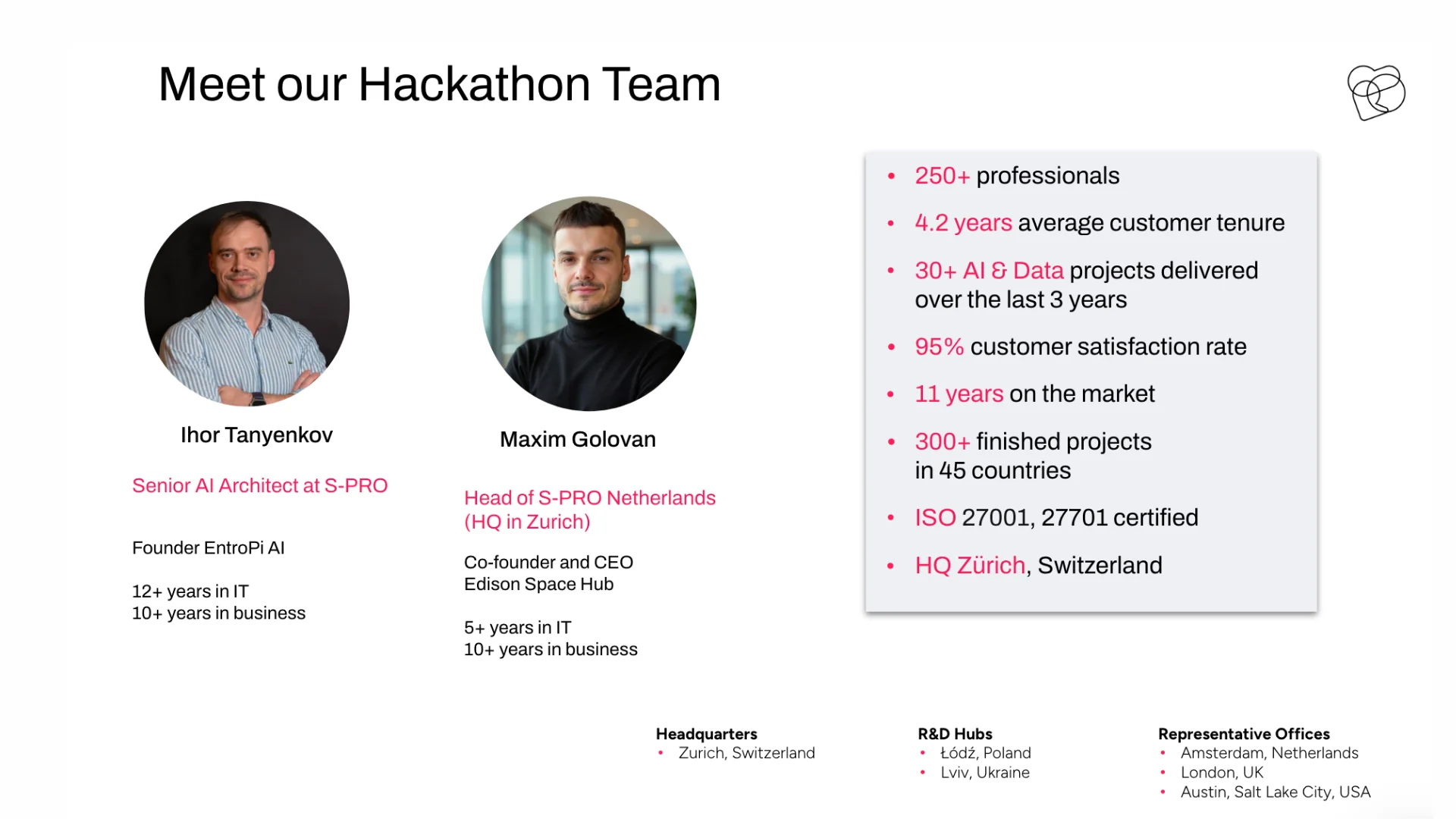
Ihor brought over a decade of experience in AI and product development and is used to shaping ideas quickly – especially when time is tight. The municipal context added a new layer, because the solution had to work not just technically but socially.
Maxim brought a mix of IT and entrepreneurial experience, along with practical knowledge of working with Dutch partners. That helped frame the challenge early and stay focused on what mattered for Rijswijk.
They arrived with curiosity and two laptops, and they left with a working prototype – and a clearer picture of how fast a team can move when the deadline is measured in hours.
The Challenge & What We Built
The task from Rijswijk pointed in one direction: cities need a faster way to understand what people are talking about. That was enough for us to start building.
We focused the entire 24-hour sprint on one idea – a tool that turns scattered public conversations into something a municipality can read, understand, and act on without days of manual analysis.
We created StadSense, a compact but powerful prototype built around three simple actions: listen, analyze, and act.
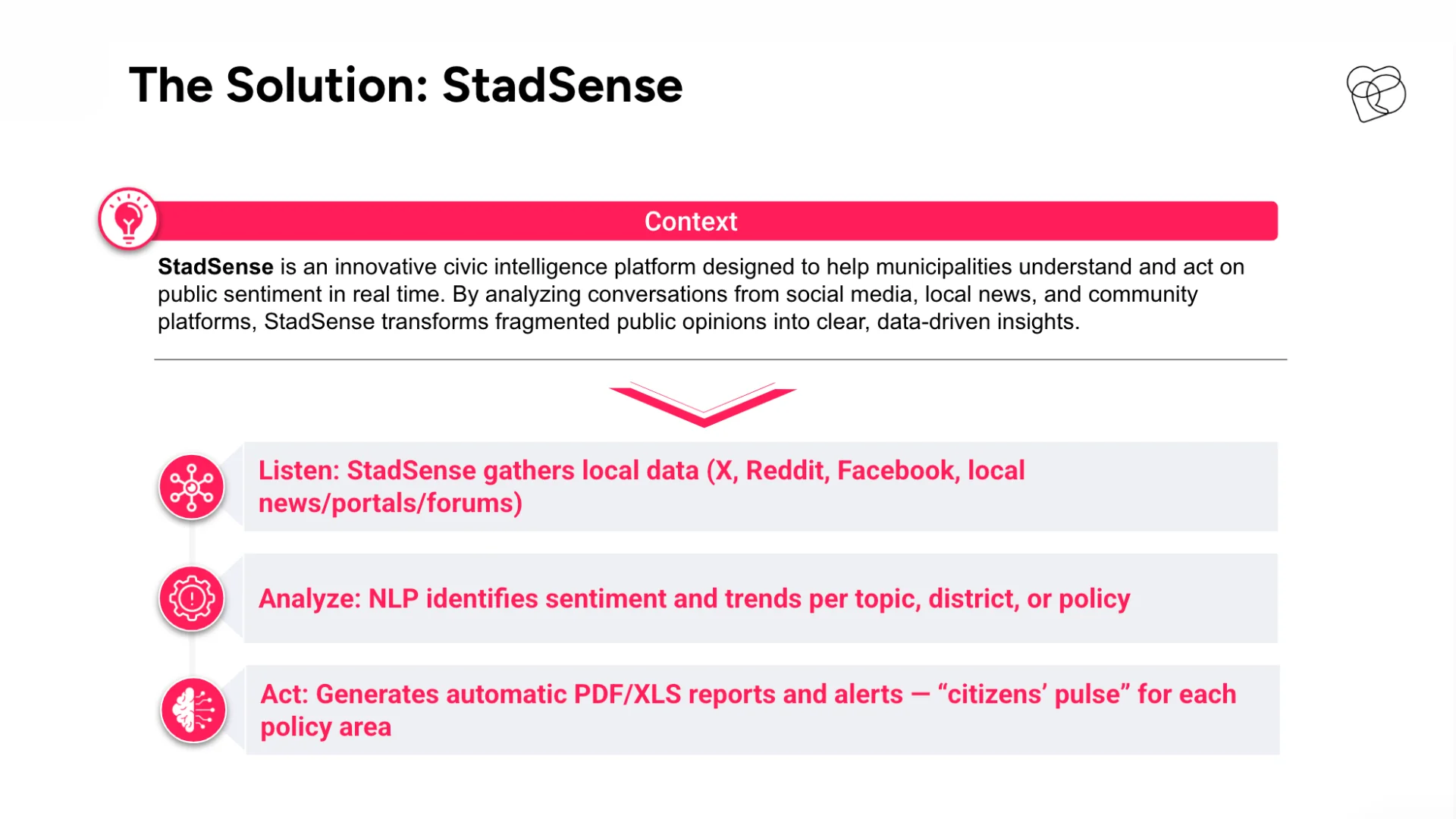
Here’s what we delivered within the 24-hour window:
- Social Monitor – collects posts from X, Reddit, local news sites, and forums, then groups them by topics and sentiment. It gives a quick sense of what’s rising, what’s dropping, and where emotions run high.
- Policy Monitor – takes any policy link or text and shows how people react to it in real time. It’s a fast way for a municipality to check if a new update is landing well or causing frustration.
- PDF/XLS/CSV export – creates simple, ready-to-share reports. No dashboards, no complexity – just clear outputs that teams can use immediately.
- Agent creation – lets users set up separate “projects” inside the tool so different departments or topics don’t mix. Helpful when several initiatives run at the same time.
The goal wasn’t to build a full platform. It was to show that a city can quickly understand what people are saying without digging through thousands of posts by hand. And the prototype proved that – in just a few hours, scattered conversations turned into clear, readable patterns.
The Road Ahead
The prototype built in 24 hours was only the starting point. After the hackathon, the next question was simple: where does StadSense go from here?
The future isn’t about adding more features – it’s about giving municipalities tools they don’t have today.
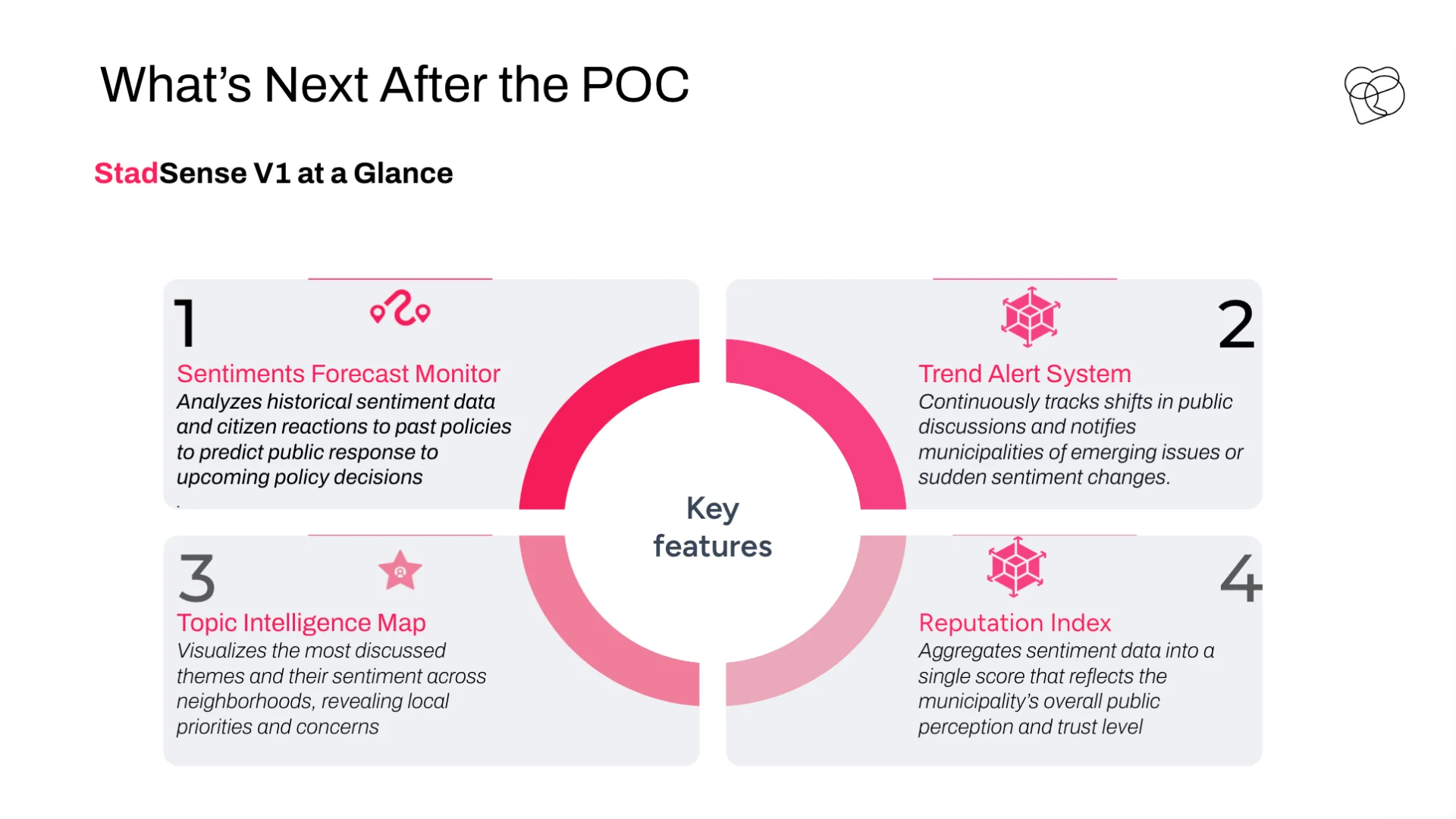
StadSense is set to move beyond recording reactions and into predicting them. A Sentiment Forecast Monitor will analyze how residents responded to past policies and use those patterns to estimate how they might react to new proposals. This gives teams a chance to adjust communication or timing before an issue becomes sensitive.
A Trend Alert System will track unusual spikes in conversations or sudden changes in tone. Municipalities will see these shifts as they happen, rather than discovering them after the discussion has already escalated.
A Topic Intelligence Map will highlight which issues dominate in different neighborhoods – mobility, housing, safety, local infrastructure – making it easier to understand not only what people discuss, but where those discussions intensify.
And a Reputation Index will bring everything together by turning thousands of posts into one clear indicator of public perception over time. It shows a trend, not a single moment, giving municipalities a clearer sense of how sentiments evolve.
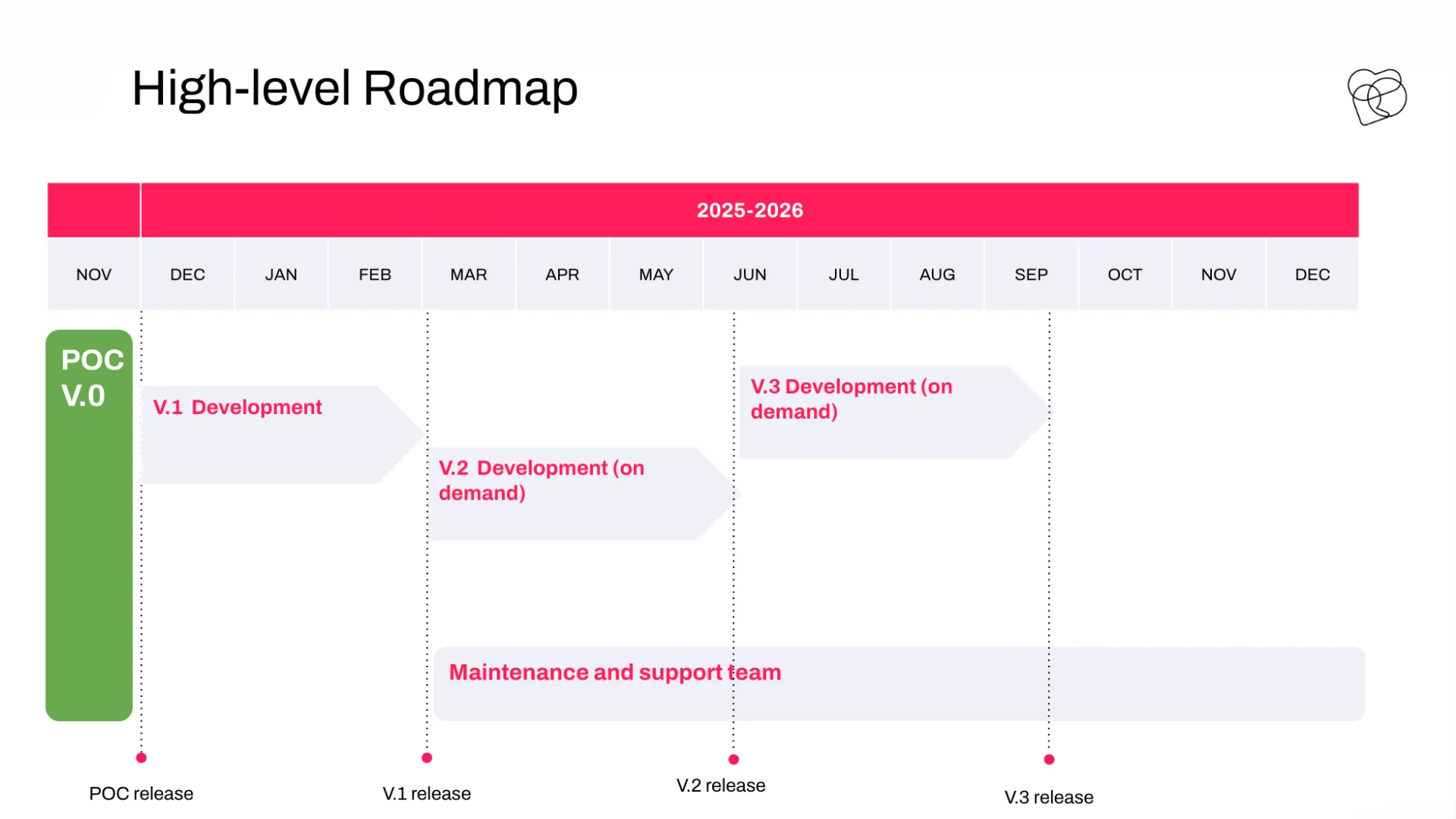
The roadmap reflects this direction. The POC is done. Version 1 is outlined as a next logical step. If the project advances, future iterations could move quickly. The goal remains simple: start with a fast prototype and grow it into a tool that helps cities make better decisions.
And it raises a simple question: what fast prototyping really changes?
Why Building Fast Matters
AI has changed the pace of early product work. What once took weeks can now be tested in hours – long before budgets or plans lock teams into assumptions that may not survive real use.
Fast prototyping brings something teams rarely get early on: truth. You see how an idea behaves with real data, where it breaks, and whether anyone actually needs it. And all of that happens before months of development, not after.
For startups, this speed can decide the fate of an idea. A quick prototype shows what holds up and what collapses the moment it meets reality. Direction becomes clearer while changes are still cheap.
Municipalities benefit in the same way. They don’t need a polished platform to understand whether a tool helps them. They need a simple version that answers one question: does this solve the problem we actually have?
The hackathon made this obvious. One loop of building and testing revealed more than weeks of meetings could. Even a basic version of StadSense proved its value within hours – enough to guide the next step with confidence. This is also how S-PRO works. We move fast, test early, and learn in motion. Not to rush, but to remove guesswork and let evidence shape the product.
Fast prototyping isn’t only about speed. It’s about turning uncertainty into direction.
Subscribe


Thank you!
Get ready! You will receive handpicked content right to your inbox.