

One of Ukraine’s largest cinema chains manages over 20 million tickets annually across a network of over 20 theaters. Despite this scale, the organization faced a universal challenge in the entertainment industry: the “perishable inventory” of a cinema seat. A seat that remains empty during a Tuesday matinee is revenue lost forever.
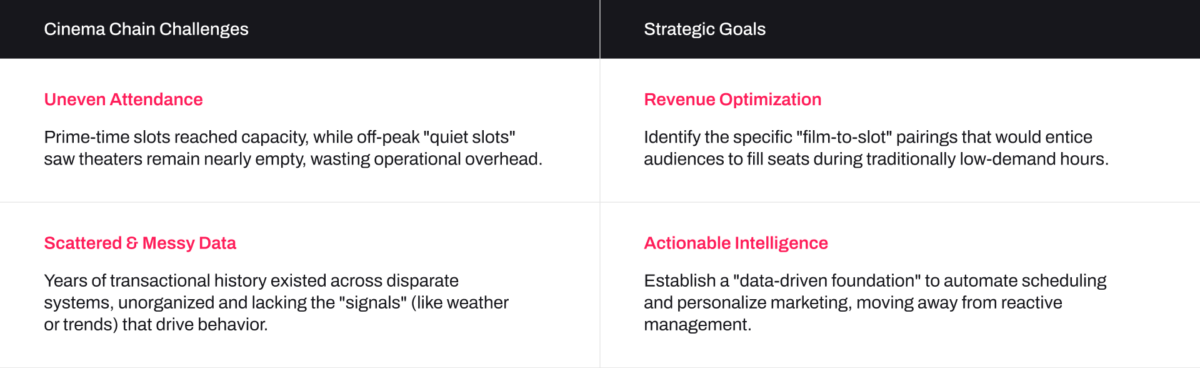
To solve this, the cinema had to move past intuition-based scheduling. They sat on years of ticket sales and purchase history, but this data was siloed and “raw.” The strategic hurdle wasn’t just collecting data – it was architecting a system that could turn that data into a predictable revenue driver.
The “So-What?”
These hurdles created a “reactive” business model. Without the ability to predict demand, the cinema was forced to manage the crowds that showed up, rather than actively engineering the audience they wanted. Solving this required more than a better spreadsheet; it required a foundational shift in how they understood their customers.
Step 1: Solving the Identity Crisis through Customer Segmentation
The first “strategic building block” in this transformation was Customer Segmentation. In a cinema context, segmentation is the process of moving from “anonymous ticket buyers” to distinct, behavioral clusters.
The cinema utilized AI to find patterns in the noise, ensuring that every data point was processed ethically under a strict data processing agreement. By anonymizing data and removing personal identifiers, the system focused on behavioral truth rather than PII (Personally Identifiable Information).
The Three Pillars of Audience Understanding
1. Film Preferences
Mapping which genres or franchises drive repeat visits, allowing the team to identify “loyalty anchors” for specific segments.
2. Visit Frequency
Distinguishing “High-Loyalty Super-Users” from “Occasional Moviegoers.” This allowed the cinema to prioritize retention for regulars and “win-back” strategies for the occasional visitor.
3. Timing Habits
Identifying the “Weekday Matinee Crowd” versus the “Weekend Blockbuster” segment to ensure scheduling aligned with the life-rhythms of the audience.
✔️The “So-What” of segmentation is the death of the “one-size-fits-all” blast. By understanding these pillars, the cinema moved to Personalized Communication. Instead of generic promotions, they could send the right film recommendation to the right segment at the exact moment they were likely to book.
However, knowing who your audience is only provides the map; to drive revenue, you need the engine that tells you how to change their behavior.
Step 2: Predictive Power with Uplift Modeling
With segments defined, the architecture moved to Uplift Modeling. As a curriculum architect, I define Uplift as the measurement of incrementality. It isn’t just predicting that people will show up for a blockbuster; it is predicting the additional revenue generated by making a specific change to the schedule – the “lift” over the status quo.
The system simulates thousands of schedule variations by cross-referencing audience segments against specific time slots. It calculates the “Uplift” – the delta between a standard schedule and an optimized one. This specifically targets the “quiet slots” by identifying which niche films have the highest probability of drawing a segment out of their home and into a theater on a Tuesday afternoon.
✔️A critical business constraint in this implementation was the “Human-in-the-Loop” design. The platform offers “Auto-Recommendations” alongside a “Manual Option.” This ensures that AI handles the heavy lifting of data processing while theater managers retain the agency to apply local expertise or operational nuance.
This sophisticated modeling is only possible because of the robust engine running underneath the surface.
The Engine Under the Hood: The S-PRO Forecasting Agent
The S-PRO Agent serves as the technical “foundational layer,” designed to handle the “messy data” that often stalls digital transformation projects. Its workflow is built to transform raw inputs into executive-level certainty through a three-step process:
1. Plug It In: The agent connects to existing internal systems (Ticket databases, Excel logs). It is built on the philosophy that you do not need “perfect” data to begin; you just need a point of entry.
2. Enrich and Train: The system “normalizes” the messy internal data and enriches it with external signals that correlate with cinema-going behavior. These include:
- Weather Patterns: Identifying the “indoor escape” effect.
- Market Activity & Search Trends: Gauging real-time hype for new releases.
- Pricing & Competitive Landscape: Adjusting for external market pressures.
3. Compare, Then Trust (The Backtest): Before the agent is ever allowed to influence a live schedule, it is backtested. It runs against historical data to prove that its “optimized” schedule would have outperformed the actual historical results.
✔️ Backtesting is the ultimate “So-What” for leadership. It moves AI from a “black box” to a proven asset by showing a side-by-side comparison of the AI’s logic versus the status quo, effectively building the trust necessary for wide-scale adoption.
Measuring Magic: The Results of Data-Driven Decisions
The transition from descriptive data to predictive intelligence yielded immediate, verifiable results. Crucially, these results were not static; they improved as the model learned, reaching peak performance after 5 iterations.
THE OPTIMIZATION EFFECT +5.2% – Incremental Lift
The system achieved a 5.2% increase in ticket sales over a 10-day testing period. This wasn’t just “total sales,” but the specific uplift generated by AI-optimized scheduling decisions.
THE SCIENTIFIC BENCHMARK 95% – Corridor Comparison
To prove causality, the optimized theater was measured against “twin venues” (control groups). The results stayed within a strict 95% confidence corridor, confirming the revenue growth was a direct result of the AI, not market fluctuations.
OPERATIONAL VELOCITY – Rapid Planning & Resource Allocation
Beyond the bottom line, the “So-What” for the staff was a massive reduction in manual planning time, allowing managers to focus on high-level strategy rather than shift-slot puzzles.
This shift represents the ultimate goal of any AI implementation: moving an organization from a “rear-view mirror” approach (describing what happened) to a “high-beam” approach (predicting and shaping the future).
Subscribe


Thank you!
Get ready! You will receive handpicked content right to your inbox.