

Working with AI often starts the same way – a few ideas on where it could help, a couple of promising use cases, and a lot of open questions.
But things get clearer when you actually start building.
That’s the idea behind APEX Workshop – a series of hands-on workshops S-PRO has been running in 2026, where teams take real business scenarios and turn them into working prototypes with AI during the session.
One of these workshops took place during Utah Tech Week in Salt Lake City, and we’re continuing with sessions in Zurich and Amsterdam in the coming weeks. If you have a scenario you’ve been thinking about and want to see how it plays out in practice, you can join one of the upcoming workshops (online or offline) – just get in touch and let us know.
To make this more concrete, let’s look at a real case from one of our private workshops.
During the session, a group explored a procurement problem – fragmented vendor data and slow supplier evaluation – and within a few hours shaped it into a working concept: a Vendor Intelligence Platform. Let’s walk through how it was built. Watch the video to see the full process.
The problem we explored
The starting point wasn’t a new idea but a situation many procurement teams deal with every day.
Vendor information is usually available, often in large amounts. However, it is rarely structured in a way that makes it easy to use. Details about suppliers are spread across documents, internal systems, and spreadsheets, and as a result, bringing them together takes time.
Because of this, decision-making slows down. Finding a suitable vendor requires manual work, while comparing options becomes inconsistent due to fragmented data. At the same time, risks – whether financial, operational, or compliance-related – are often identified too late.
So even what should be a straightforward decision turns into a more complex process.
At the core of this situation is a simple question:
How can we make the right decision when all the data is scattered?
Within a few hours, the group of procurement leaders turned this scenario into a working concept: a Vendor Intelligence Platform.
The platform brings relevant information into one working environment where it can be explored, compared, and interpreted in context. Instead of switching between sources, teams can work with a connected view of the data and evaluate options based on what matters to them.
While vendor evaluation was the scenario used during the session, the same approach applies more broadly. Similar patterns appear in finance, operations, and product teams – anywhere decisions depend on combining inputs from multiple sources.
Let’s take a closer look at how this Vendor Intelligence Platform works.
Inside the prototype
Search in plain language
It all starts with search. Instead of working through multiple filters, the user describes what they need in plain language – for example, suppliers with specific certifications, capacity, or risk profile. The system returns a list of matching vendors, already structured into something usable, with key details like certifications, lead time, location, and risk level visible at a glance.
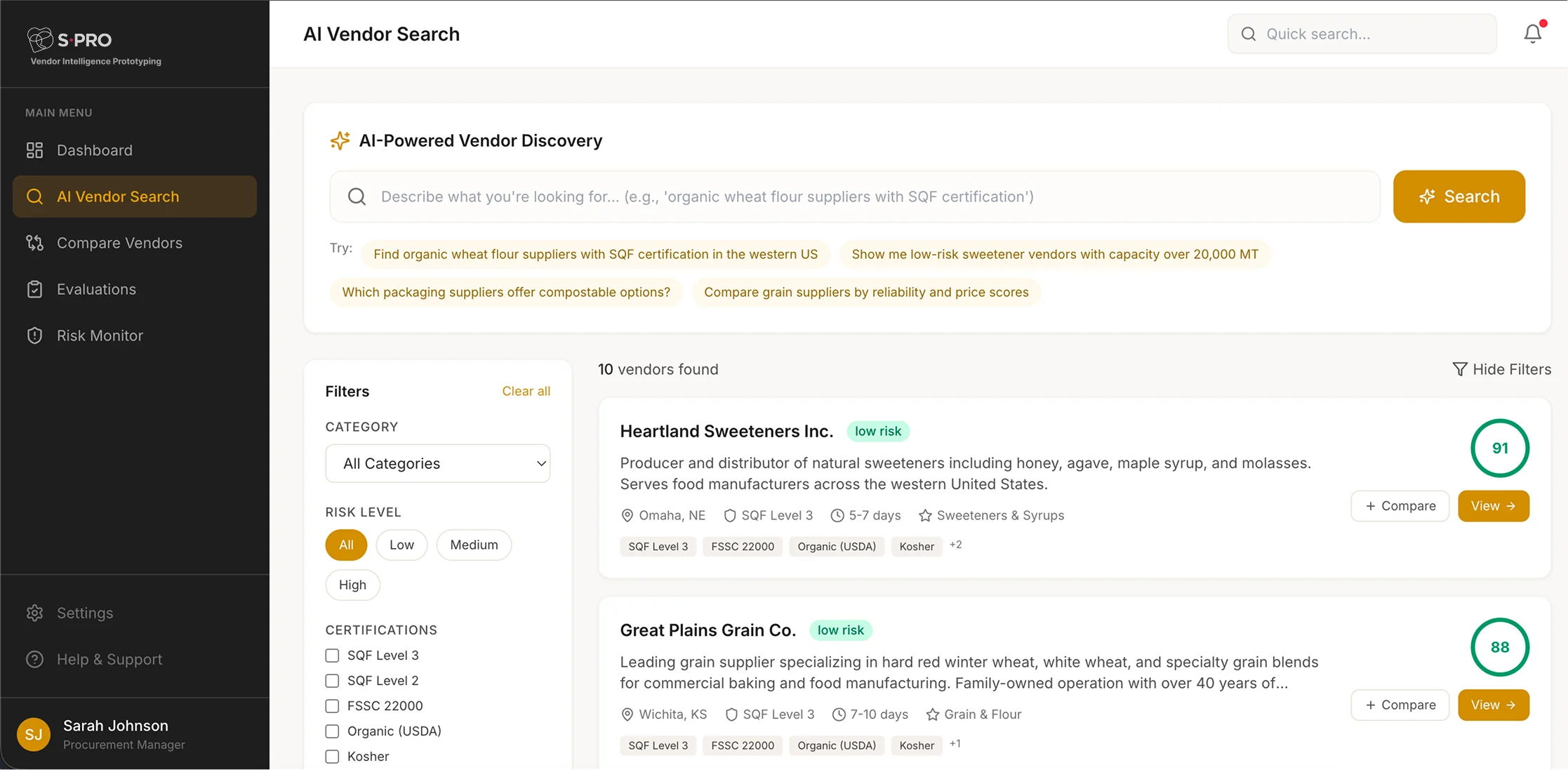
Each result includes an overall score, making it easier to compare options at a glance. Filters are still available but secondary, as the main interaction happens through search.
AI-powered summary
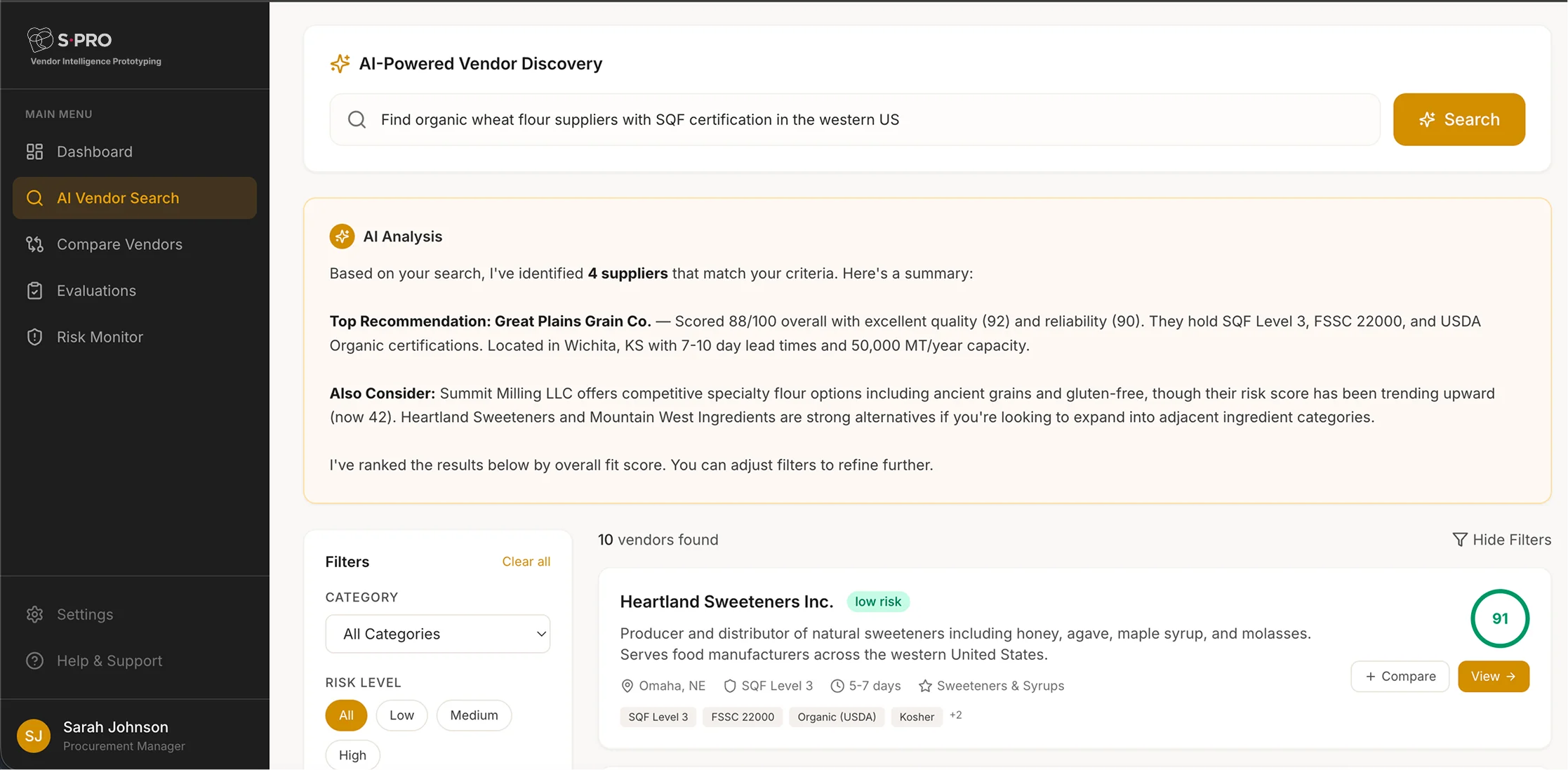
After the search, the system adds a layer of interpretation. Instead of reviewing each vendor manually, the user gets a short summary with a top recommendation, key strengths, and alternative options.
The output is based on the selected criteria and highlights what matters most – quality, reliability, risk, and capacity – making it easier to understand trade-offs without going through each profile in detail.
Selecting vendors for comparison
Once relevant vendors are found, they can be selected and compared side by side. The interface keeps track of chosen options and makes it easy to move from exploration to evaluation without losing context.
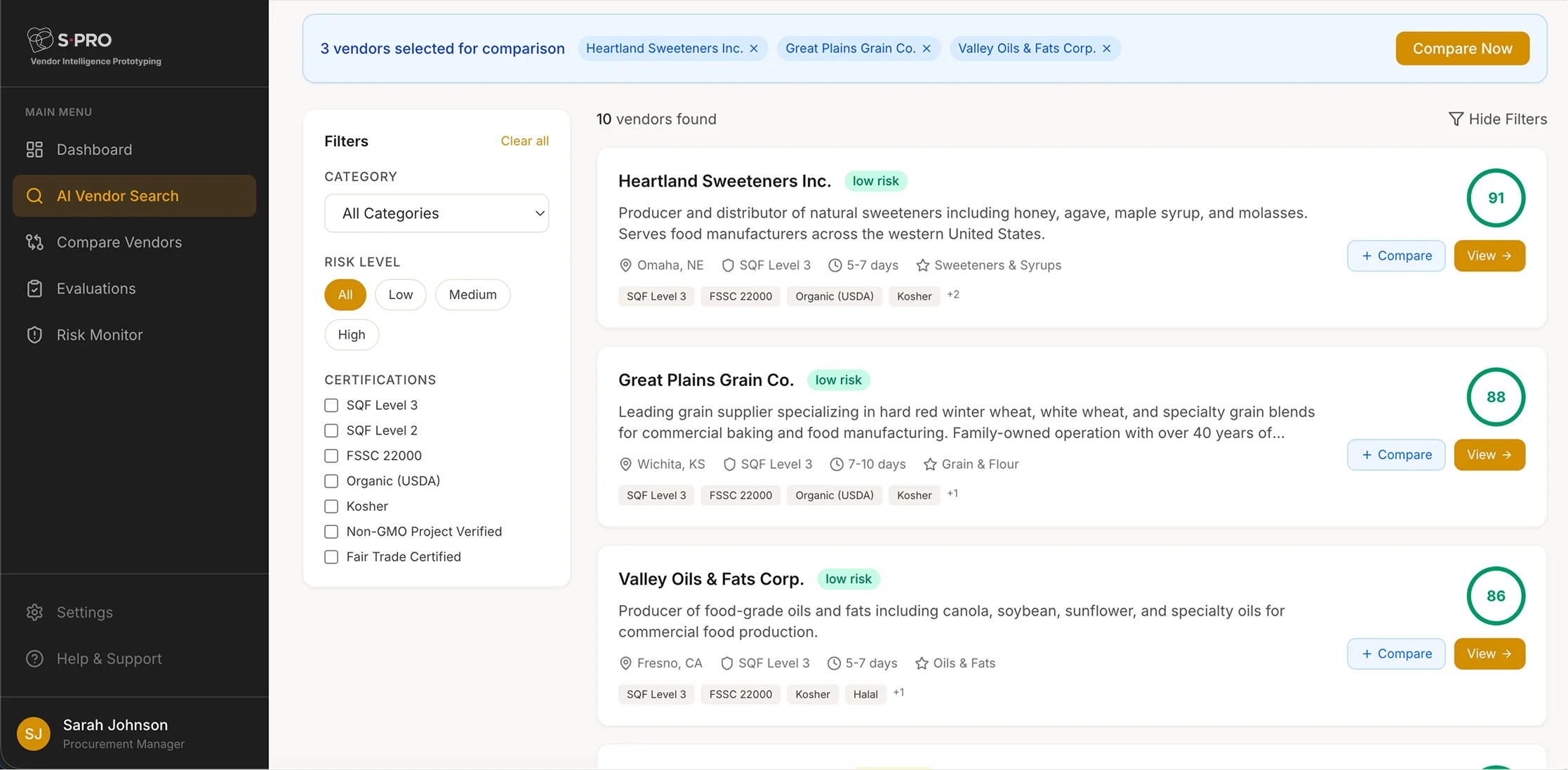
This removes the need to manually collect and align data, as the comparison flow is built directly into the process.
Comparing vendors side by side
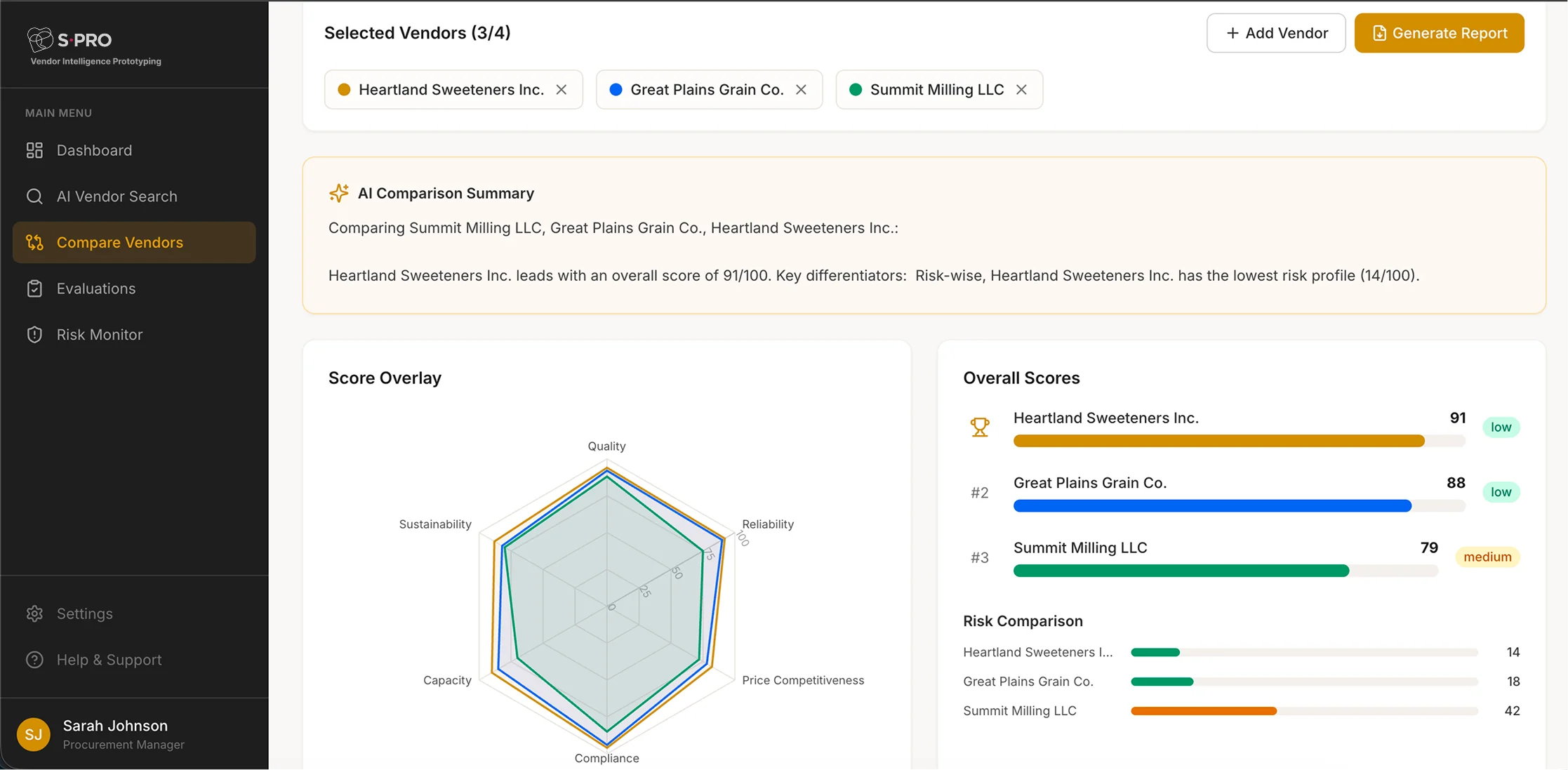
Once vendors are selected, the comparison becomes visual and structured. Key factors like quality, reliability, price, compliance, and capacity are displayed together, making differences easier to understand.
Alongside this, the system provides a short AI-generated summary and highlights key distinctions, helping teams quickly see which option stands out and why.
From comparison to decision
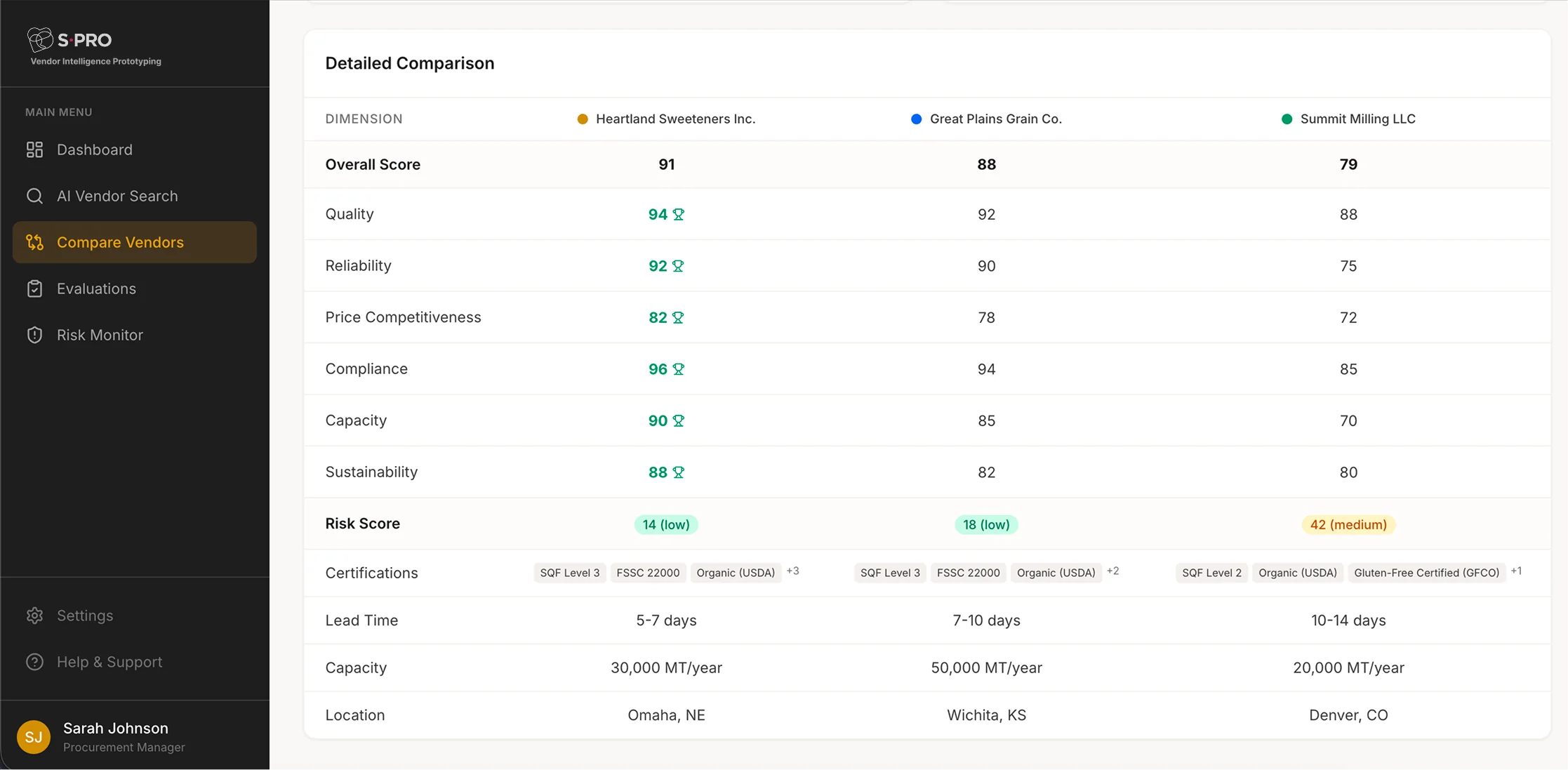
The platform supports both high-level comparison and deeper analysis in one flow. Teams can start with a structured comparison across key dimensions – scores, certifications, lead times, capacity, and risk – and then move into detailed vendor profiles.
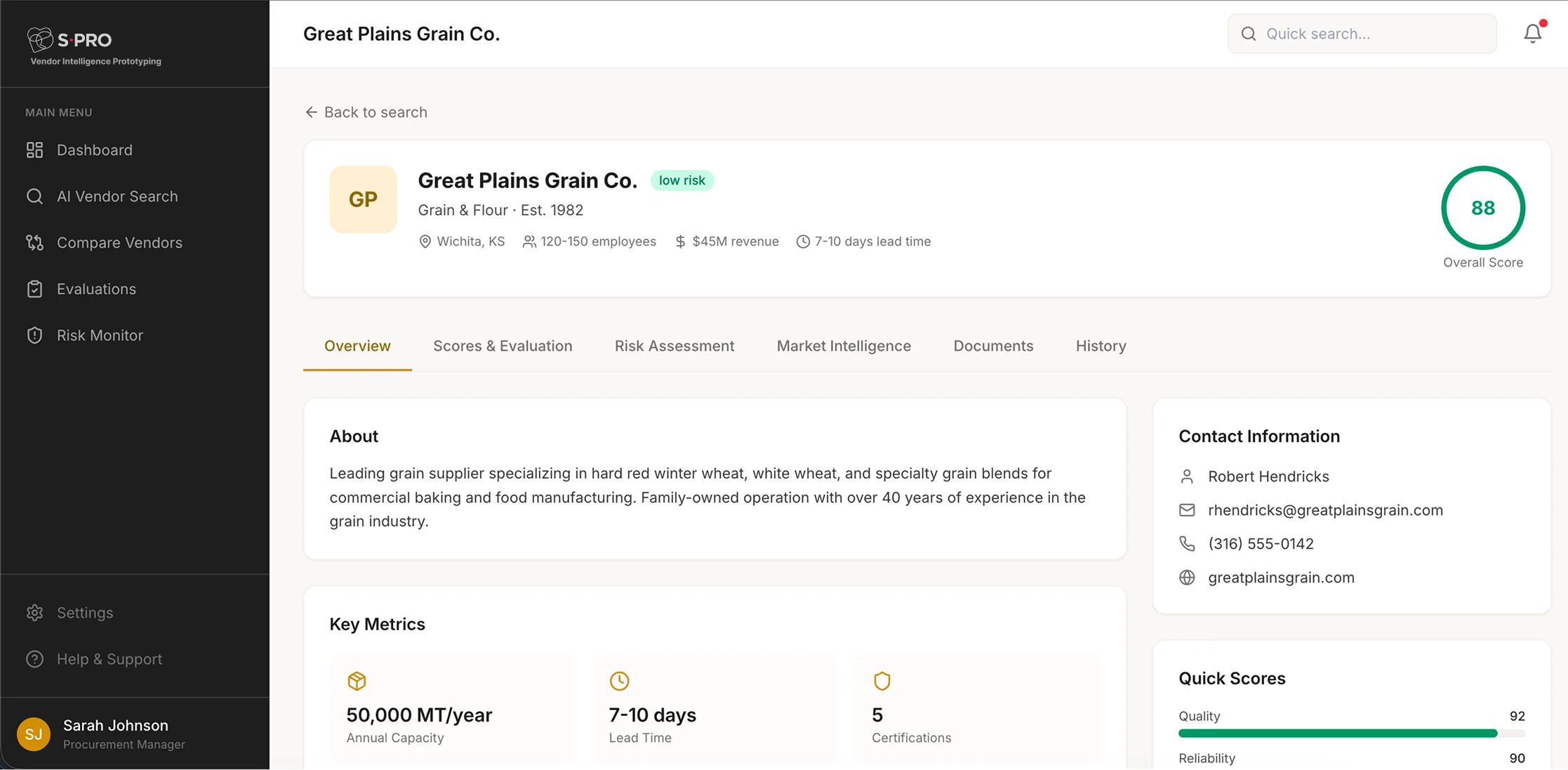
Each profile brings together everything needed for evaluation: company overview, key metrics, performance indicators, and contact details. This makes it easier to validate assumptions, double-check critical data, and move toward a confident decision without switching between tools.
Adjusting decisions in real time
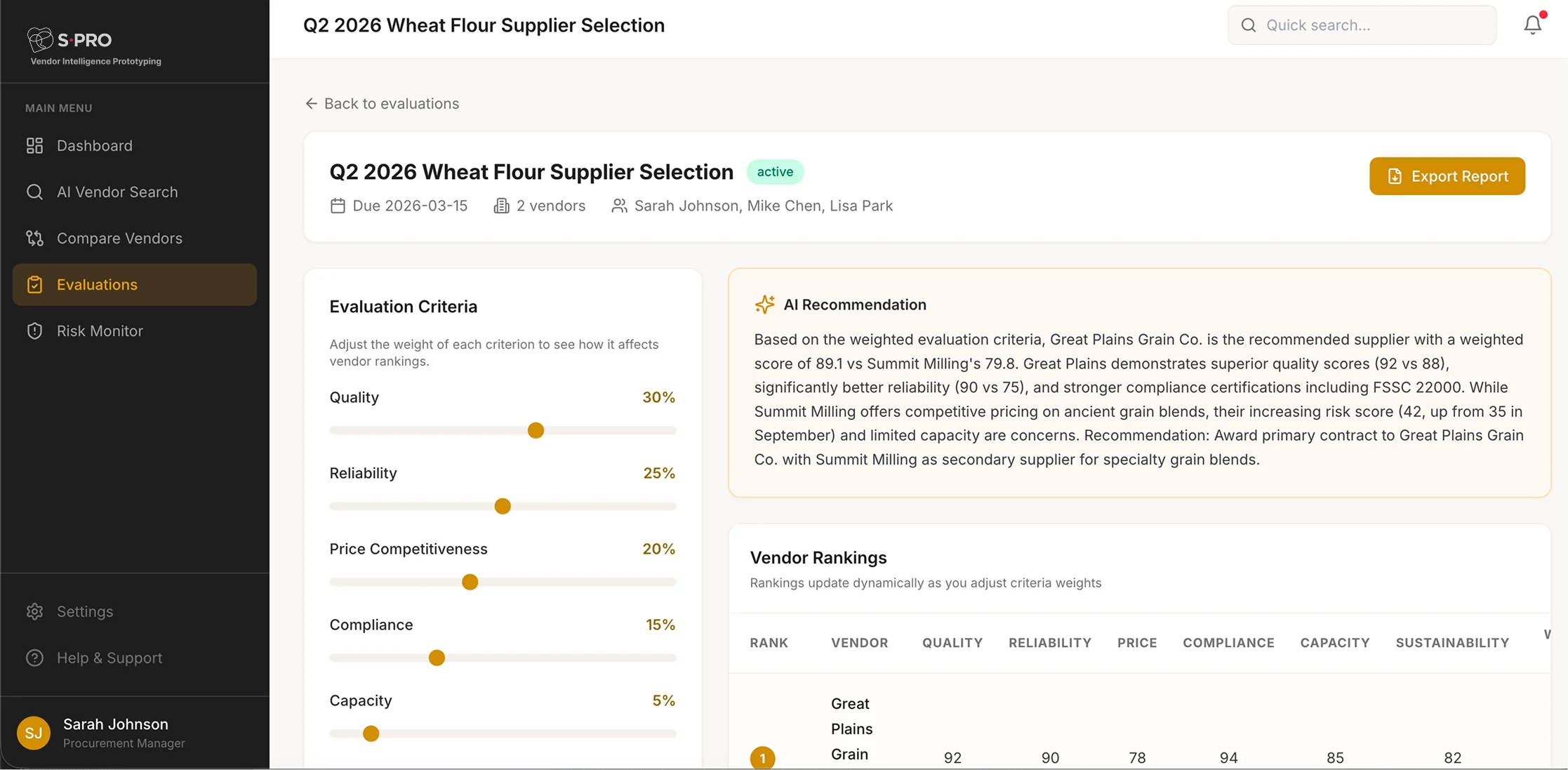
Evaluation doesn’t stop at comparison. Teams can adjust criteria weights – like quality, reliability, price, or compliance – and instantly see how rankings change.
The platform also provides a clear AI recommendation based on those inputs. This makes the decision process more transparent and flexible, especially when different stakeholders prioritize different factors.
Monitoring risk across vendors
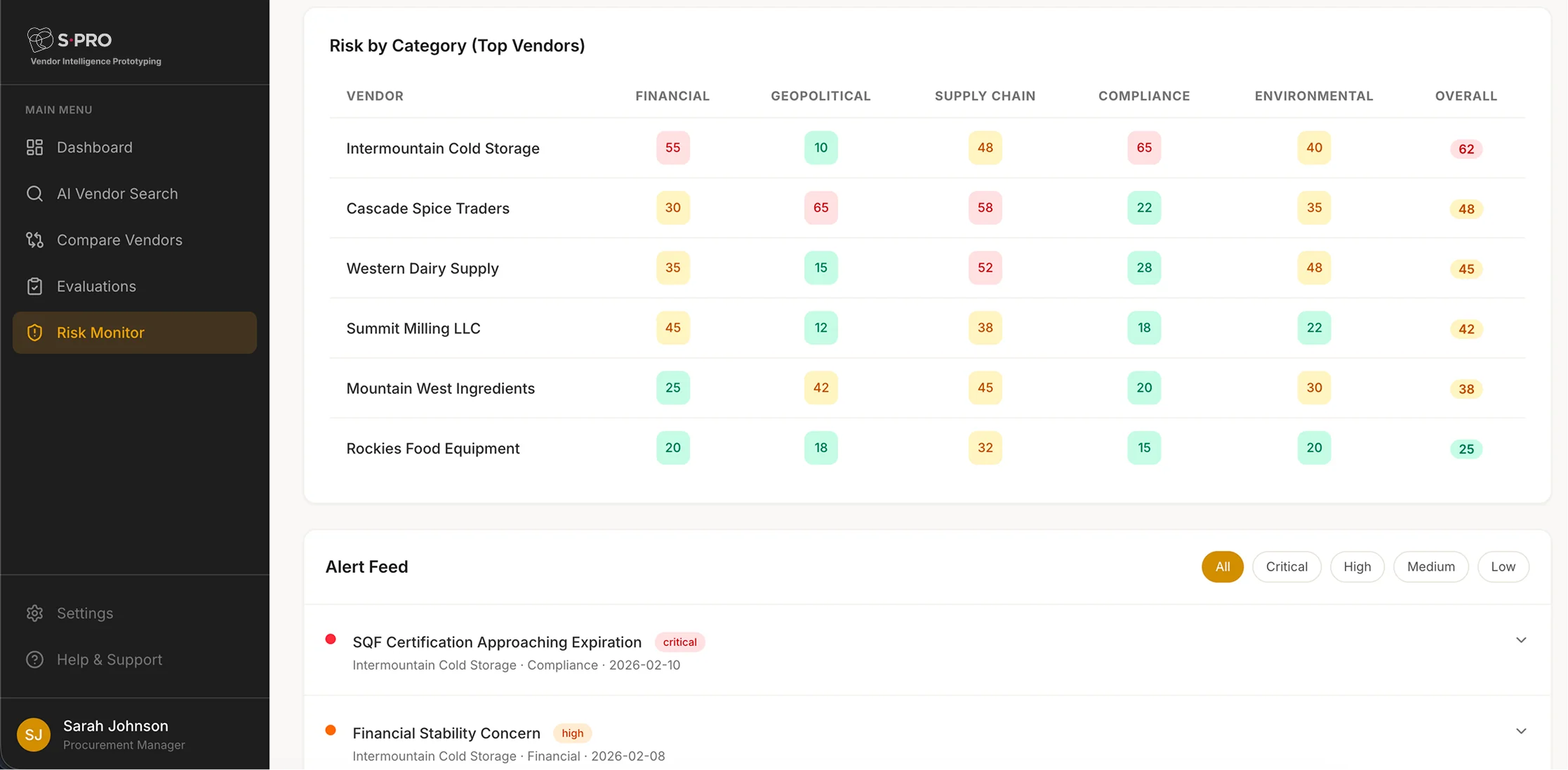
The platform also gives a clear view of supplier risk across the entire portfolio. Teams can track overall risk trends, spot high-risk vendors, and monitor changes over time.
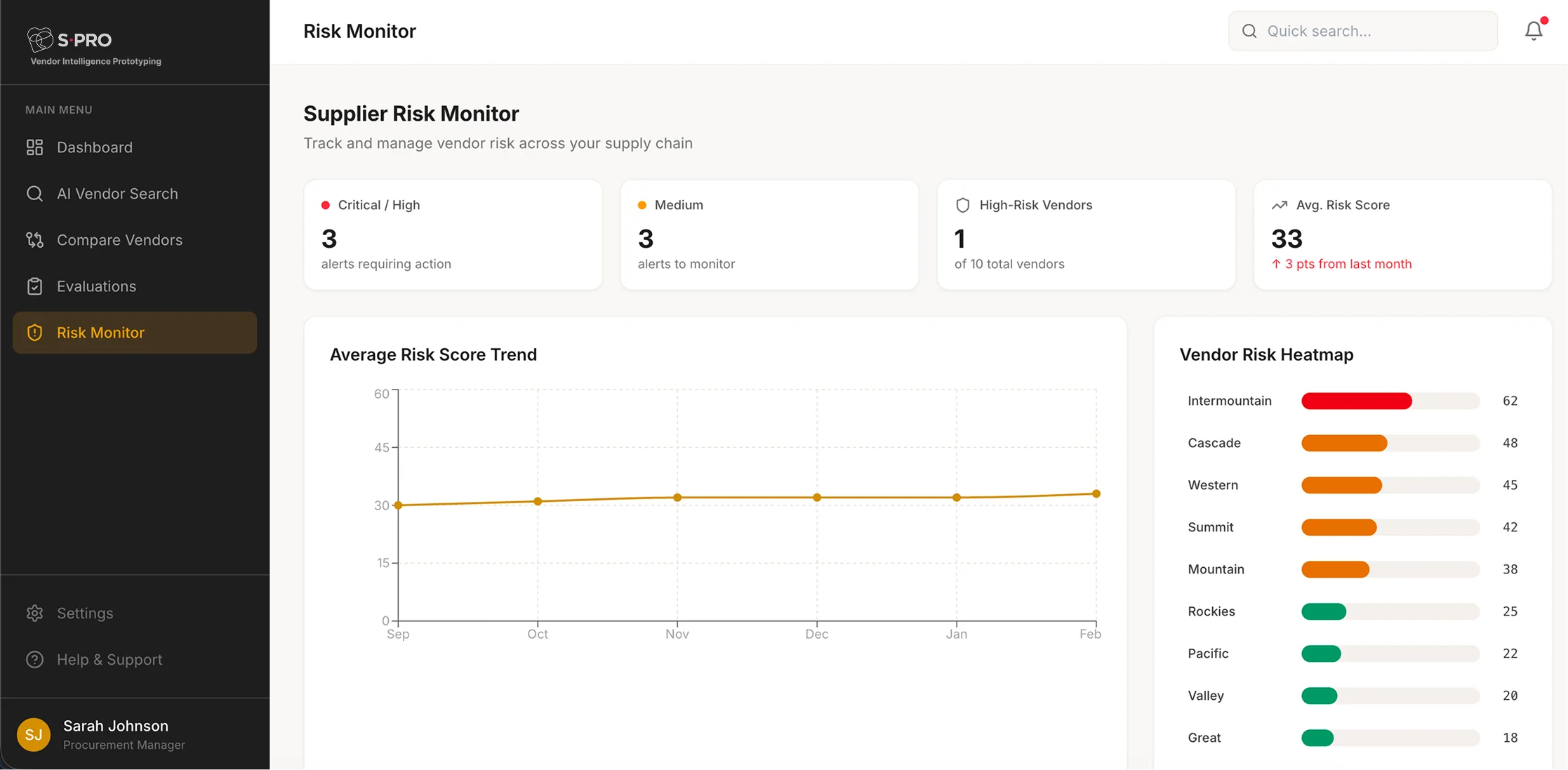
Risk is broken down into categories like financial, supply chain, compliance, and environmental factors, with alerts highlighting issues that require attention. This helps teams stay proactive and avoid surprises instead of reacting too late.
What came out of the session
This case showed how quickly a complex procurement process can be turned into a structured, working system.
Within one session, the procurement team built a concept that covers the full flow – search, comparison, risk visibility, and decision adjustment. Supplier data becomes structured and usable, vendors can be compared side by side, and risk signals are visible early in the process.
What stands out is how complete this became in such a short time. The result reflects how procurement decisions actually work – with multiple criteria, trade-offs, and changing priorities – but without the usual fragmentation.
Test your use case in practice
If you already have a process that feels slow, unclear, or hard to evaluate, it’s a good candidate for this kind of session.
Bring your scenario into the APEX workshop and work through it together with the S-PRO team. You’ll be able to see how the idea behaves, where it creates value, and what it would take to move forward.
The example in this article is just one case. We work with a wide range of scenarios, and the same approach can be applied across different types of problems and industries. While this example focused on procurement, we regularly prototype solutions for teams in fintech, healthcare, energy, manufacturing, and beyond.
The workshop is currently offered free of charge, which makes it a practical way to explore ideas without committing time and budget upfront.
If you have a scenario in mind, bring it into an APEX session and see how it plays out in practice. You’ll be able to understand where it creates value, what holds up, and what the next step could look like. Get in touch to book a session – we’ll help you find a format that fits.
Subscribe


Thank you!
Get ready! You will receive handpicked content right to your inbox.