
Case study
IUCN ChatR&R: an AI assistant whose every answer points to its source
For IUCN, the International Union for Conservation of Nature, S-PRO built ChatR&R, in production since 2024: a search and chat tool over IUCN's resolutions and recommendations. Every answer links to the documents behind it, and the user checks the source before relying on it. Over a corpus of 1,466 documents, 695 of them in force, the system helped identify more than 50 contradictions after the base was loaded.

Client review
Analyzing a motion could take up to two weeks. Now, the same task takes under 10 seconds.
Client review video: Francois Jolles, IUCN.
A union whose decisions are documents
IUCN, created in 1948, is the world's largest and most diverse environmental network, with more than 1,600 Member organisations. Its Resolutions and Recommendations are the decisions members refer to: 1,466 documents, 695 of them in force, that amend, replace and cite one another across decades. S-PRO also built a second product for IUCN, a grants management platform.
Why every answer carries its source
Because in a policy archive an answer without a source is worse than no answer. If a reader cannot open the document behind a statement, they cannot rely on it, and a confident but unsourced sentence is a risk, not a help. The same holds for any organisation whose decisions rest on documents: a union with 1,600+ members, a bank with a regulatory library, an insurer with underwriting rules. Finding how one resolution relates to another by hand is slow work. The words of IUCN's Director, Global Information Systems Group, above describe the starting point: analysing a single motion could take up to two weeks.
Search, clusters and chat over 1,466 documents
S-PRO built an AI search and chat over IUCN's resolutions and recommendations. The tool does four things:
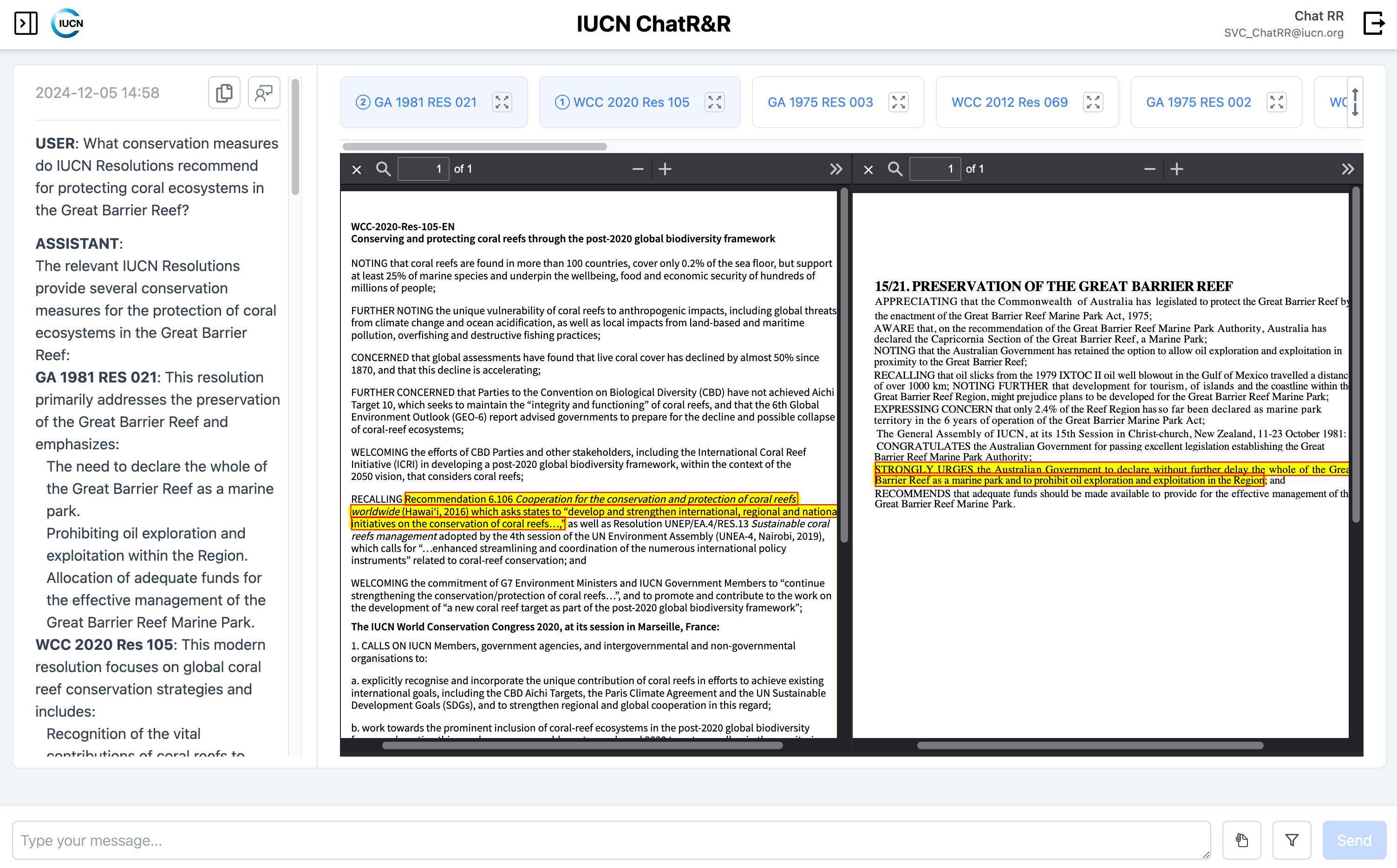
- Clusters documents by topic. Examples on the page include oceans, climate change and governance.
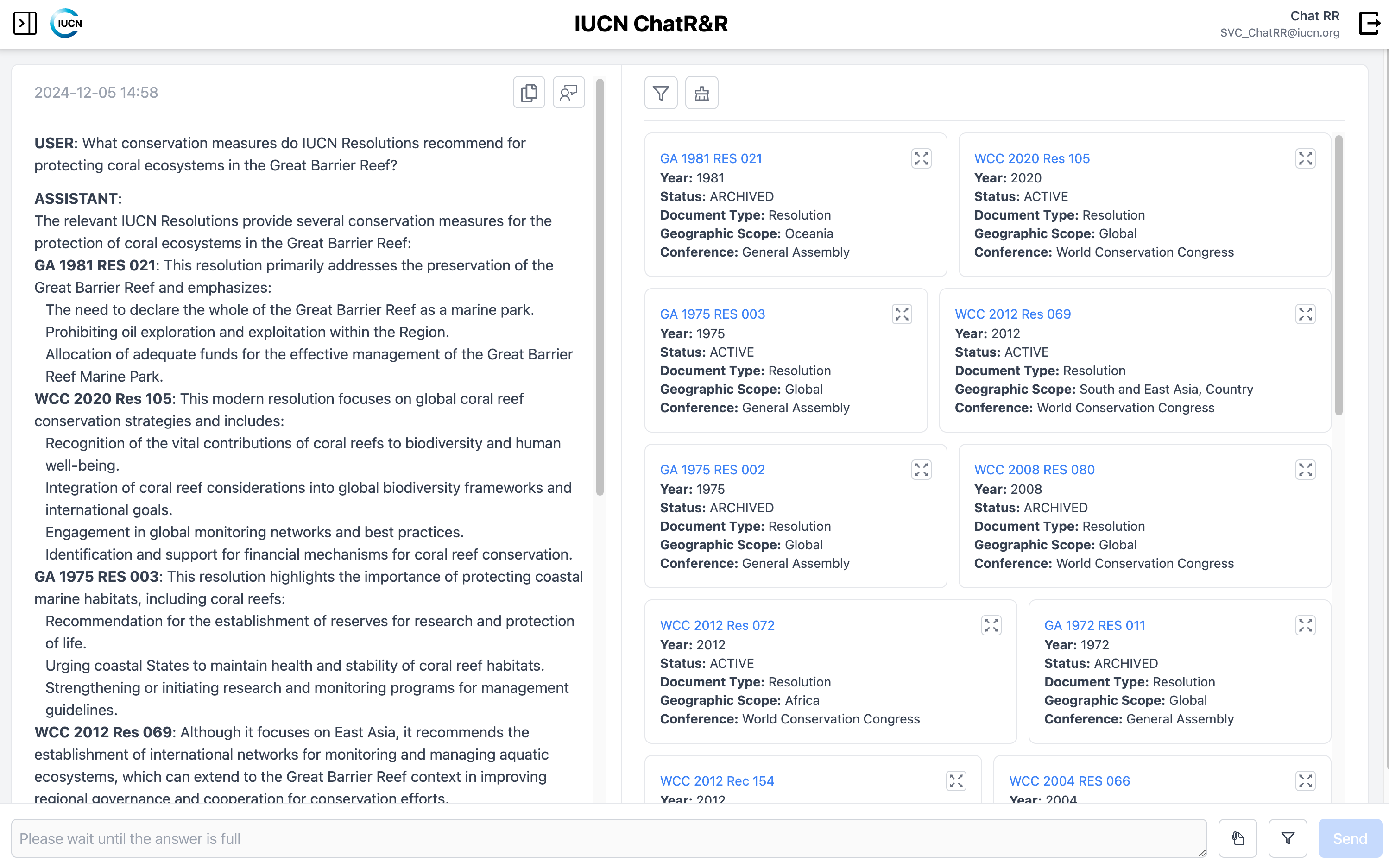
- Answers questions in chat. Every answer carries links to the documents it draws on.
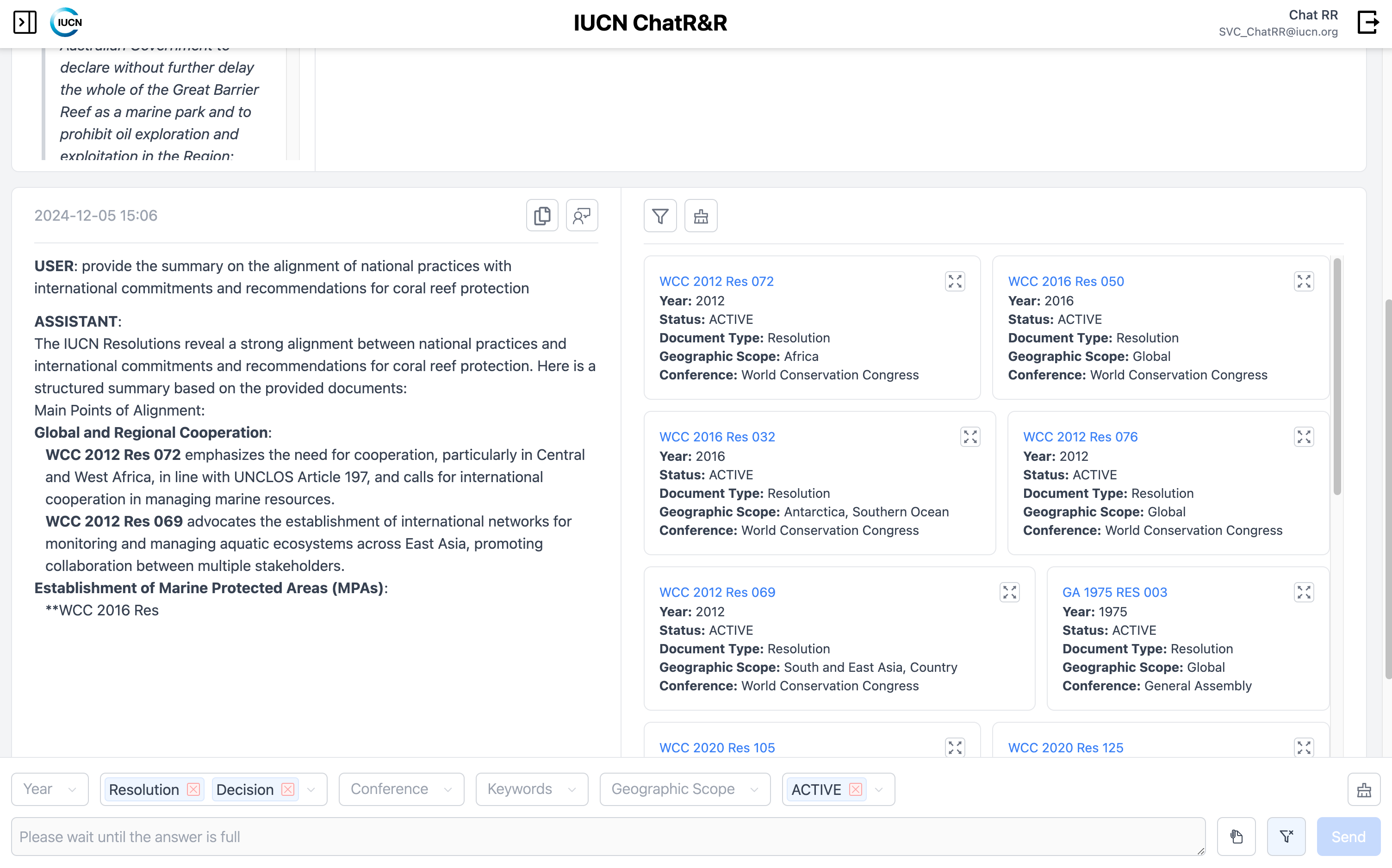
- Summarises in context. Summaries come with citations to the passages they rest on.
- Tracks policy changes. The user can follow how a policy has changed.
The interface highlights the source passage, so the user sees the exact place in the document that supports an answer.
Built on Azure
ChatR&R runs on Microsoft Azure, which hosts IUCN's data. Azure OpenAI and Azure Cognitive Search index, embed and retrieve the documents. Hugging Face Chat UI is the interface staff use, and machine learning models handle clustering, classification and policy extraction. Over time we extended the reasoning layer with Anthropic's Claude for summarisation, clustering and natural-language querying.
Hosting
Microsoft Azure
Hosts IUCN's data and the application.
Retrieval
Azure OpenAI and Azure Cognitive Search
Index, embed and retrieve the documents.
Interface
Hugging Face Chat UI
The chat interface IUCN staff use.
Models
Machine learning models
Clustering, classification and policy extraction.
Reasoning
Anthropic's Claude
Summarisation, clustering and natural-language querying.
S-PRO is a Certified partner in the Claude Partner Network.
From a question to a checked answer
In four steps:
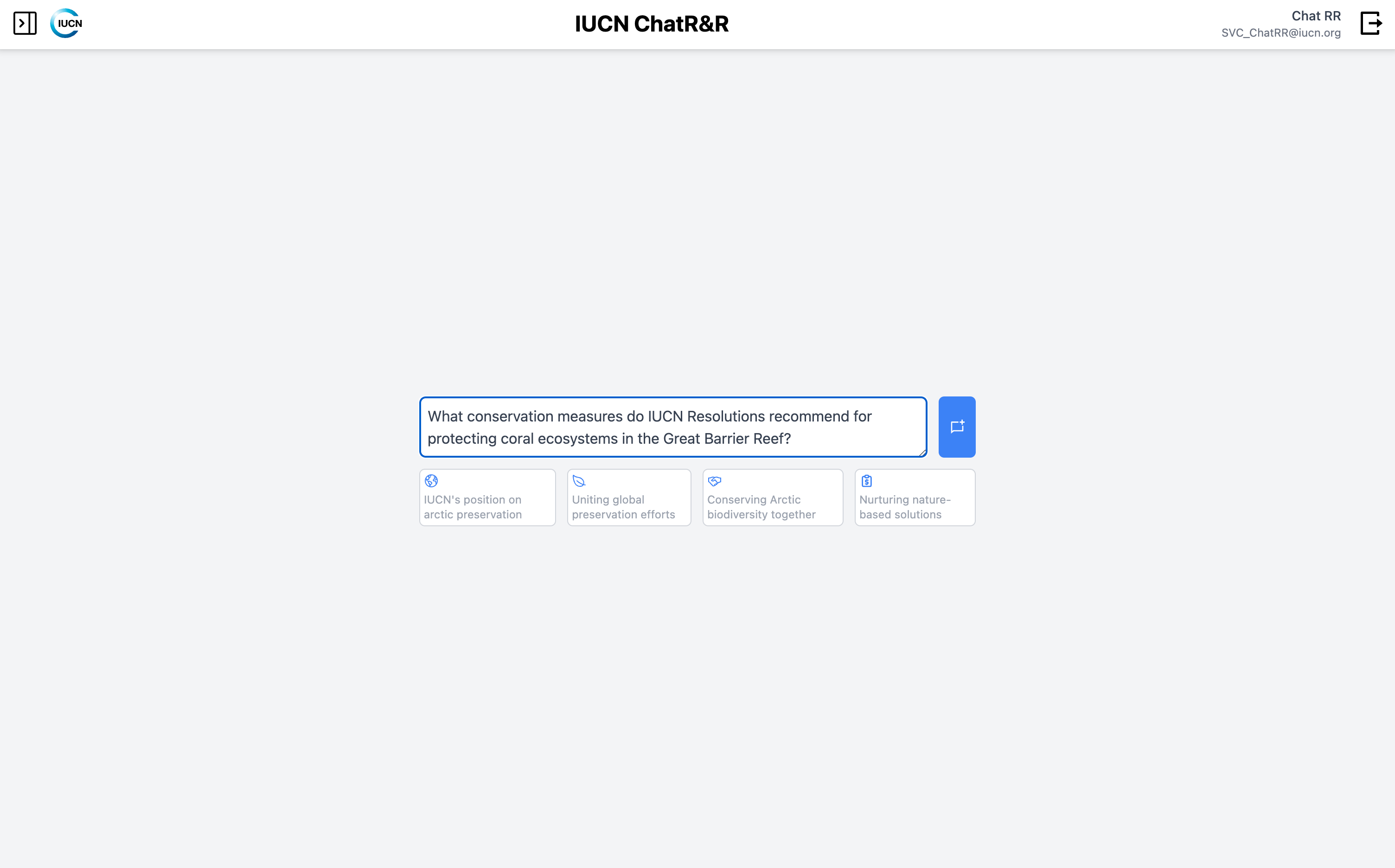
- Query. The user asks a question in chat.
- Answer with sources. The assistant replies and links the documents it used.
- Check. The user opens the linked resolutions and compares.
- Contradiction found. Where documents disagree, the system points it out.
The AI reads, the person decides
The AI reads, clusters and searches. The person decides and verifies. Every answer points to its source, and the user checks it against the resolution itself, so the assistant shortens the way to the right document and leaves the decision to the reader. After the document base was loaded, ChatR&R helped identify more than 50 contradictions in the existing documents, each confirmed by the user. To see how S-PRO builds AI agents that act within defined limits, start with AI agent development.
From two weeks to ten seconds
Analysing a single motion used to take up to two weeks. According to IUCN's Director, Global Information Systems Group, the same task now takes under 10 seconds. After the document base was loaded, ChatR&R helped identify more than 50 contradictions in the existing documents, confirmed by the user. Policies are grouped by theme, summaries come with precise citations, and staff need minimal training to use the chat.
In October 2025, ChatR&R was presented at the IUCN World Conservation Congress in Abu Dhabi (9–15 October). Attendees were impressed by how quickly it retrieves and summarises decades of documents.
Three things we would build the same way again
Three lessons from the design:
- An assistant should not answer without a source. Over a policy base, an answer the user cannot trace to a document is not usable.
- The person verifies. The tool narrows the search. The decision and the check stay human.
- Change over time matters. A policy base is not a flat list, so the tool has to show how documents relate and what changed.
A bank needs the same thing for regulations, internal policies and procedures: an assistant that answers over a large body of documents and shows where each answer comes from. For a bank-side example of moving an AI tool from experiment to daily work, see the Swiss private bank Copilot case.
Scaling to larger document collections
The design scales to larger document collections and deeper policy analysis, and it can serve as a base for further AI work in conservation and other global organisations. The same pattern applies wherever staff must find, compare and verify rules: policy, regulation and internal procedures.
FAQ
Questions about this project
What did S-PRO build for IUCN?
ChatR&R, an AI search and chat over IUCN's resolutions and recommendations, in production since 2024. It clusters documents by topic, answers questions with links to the source documents, adds summaries with citations and tracks policy changes. The user checks every answer against the original resolution.
How can an AI assistant avoid made-up answers over policy documents?
In S-PRO's design, every answer carries a link to the documents behind it, and the interface highlights the source passage. The user opens the source and verifies.
What did ChatR&R find in IUCN's documents?
After the document base was loaded, the system helped identify more than 50 contradictions in the existing documents, confirmed by the user. IUCN's Director, Global Information Systems Group, says that analysing a motion could take up to two weeks and now takes under 10 seconds.
Can a similar assistant work over a bank's policies and regulations?
Yes. The pattern carries over: an assistant answers over a large set of documents, shows its sources and leaves the decision to a person. A bank project gets its own data, access and compliance design, which S-PRO scopes at the start.
How can an organisation start a similar project?
With a short pilot on a limited set of documents, checking answers against their sources. S-PRO's design thinking pilot starts from USD 20k and takes 2 to 4 weeks.
Which technologies does ChatR&R use?
ChatR&R runs on Microsoft Azure, which hosts IUCN's data. Azure OpenAI and Azure Cognitive Search index, embed and retrieve the documents. Hugging Face Chat UI is the interface staff use, and machine learning models handle clustering, classification and policy extraction. Over time we extended the reasoning layer with Anthropic's Claude for summarisation, clustering and natural-language querying. S-PRO is a Certified partner in the Claude Partner Network.
Need an AI assistant that shows where every answer comes from?
S-PRO has delivered 100+ AI projects, 40+ of them agentic. Tell us about your document base, and we will propose a first design with citations and checks.