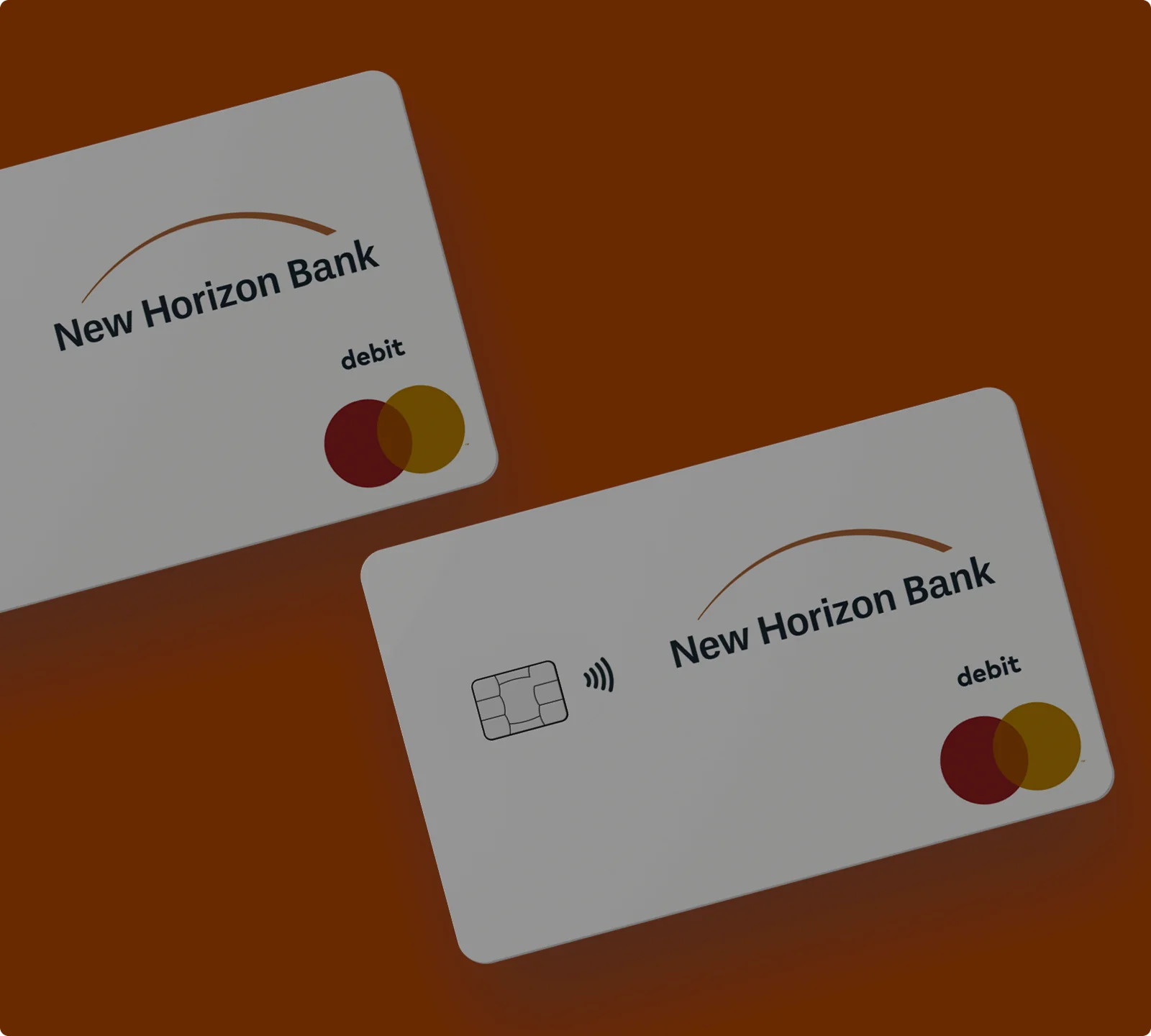
New Horizon Bank, a growing U.S.-based community bank expanding across multiple markets, set out to rethink how its clients and internal teams manage money movement.
In recent years, New Horizon Bank has been actively scaling its operations, opening new locations across the U.S. and strengthening its focus on business banking.
Their core banking setup handled transactions but the digital layer around it didn’t keep up for B2B use cases like multi-entity structures, approvals, and internal transfers. The bank needed a digital banking platform on top of the core system that could handle wires, ACH, and internal transfers within structured approval workflows.
S-PRO joined the initiative as a long-term tech partner, continuing a collaboration that started in 2019 within the broader White Bay Group ecosystem. Prior to this project, the teams had already worked together on several successful systems, including the Clear Street asset management platform.
With that in place, the project didn’t start from scratch in terms of collaboration. New Horizon Bank builds on that partnership, moving forward with S-PRO as a team they already trust from other business-critical platforms.
2009
year founded
4
locations across Virginia
2
years of collaboration between S-PRO x New Horizon Bank
7
years of partnership S-PRO x White Bay Group
Goals and Challenges
New Horizon Bank needed a way to support a growing business and increasing operational complexity without losing control or visibility across teams and transactions.
Centralizing Payments Across Multiple Entities
As the bank expanded, managing payments across different entities, accounts, and teams became increasingly complex. Transactions had to be coordinated across multiple roles, systems, and approval steps, making it harder to maintain control and visibility.
The goal was to bring everything into a single platform where internal teams and business clients (including organization admins, approvers, and operators) could create, approve, and monitor transactions in one place, with clear ownership, structured workflows, and full visibility across the organization.
Supporting Real-World B2B Payment Workflows
The platform had to handle different types of transactions while reflecting how businesses actually operate. This included:
internal transfers between entities
domestic and international wire transfers
ACH payments, including batch processing and bulk transactions
role-based access for admins, approvers, and operators
flexible approval workflows depending on transaction type and amount
ACH, in particular, introduced additional complexity due to batch processing, validation requirements, and stricter formatting rules compared to standard transfers.
Working on Top of Legacy Core Banking (DCI)
All transactions still had to be processed through the existing core banking system (DCI), which introduced a separate set of constraints. The system had inconsistent API behavior, limited documentation, and required coordination with external support for issue resolution.
To work around this, the platform had to act as a stable layer between users and the core system, handling validation, structuring requests, managing edge cases, and keeping the user experience consistent despite underlying limitations.
Solution
To address both operational and technical challenges, S-PRO designed and built a web-based B2B digital banking platform that sits on top of the bank’s core system and manages the full lifecycle of business payments.
Platform Architecture
The platform was built as a separate digital layer on top of the existing core banking system (DCI), handling user interaction, business logic, and transaction orchestration.
Instead of relying directly on core system flows, the solution introduces an API-driven layer that structures requests, validates data, and manages communication between the UI and core banking. This approach allows the platform to remain flexible on the front-end while keeping compatibility with the underlying system.
Payments and Approval Workflows
At the core of the platform is a unified payment system that supports different transaction types and user roles. Users can:
create internal transfers between accounts and entities
initiate domestic and international wire transfers
process ACH payments, including batch uploads
assign and manage approval flows based on roles and transaction rules
The system reflects real organizational structures, where different users are responsible for creating, reviewing, and approving transactions. Transaction flows are structured step-by-step, guiding users through required inputs and enforcing validation rules for each payment type, including strict formatting, field-level validation, and error handling for ACH and wire transfers.
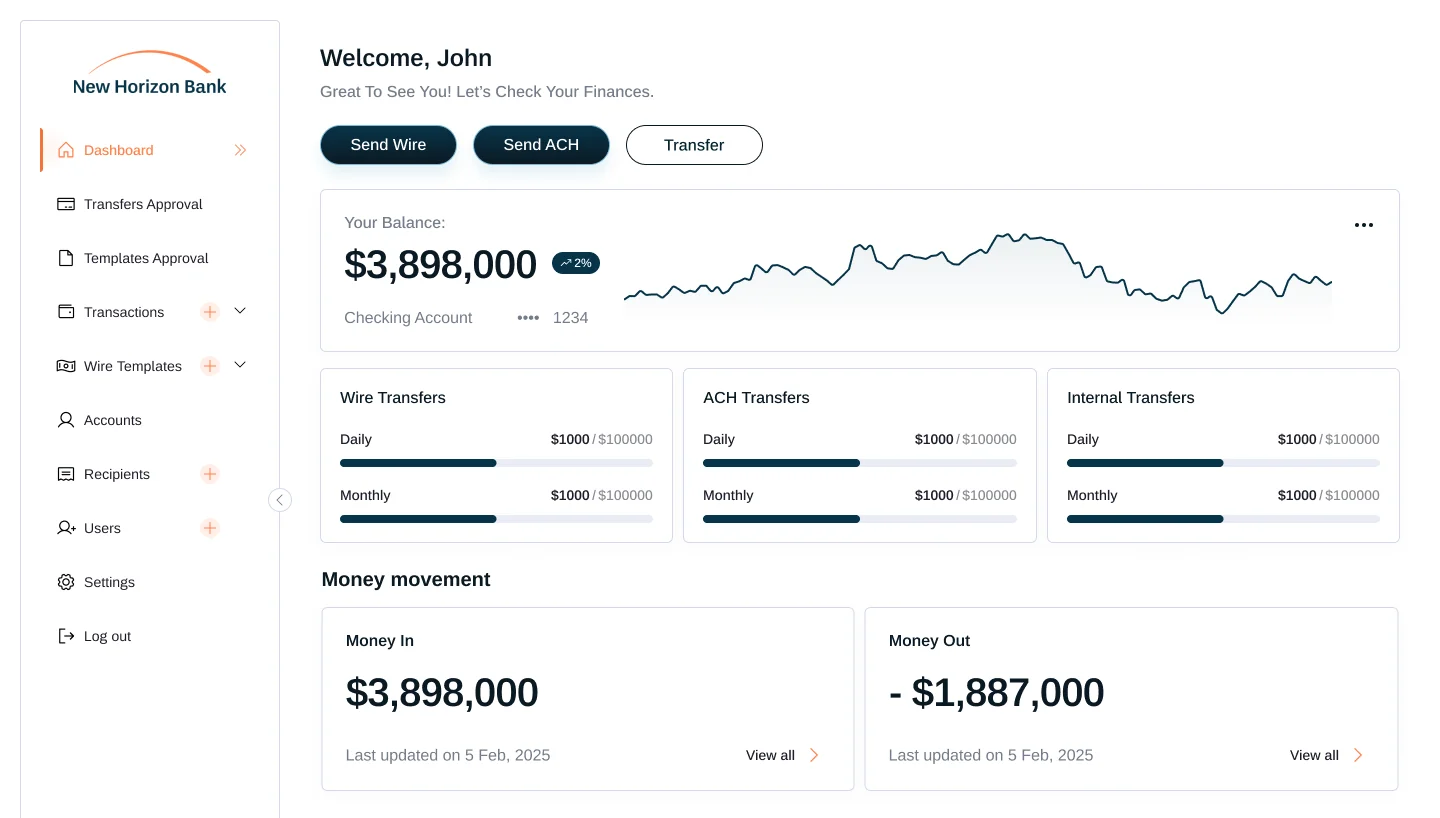
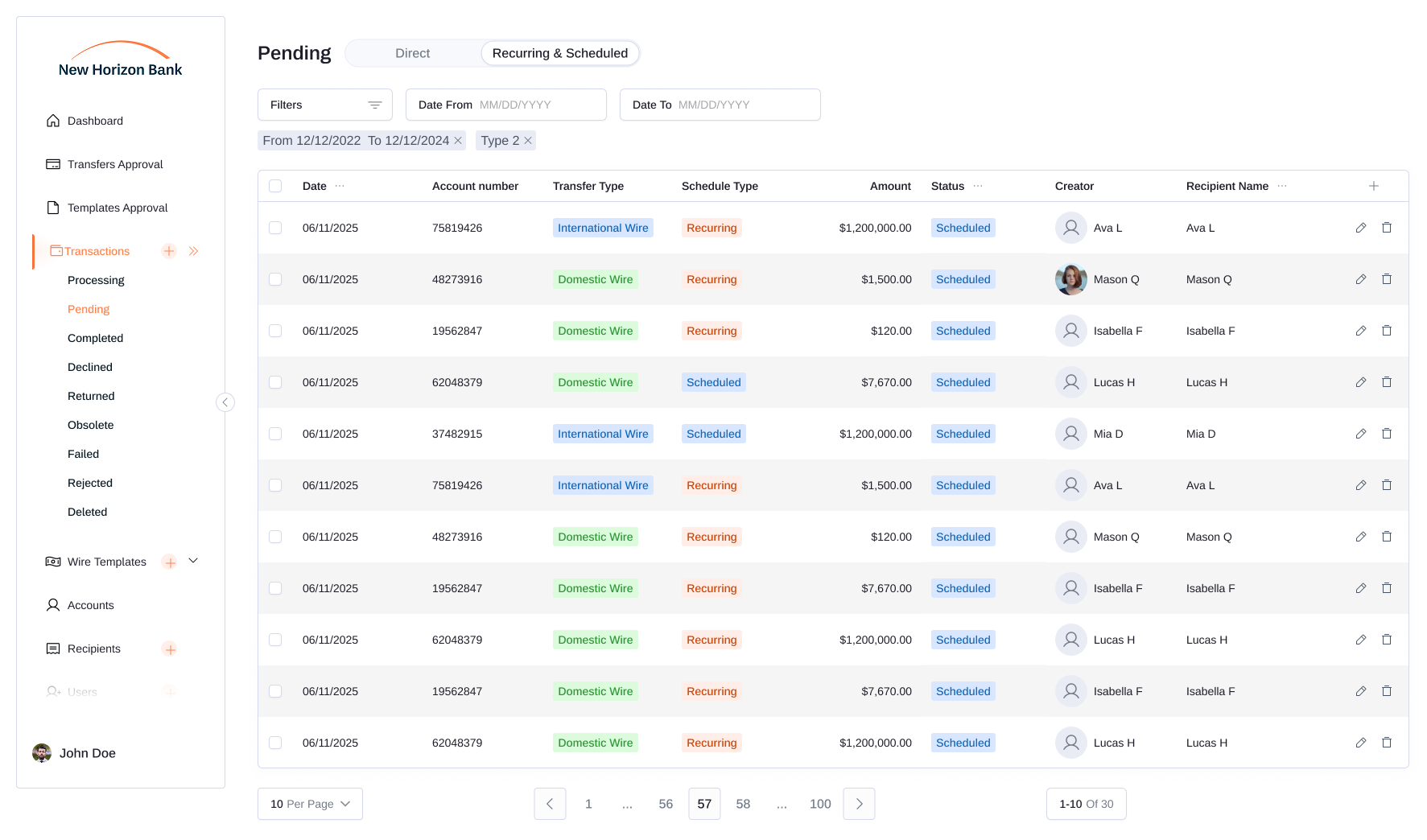
Dedicated approval dashboards allow users to review pending transactions, track statuses, and take action based on their role. At the same time, account and entity-level views provide clear visibility into balances, transactions, and relationships across the organization – all within a single dashboard.
Integration with Core Banking (DCI)
All transactions are processed through the existing DCI core banking system, which requires building a stable integration layer to handle API-level inconsistencies and limitations. This layer reduces direct dependency on the core banking system and allows New Horizon Bank to operate more independently while maintaining a predictable and controlled user experience.
The platform manages:
request formatting and validation before sending data to DCI
handling asynchronous responses and status updates
retry logic and error handling for failed operations
mapping between user-facing data and core banking structures
The platform provides full visibility into transaction states (from scheduled and pending to processing and completed) allowing users to track how requests are handled by the core system in real time.
Technology
The platform was built using a modern, API-driven architecture designed to support complex payment workflows, ensure system reliability, and integrate with existing banking infrastructure.
Core components:
API-driven backend layer handling business logic and orchestration
Web-based frontend for internal teams and business clients
Integration layer for communication with the DCI core banking system
Payments and integrations:
Wire transfers (domestic and international)
ACH processing using ACH Pro, including batch payments and validation
Internal transfers between accounts and entities
Infrastructure and reliability:
Cloud infrastructure hosted on AWS
Asynchronous processing for transaction handling
Retry mechanisms and fault-tolerant workflows for failed operations
Security and compliance:
Role-based access control (RBAC)
Data validation aligned with banking requirements
External penetration testing to validate system security
Team
The project was delivered by a cross-functional S-PRO team covering product, design, and engineering end-to-end, working in close collaboration with the client’s internal teams.
The project team from S-PRO included:
Delivery Manager
Solution Architect
Product Manager / Business Analyst
Backend Engineer
Frontend Engineer
UI/UX Designer
QA Engineer
DevOps Engineer
On the client side, multiple stakeholders were involved across business, operations, and finance, contributing to product decisions, validation, and rollout planning. The collaboration was built as a continuous feedback loop. This setup allowed both teams to move faster through ambiguity, align on priorities, and adapt the platform as new requirements emerged, while keeping development and business goals in sync.
Results
The platform reached its first major milestone with a successful production rollout in December 2025, well received by the client’s teams and followed by ongoing user acceptance testing and gradual onboarding of new users.
At this stage, the core functionality is fully implemented and stable. The platform already supports key payment operations along with role-based access and approval workflows. While additional features remain in the backlog, the foundation is in place and actively used.
Security validation became one of the most demanding stages of the project for our team. The platform underwent external penetration testing conducted by ethical hackers, simulating real-world attack scenarios and probing for vulnerabilities across the system. For us, going through this phase showed that the decisions we had already made (from architecture to access control and data handling) hold up under real-world security threats and conditions.
The release was received very positively by both operational teams and leadership on the client side. The platform fits naturally into existing workflows around transaction management without major process changes. At the same time, New Horizon Bank continues to grow, gradually expanding into new locations and strengthening its team, with the platform supporting this next phase of development.
Future outlook
With the web platform now in place, the next step for New Horizon Bank is expanding its digital ecosystem further, including the development of a dedicated mobile application.
The core is already built but the product continues to evolve, with new features planned as the platform scales across more users and entities.
Software development in banking is a long-term effort, where trust is built over time, through consistent delivery and shared decisions. Since 2019, the partnership between S-PRO and the broader White Bay Group ecosystem has grown across multiple projects, and New Horizon Bank is another successful result of the trust and commitment built over years of working together.
Get in touch
Get in touch
Ready to discuss your project?
Share your ideas, findings, and questions with us. We’re excited to extend our expertise to your project. After form submission, we'll respond within 24h.